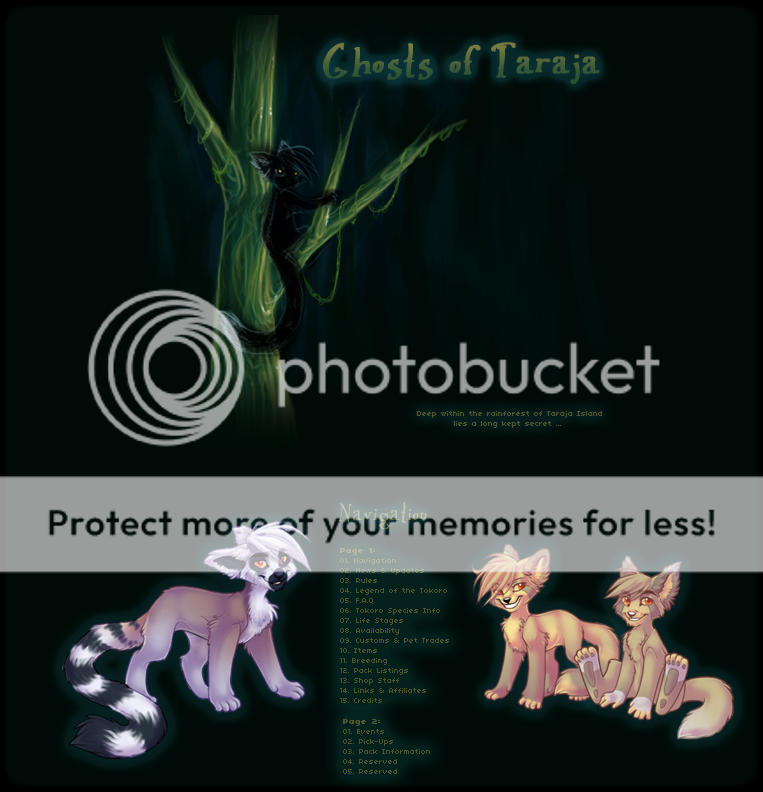

Here you can find specific information about the Tokoro species. Listed are their location, habitat, physical traits, social groups, etc. All this information should be taken into consideration when roleplaying your pet.
LOCATION //
Country: Indonesia
Province: Maluki
Island: Taraja
Local Tribe: Nayulu
Island Population: 300
Habitations: The Nayulu are seperated into 3 villages along the northern coast of Taraja, the largest being the port/village of Burua
Language: Indonesian
GEOGRAPHY //
Island Size: Approx. 540 km long and 360 km wide
Highest point: Mt. Banjara, 3,019 m (9,905 ft)
Taraja is traversed by a eastern mountain range, the highest point of which is called Mt. Banjara. The Minggu River flows from the base of Mt. Banjara all the way to the western coast where it flows out into the Indian Ocean. Taraja also boasts flat grasslands on its western side where many unqiue species such as the lowland Anoa (pigmy buffalo), and Dhole (asian wild dog) are found. The vast and mystical rainforest of Taraja Island is home to some of the most rare creatures on earth, including the Dingiso (tree kangaroo), Komodo Dragon, Flying Squirrel, Silvery Gibbon, Sumatran Tiger, and of course the most rare and fleeting of all, the Tokoro.
More information and pictures of these rare animals can be found here.
TOKORO FACTS //
Average full grown Tokoro: Height = 2' 6" / Weight = 35 lbs.
Physical Traits:
Tokoro have great hand coordination for foraging and other activities. Their soles and palms are covered with soft skin that enables them to grip onto various objects when climbing or traveling through trees. Tokoro also have long furry prehensile tails, like some primates, which are adapted for seizing, grasping, holding, or hanging from branches. They also use their tails for balance when leaping through the forest canopy. Their long spring-like legs allow them to jump over 30 feet (9 m) from tree to tree.
Tree Life:
Tokoro are mainly arboreal (spend most of their time in trees), but sometimes travel along the ground when foraging or playing. They are one of the fastest arboreal creatures on earth and can cover an area as large as 3½ miles during the course of a day's foraging. Tokoro usually stay within a common home range, aggressively defending it from other packs.
Social Groups:
Tokoro are very territorial and social animals. Their social groups or packs normally consist of 2 to 24 individuals, which are tightly knit and dependant on eachother. There may be male or female dominant hierarchies within the pack depending on the individual group. When territorial fights between packs occur, both males and females are on the front lines. They threaten the Tokoro in the opposing pack by leaping and darting toward them but rarely does an actual fight break out. Almost always, the larger pack will win dominance and the rights to that territory.
Communication:
The Tokoro species communicate vocally and through scent markings. They have scent glands on their hands and feet that leave odors on surfaces they cross.
Diet:
Tokoro are generally omnivores, eating a variety of fruit, seeds, flowers, nectar, leaves, as well as insects.
Predators:
Predators of the Tokoro include snakes, other large reptiles (komodo dragons), large mammals (wild dogs, tigers, etc.), and humans.