


Eshmasesh
On the Death Penalty
One of the most controversial topics in world politics is the death penalty; everyone has a strong opinion on the subject, and everyone wants to be heard. What makes this subject so controversial (and similar to other subjects such as abortion and homosexual rights) is that too many people distort the facts and rely on emotional shock to sway others into agreement. However, its effect on the safety of families separates this topic from the rest. For instance, it is very difficult for one to personally justify their anti-execution argument when a murderer, released on parole, sneaks into their house and kills their family. Pro-death civilians argue that no criminal deserves to live, that they make up the lowest hierarchy in society and don’t deserve protection, pity, or rights.
However, where do we draw the line? Arbitrary judgment will always hinder any possibility of uniformly deciding who does and does not deserve to die. Two 16 and 18-year-old Iranian teens were executed in July 19, 2005 for the “grave” offense of having sexual contact. Some countries, such as China, still have not outlawed capital punishment for child offenders (convicted criminals under 18 at the time of the crime), despite its infraction of international law. Although we scoff at these countries and call them barbarians, their cultures are different. Perhaps one day their cultural preconceptions will change and they will list their past actions as crimes against humanity, but we can not force people to change their culture.
So what does that leave us Americans with? We can only evaluate our own country, our own culture, and decide whether or not capital punishment is a justifiable punishment. Because of its futile value as a deterrent of crime, arbitrariness in judgment from both the judge and the jurors, its classification as cruel and unusual punishment, the ever-present possibility of falsely condemning an innocent person, and the simple alternative of ’life without parole’, capital punishment is not only a pointless practice but also a detriment to American society.
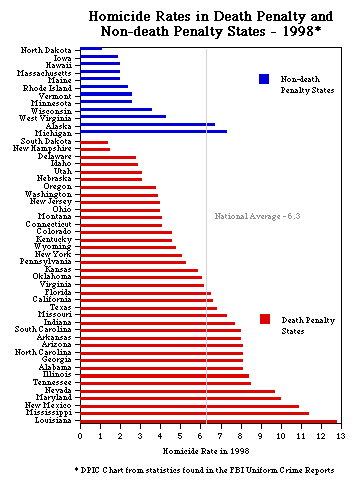
As was stated before, the main problem with this topic is the distortion of facts for the sake of appealing to emotions. In order to properly evaluate the topic, one must know the undeniable facts. Between 1993 and 2005, an average of almost 80% of all executions were carried out in the south. The graph on this page (New York Times, 9/22/00) shows that the states with the highest homicide rates are also states with the death penalty (also worth noting is that the majority of the highest states are southern, and that no southern state has illegalized capital punishment). According to one government study, police officers were at a drastically greater risk of being feloniously killed from 1989-1998 in southern states. One important application of these facts is to an argument used by some pro-death advocates that capital punishment acts as a deterrent of crime. If this was true, then southern states should have a much smaller homicide rate than northern ones. Also, not only do statistics not agree with this statement, but criminal psychology does not either. There are three reasons behind why murderers commit their deeds, none of which can be deterred: for personal gain, for passion, or to satiate a compulsion. A person who murders for personal gain tries his or her best to “beat the system” and does not plan to be caught; therefore the threat of a death penalty fails to influence their decision. Crimes of passion are done irrationally, in “the heat of the moment”, such as if a woman discovers that her husband has cheated on her for years. The inherent irrationality of these crimes grant immunity to any punishment society threatens. Finally, a crime of compulsion can not be deterred because they are done to satisfy an uncontrollable primal instinct. Sadly, these crimes include that of a child rapist or a sadistic serial killer, but can never be deterred.
Between the years 1973 and 2003, 123 people have been released from death row because “a) their conviction was overturned and either they were acquitted at a re-trial or all charges were dismissed; or b) they were given an absolute pardon by the governor based on new evidence of innocence,” according to the Death Penalty Information Center. On average, the inmates spent 9.2 years of their lives on death row before exoneration.
One of the more controversial topics involves race and how it affects the death penalty. According to one study, the percentage of white people populating death row is 45.3%, or 1,525 people. For black people, this percentage is 41.8%, or 1,407 people. The study also shows that fifteen white defendants have been executed since 1976 for murdering a black victim, while 213 black defendants have been executed for murdering a white victim. These numbers are somewhat confusing when taking into consideration the fact that black people make up the minority of the country. Disregarding a possible racist agenda in the legal system (it is still a possibility, however), only two possibilities exist; either a much larger percentage of black people versus white genuinely do commit murders, which is highly unlikely, or the result is due to arbitrary judgment by the jurors and judge.
Within this context, arbitrariness is defined as inconsistencies with sentences for the same crimes but with different people. Perhaps the artificially increased percentage of black death row inmates could be attributed to a larger concentration of black people in the lower class and white in the upper. In April 10, 2001, Judge Ruth Bader Ginsburg said, “People who are well represented at trial do not get the death penalty. . . . I have yet to see a death case among the dozens coming to the Supreme Court on eve-of-execution stay applications in which the defendant was well represented at trial.” Many lower class civilians can not afford a good lawyer in their defense, and for these cases a government-assigned lawyer is provided. However, the majority of these lawyers lack experience and expertise, especially when compared to a highly paid, Harvard-graduate lawyer.
One black man, George McFarland, is currently on death row in Texas for both robbery and murder but claims he is innocent. No weapon, fingerprint, shoe print, or stolen item was ever recovered; in fact, no physical evidence even existed for his case. Instead, his condemnation relied solely on the testimony of an eyewitness who not only did not know the shooter, but also changed her description of the shooter. The lawyer he had hired, 72 year old John Benn who had not tried a capital punishment case in over 20 years, fell asleep during the trial. Contrast this with Gary Ridgway, a man who committed 48 murders since 1982 but was only sentenced to life without parole in exchange for his cooperation with police in giving the location of remaining victims which were still missing, or perhaps Charles Cullen, a nurse who also escaped the death penalty for murdering 13 patients after pleading guilty. Even if George McFarland is guilty, why must he wait in Death Row for the crime while others have avoided the sentence with graver crimes, especially when almost no conclusive evidence was provided in his case?
Compared to life without parole, capital punishment is also extremely inefficient as a sentence. Unlike the former, criminals on death row wait for many years for their process to be carried out (if ever), and undergo multiple appeals processes throughout the duration. These appeals make up a huge percentage of tax money spent on the criminal system; added together with the cost of keeping inmates relatively fed and carrying out the execution, this makes the death penalty even more expensive than life without parole.
Some argue that the solution for this problem is to speed up the death row sentence (the majority of which seem to reside in Texas, where this eventually passed as a law for certain convicts). However, the major flaw with this action is that those falsely condemned with murder are given even less time for their cases to be re-evaluated, and they become more likely to die before the legal system can determine innocence. Proponents of capital punishment tend to disregard the possibility as bleeding-heart liberal slander, but evidence to the contrary exists.
Alan Gell was convicted with murder in 1998 and given the death penalty, but was acquitted six years later. Apparently, the two alleged witnesses of his crime were the real murders and had conspired together to avoid prosecution. The prosecution withheld two pieces of evidence during his trial: the first was an audio recording of one of the girls stating she had to “make up a story” about the murder, the second that he was already in jail the night of the murder for an unrelated crime. Another man, Shareef Cousin, was convicted of the murder of Michael Gerardi in 1996, but was exonerated in 1999. The prosecutors knew he was not guilty; Shareef was playing in a basketball game at 9:30 pm through the time of the murder, 10:00 pm, but the prosecutors altered video evidence so that it showed the game ending at 9:30 instead. Three of his teammates which had come to trial to testify could not be found when Shareef’s lawyers looked for them; the prosecution had tricked them into going to the D.A.’s office at the time. Finally, the prosecution convinced their main witness, Connie Babin, to lie on the stand. She was Gerardi’s date during the murder, and told police that not only was it dark at the time of the murder, but that she had neither her contacts nor her glasses, and was “coming at this at a disadvantage”. The jury did not know this; they only heard her say that she was “100 percent, absolutely sure” that she had seen Shareef murder him. Shareef had to wait three years to be found innocent, and Alan Gell six; if their sentences had been expedited, these two would more than likely have been executed by the hands of a corrupt legal system.
Of course, not every criminal is innocent, and to say otherwise would be ignorant of the facts. The controversy around Capital Punishment for true criminals focuses on the eighth amendment of the U.S. Constitution which forbids “Cruel and Unusual Punishment”. The problem lies in the interpretation of this phrase; one could argue that all punishments are inherently cruel, which the founding fathers certainly did not intend. In the case Furman vs. Georgia, Justice Joseph Brennan stated a possible basis for determining whether or not a punishment falls under this category. They are as follows:
1. “…a punishment must not by its severity be degrading to human dignity.” An example of this would be torture
2. "A severe punishment that is obviously inflicted in wholly arbitrary fashion."
3. "A severe punishment that is clearly and totally rejected throughout society."
4. "A severe punishment that is patently unnecessary."
However, the only principal of these sentences in the past which have not been broken are that the punishments had not been rejected by society. On the comedic, but very informative, show “Penn and Teller Bullshit! The Death Penalty”, the hosts Penn and Teller give a simple but accurate outline of the history of the Death Penalty with the help of a few experts, and show that every form of execution, including the most widespread, falls under cruel and unusual punishment for torturing criminals.
Hanging became popular worldwide around the seventeenth or eighteenth century, and one expert said it “was very gruesome. It was mostly strangulation, [but] if you didn’t weigh very much, you didn’t pull on the rope, you could hang there for days struggling and gasping for air.” They also show pictures of men whose heads were snapped off from the drop due to weighing too much. The next punishment was the Firing Squad, in which a group of men would aim and shoot a convict. The inhumanity of this punishment speaks for itself, and unless a miraculous shot kills the victim instantly, a slow and painful death from blood loss will result. The Gas Chamber became popular around the time of Nazi Germany, since it allowed the oppressors to easily and quickly kill large amounts of victims. Technically, this is still a legal form of execution in five states (Wyoming, Arizona, California, Missouri, and Maryland), but it is unlikely that for these states to utilize this punishment unless specifically requested by a criminal. The most recent execution in this manner was for Donald Eugene Harding, and eyewitnesses reported after the event that he went into violent spasms as he gasped and moaned, until the spasms slowly died down in intensity and stopped entirely, over six minutes after they began.
The second most popular form of execution in the United States today is electrocution. The head and legs of the inmate are first shaved clean and the person is strapped into a seat called the “electric chair”. A moist sponge is put on top of the head, since water is a conductor of electricity. Two electrodes are attached to the body; one to the head and one to the legs, forming a closed circuit. The executor then triggers jolts of electricity through the circuit, first stopping the heart and inducing unconsciousness, then destroying internal organs. Theoretically, unconsciousness occurs instantly. However, there have been many instances in practice of “horrible botches of electrocution in which the inmate’s head catches on fire”. The expert even presents a shirt she owns of an inmate whose face had melted off onto it. This can hardly be classified as a “humane” form of execution.
Electrocution has met a steady decline in turn for what is believed by many to be a less inhumane form of execution, lethal injection. In this execution, a restrained criminal is injected with sodium thiopental, a short-acting barbiturate which induces unconsciousness with high doses. Then pancuronium bromide is administered to paralyze the muscles. Finally, an injection of potassium chloride is administered, stopping the heart and causing death. However, some researchers published a letter in The Lancet, a medical journal, containing a very interesting investigation. They chose forty nine different executions by lethal injection from five different states and discovered that the level of thiopental in the blood was lower than that required for surgery for forty three of the executed. Twenty one of those had levels so low that they could have been completely awake during the entire execution. This means that those people were fully aware of what transpired and underwent excruciating torture during the procedure. However, the paralytic agent administered, pancuronium bromide, conveniently gives the criminal an appearance of serenity. The study concludes that this would fail to meet the standards for putting down animals. What justification do we have for forcing this on a human being?
We live in a civilized country, but the practice of the death penalty directly contradicts this fact. History shows that prosecutors exist who are willing to do anything for the sake of getting a guilty verdict and maintaining an impressive resume, including forge evidence and condemn an innocent person. Even if we accept the fact that not every death row inmate is innocent, there is no excuse for the terribly inhumane fates of the guilty which the eighth amendment forbids. Proponents of execution believe criminals deserve their fate and do not deserve rights, but subjective opinion should never mandate law.
We, the American populace, can fix this problem if we vote to replace capital punishment with the only logical alternative, life without parole. This sentence easily accomplishes what Pro-death civilians desire: it isolates the criminal from society, keeping more civilians from dying; it allows a much longer time frame for the re-evaluation of evidence to save a potential innocent from dying; it helps to rectify the unfair probability that a rich man will escape with what a poor man would be killed for; it even would ultimately save tax payer money for the penny-pinchers. Excluding eastern countries, America remains as the only fully-developed, democratic country which still refuses to abolish the death penalty entirely. Perhaps one day we can change this, and prove we are as humane and logical as the rest of the world.
One of the most controversial topics in world politics is the death penalty; everyone has a strong opinion on the subject, and everyone wants to be heard. What makes this subject so controversial (and similar to other subjects such as abortion and homosexual rights) is that too many people distort the facts and rely on emotional shock to sway others into agreement. However, its effect on the safety of families separates this topic from the rest. For instance, it is very difficult for one to personally justify their anti-execution argument when a murderer, released on parole, sneaks into their house and kills their family. Pro-death civilians argue that no criminal deserves to live, that they make up the lowest hierarchy in society and don’t deserve protection, pity, or rights.
However, where do we draw the line? Arbitrary judgment will always hinder any possibility of uniformly deciding who does and does not deserve to die. Two 16 and 18-year-old Iranian teens were executed in July 19, 2005 for the “grave” offense of having sexual contact. Some countries, such as China, still have not outlawed capital punishment for child offenders (convicted criminals under 18 at the time of the crime), despite its infraction of international law. Although we scoff at these countries and call them barbarians, their cultures are different. Perhaps one day their cultural preconceptions will change and they will list their past actions as crimes against humanity, but we can not force people to change their culture.
So what does that leave us Americans with? We can only evaluate our own country, our own culture, and decide whether or not capital punishment is a justifiable punishment. Because of its futile value as a deterrent of crime, arbitrariness in judgment from both the judge and the jurors, its classification as cruel and unusual punishment, the ever-present possibility of falsely condemning an innocent person, and the simple alternative of ’life without parole’, capital punishment is not only a pointless practice but also a detriment to American society.
As was stated before, the main problem with this topic is the distortion of facts for the sake of appealing to emotions. In order to properly evaluate the topic, one must know the undeniable facts. Between 1993 and 2005, an average of almost 80% of all executions were carried out in the south. The graph on this page (New York Times, 9/22/00) shows that the states with the highest homicide rates are also states with the death penalty (also worth noting is that the majority of the highest states are southern, and that no southern state has illegalized capital punishment). According to one government study, police officers were at a drastically greater risk of being feloniously killed from 1989-1998 in southern states. One important application of these facts is to an argument used by some pro-death advocates that capital punishment acts as a deterrent of crime. If this was true, then southern states should have a much smaller homicide rate than northern ones. Also, not only do statistics not agree with this statement, but criminal psychology does not either. There are three reasons behind why murderers commit their deeds, none of which can be deterred: for personal gain, for passion, or to satiate a compulsion. A person who murders for personal gain tries his or her best to “beat the system” and does not plan to be caught; therefore the threat of a death penalty fails to influence their decision. Crimes of passion are done irrationally, in “the heat of the moment”, such as if a woman discovers that her husband has cheated on her for years. The inherent irrationality of these crimes grant immunity to any punishment society threatens. Finally, a crime of compulsion can not be deterred because they are done to satisfy an uncontrollable primal instinct. Sadly, these crimes include that of a child rapist or a sadistic serial killer, but can never be deterred.
Between the years 1973 and 2003, 123 people have been released from death row because “a) their conviction was overturned and either they were acquitted at a re-trial or all charges were dismissed; or b) they were given an absolute pardon by the governor based on new evidence of innocence,” according to the Death Penalty Information Center. On average, the inmates spent 9.2 years of their lives on death row before exoneration.
One of the more controversial topics involves race and how it affects the death penalty. According to one study, the percentage of white people populating death row is 45.3%, or 1,525 people. For black people, this percentage is 41.8%, or 1,407 people. The study also shows that fifteen white defendants have been executed since 1976 for murdering a black victim, while 213 black defendants have been executed for murdering a white victim. These numbers are somewhat confusing when taking into consideration the fact that black people make up the minority of the country. Disregarding a possible racist agenda in the legal system (it is still a possibility, however), only two possibilities exist; either a much larger percentage of black people versus white genuinely do commit murders, which is highly unlikely, or the result is due to arbitrary judgment by the jurors and judge.
Within this context, arbitrariness is defined as inconsistencies with sentences for the same crimes but with different people. Perhaps the artificially increased percentage of black death row inmates could be attributed to a larger concentration of black people in the lower class and white in the upper. In April 10, 2001, Judge Ruth Bader Ginsburg said, “People who are well represented at trial do not get the death penalty. . . . I have yet to see a death case among the dozens coming to the Supreme Court on eve-of-execution stay applications in which the defendant was well represented at trial.” Many lower class civilians can not afford a good lawyer in their defense, and for these cases a government-assigned lawyer is provided. However, the majority of these lawyers lack experience and expertise, especially when compared to a highly paid, Harvard-graduate lawyer.
One black man, George McFarland, is currently on death row in Texas for both robbery and murder but claims he is innocent. No weapon, fingerprint, shoe print, or stolen item was ever recovered; in fact, no physical evidence even existed for his case. Instead, his condemnation relied solely on the testimony of an eyewitness who not only did not know the shooter, but also changed her description of the shooter. The lawyer he had hired, 72 year old John Benn who had not tried a capital punishment case in over 20 years, fell asleep during the trial. Contrast this with Gary Ridgway, a man who committed 48 murders since 1982 but was only sentenced to life without parole in exchange for his cooperation with police in giving the location of remaining victims which were still missing, or perhaps Charles Cullen, a nurse who also escaped the death penalty for murdering 13 patients after pleading guilty. Even if George McFarland is guilty, why must he wait in Death Row for the crime while others have avoided the sentence with graver crimes, especially when almost no conclusive evidence was provided in his case?
Compared to life without parole, capital punishment is also extremely inefficient as a sentence. Unlike the former, criminals on death row wait for many years for their process to be carried out (if ever), and undergo multiple appeals processes throughout the duration. These appeals make up a huge percentage of tax money spent on the criminal system; added together with the cost of keeping inmates relatively fed and carrying out the execution, this makes the death penalty even more expensive than life without parole.
Some argue that the solution for this problem is to speed up the death row sentence (the majority of which seem to reside in Texas, where this eventually passed as a law for certain convicts). However, the major flaw with this action is that those falsely condemned with murder are given even less time for their cases to be re-evaluated, and they become more likely to die before the legal system can determine innocence. Proponents of capital punishment tend to disregard the possibility as bleeding-heart liberal slander, but evidence to the contrary exists.
Alan Gell was convicted with murder in 1998 and given the death penalty, but was acquitted six years later. Apparently, the two alleged witnesses of his crime were the real murders and had conspired together to avoid prosecution. The prosecution withheld two pieces of evidence during his trial: the first was an audio recording of one of the girls stating she had to “make up a story” about the murder, the second that he was already in jail the night of the murder for an unrelated crime. Another man, Shareef Cousin, was convicted of the murder of Michael Gerardi in 1996, but was exonerated in 1999. The prosecutors knew he was not guilty; Shareef was playing in a basketball game at 9:30 pm through the time of the murder, 10:00 pm, but the prosecutors altered video evidence so that it showed the game ending at 9:30 instead. Three of his teammates which had come to trial to testify could not be found when Shareef’s lawyers looked for them; the prosecution had tricked them into going to the D.A.’s office at the time. Finally, the prosecution convinced their main witness, Connie Babin, to lie on the stand. She was Gerardi’s date during the murder, and told police that not only was it dark at the time of the murder, but that she had neither her contacts nor her glasses, and was “coming at this at a disadvantage”. The jury did not know this; they only heard her say that she was “100 percent, absolutely sure” that she had seen Shareef murder him. Shareef had to wait three years to be found innocent, and Alan Gell six; if their sentences had been expedited, these two would more than likely have been executed by the hands of a corrupt legal system.
Of course, not every criminal is innocent, and to say otherwise would be ignorant of the facts. The controversy around Capital Punishment for true criminals focuses on the eighth amendment of the U.S. Constitution which forbids “Cruel and Unusual Punishment”. The problem lies in the interpretation of this phrase; one could argue that all punishments are inherently cruel, which the founding fathers certainly did not intend. In the case Furman vs. Georgia, Justice Joseph Brennan stated a possible basis for determining whether or not a punishment falls under this category. They are as follows:
1. “…a punishment must not by its severity be degrading to human dignity.” An example of this would be torture
2. "A severe punishment that is obviously inflicted in wholly arbitrary fashion."
3. "A severe punishment that is clearly and totally rejected throughout society."
4. "A severe punishment that is patently unnecessary."
However, the only principal of these sentences in the past which have not been broken are that the punishments had not been rejected by society. On the comedic, but very informative, show “Penn and Teller Bullshit! The Death Penalty”, the hosts Penn and Teller give a simple but accurate outline of the history of the Death Penalty with the help of a few experts, and show that every form of execution, including the most widespread, falls under cruel and unusual punishment for torturing criminals.
Hanging became popular worldwide around the seventeenth or eighteenth century, and one expert said it “was very gruesome. It was mostly strangulation, [but] if you didn’t weigh very much, you didn’t pull on the rope, you could hang there for days struggling and gasping for air.” They also show pictures of men whose heads were snapped off from the drop due to weighing too much. The next punishment was the Firing Squad, in which a group of men would aim and shoot a convict. The inhumanity of this punishment speaks for itself, and unless a miraculous shot kills the victim instantly, a slow and painful death from blood loss will result. The Gas Chamber became popular around the time of Nazi Germany, since it allowed the oppressors to easily and quickly kill large amounts of victims. Technically, this is still a legal form of execution in five states (Wyoming, Arizona, California, Missouri, and Maryland), but it is unlikely that for these states to utilize this punishment unless specifically requested by a criminal. The most recent execution in this manner was for Donald Eugene Harding, and eyewitnesses reported after the event that he went into violent spasms as he gasped and moaned, until the spasms slowly died down in intensity and stopped entirely, over six minutes after they began.
The second most popular form of execution in the United States today is electrocution. The head and legs of the inmate are first shaved clean and the person is strapped into a seat called the “electric chair”. A moist sponge is put on top of the head, since water is a conductor of electricity. Two electrodes are attached to the body; one to the head and one to the legs, forming a closed circuit. The executor then triggers jolts of electricity through the circuit, first stopping the heart and inducing unconsciousness, then destroying internal organs. Theoretically, unconsciousness occurs instantly. However, there have been many instances in practice of “horrible botches of electrocution in which the inmate’s head catches on fire”. The expert even presents a shirt she owns of an inmate whose face had melted off onto it. This can hardly be classified as a “humane” form of execution.
Electrocution has met a steady decline in turn for what is believed by many to be a less inhumane form of execution, lethal injection. In this execution, a restrained criminal is injected with sodium thiopental, a short-acting barbiturate which induces unconsciousness with high doses. Then pancuronium bromide is administered to paralyze the muscles. Finally, an injection of potassium chloride is administered, stopping the heart and causing death. However, some researchers published a letter in The Lancet, a medical journal, containing a very interesting investigation. They chose forty nine different executions by lethal injection from five different states and discovered that the level of thiopental in the blood was lower than that required for surgery for forty three of the executed. Twenty one of those had levels so low that they could have been completely awake during the entire execution. This means that those people were fully aware of what transpired and underwent excruciating torture during the procedure. However, the paralytic agent administered, pancuronium bromide, conveniently gives the criminal an appearance of serenity. The study concludes that this would fail to meet the standards for putting down animals. What justification do we have for forcing this on a human being?
We live in a civilized country, but the practice of the death penalty directly contradicts this fact. History shows that prosecutors exist who are willing to do anything for the sake of getting a guilty verdict and maintaining an impressive resume, including forge evidence and condemn an innocent person. Even if we accept the fact that not every death row inmate is innocent, there is no excuse for the terribly inhumane fates of the guilty which the eighth amendment forbids. Proponents of execution believe criminals deserve their fate and do not deserve rights, but subjective opinion should never mandate law.
We, the American populace, can fix this problem if we vote to replace capital punishment with the only logical alternative, life without parole. This sentence easily accomplishes what Pro-death civilians desire: it isolates the criminal from society, keeping more civilians from dying; it allows a much longer time frame for the re-evaluation of evidence to save a potential innocent from dying; it helps to rectify the unfair probability that a rich man will escape with what a poor man would be killed for; it even would ultimately save tax payer money for the penny-pinchers. Excluding eastern countries, America remains as the only fully-developed, democratic country which still refuses to abolish the death penalty entirely. Perhaps one day we can change this, and prove we are as humane and logical as the rest of the world.
Even though it's hella long, I suggesting at least reading most of it. It's not too boring and it raises many valid points.