About
Hello-
I am the official Captain of the guild named "Final Fantasy: Convergence". I know, your probably thinking we're just another run of the mill Final Fantasy guild... Well I'm sorry to disappoint you, but Convergence is not just your average run of the mill Final Fantasy guild.
We at Convergence, unlike other Final Fantasy guilds do not focus on just one title in the Final Fantasy series, nor do we only talk about the newer, more graphically pleasing titles (such as Final Fantasy X and higher). Final Fantasy: Convergence explores every aspect that is Final Fantasy, ranging from the first release on the Nintendo Entertainment System, to the more resent releases like the long awaited Final Fantasy XIII and beyond.
Convergence accepts all fans of Final Fantasy, be you a beginner who just picked up their first Fantasy, or an experienced veteran of the series who remembers the first 8-bit Fantasy.
Fans of Final Fantasy both young and old have always had one thing in common...
...They have all experienced the Fantasy in one way or another...
...That Fantasy that touched the hearts and floated through the minds of both young and old back in 1990 and is still alive and growing even stronger more than a decade later...
So join us, our Fantasy, our Legend...
 And so... The Convergence Begins

 Laguna:
 *Throw's Smokebomb* Duck! *Hides behind a fallen rock*
-Booom!-
Squall: Moron... Dont you know Malboros don't have eyes?
Laguna: *Peeks out from behind rock* Really? *Scratches head* Whoops?
Squall: *Holds forehead in embarassment*
Like this? Then join the many others who enjoy this story. Click the hyperlink above the text.
To all those who like Laguna: Laguna is not portrayed as a moron in this story. This was just a humorous part in it.


 -Orenji no Taiyou-
Yuugure ni kimi to mita orenji no taiyou
Nakisou na kao o shite eien no sayonara
Kirameku nami to tawamureteita mujaki na kimi no sono yokogao
Hadashi de sunahama o kakenukeru kimi ga itoshii
Suna ni kaita kimi no namae to kazari tsuketa kaigara wa
Kata o yoseta bokura no mae de nami ni sarawareta
Yuugure ni kimi to mita orenji no taiyou
Nakisou na kao o shite eien no sayonara
Aoi sora wa iki o hisomete akai yuuhi ni dakarete yuku
Boku mo kimi o dakishime nagara hitomi o tojita
Ikutsu mo no yorokobi ya kanashimi mo kazoekirenai deai ya wakare mo
Ano koro to kawarazu ni yasashiku miteru orenji no taiyou
Eien o yume miteta ano koro no bokura wa
Itsu made mo hanarezu ni dakiatte waratteta
Akireru hodo kimi o omou yo
Sore dake de boku wa mitasareru
Nakanai de, itsu date aeru yo
Hitomi o tojireba...
Yuugure ni kimi to mita orenji no taiyou
Nakisou na kao o shite eien no sayonara
-English Translation-
At dusk, I beheld the orange sun with you.
With a teary face, you bid an eternal farewell.
I watched your innocent face as you frolicked with the waves.
Running along the beach with your bare feet, you are so precious to me.
I carved your name in the sand and decorated it with shells.
Nuzzled together behind it, we watched as the waves washed it away.
At dusk, I beheld the orange sun with you.
With a teary face, you bid an eternal farewell.
The blue sky hides our breath and the red sunset embraces us.
And I embrace you too, as I close my eyes.
Endless joy and sadness, and countless hellos and farewells,
Unchanging from before, the orange sun continues to watch on gently.
Back then, we dreamed of an eternity together.
Believing we would never part, we smiled and embraced.
I can’t love you any more than I do.
And just by that, I feel complete.
So don’t cry, we can always meet again.
Whenever we close our eyes...
At dusk, I beheld the orange sun with you.
With a teary face, you bid an eternal farewell.
Now why'd he go and to that? Because he's a lummucks that's why. And you know what were going to do? We're going to have a nice garden party and you're not invited *hehe*
Samurai History
A history of the Samurai must begin with the most important aspect of a Samurai: Bushido. Knowing about Bushido is how one knows the Samurai warrior. "Bushi" is translated as "Warrior" and "do" is translated as "the way". Thus Bushido means "the Samurai way of life". Bushido consisted of a rigid code of ethics that was to be followed devoutly with bravery, honor and loyalty as the most important aspects . The most revered Bushido tenet was "freedom from fear". A Samurai was to live every moment with no fear of death, thus giving them the freedom to follow the Bushido code without hesitation and without fail. This philosophy was to be held sacred, even if one had to sacrifice one's life to pursue these ideals.
The elite Samurai warrior trained for many years in the art "Bujutsu". The Samurai were experts in a wide variety of combat skills including ground fighting, fighting unarmed, fighting with arms and fighting from horseback. Early Samurai used bow and arrows, and swords. Later Samurai used swords, spears and naginata (halberds). Samurai often named their swords, in a dedication of devotion. They believed that their warrior spirit was contained within their swords. They dedicated their lives to the combat arts of Bujutsu.
The Samurai wore two swords, a wakizashi and a katana. Their swords were made by master sword smiths and quality tested on the corpses of criminals.
The Samurai culture rose from the ongoing wars over land among the Minamoto, Fujiwara and Taira clans. Though the Samurai originated from regional groups of ancient warriors, they quickly lost their provincial ways. They developed a unique, sophisticated culture that was renowned for stoicism, honor and military expertise during the Kamakura period (1192-1333).
According to William Scott Wilson in his book "ideals of the Samurai": "The warriors in the Heike Monogatari served as models for the educated warriors of later generations, and the ideals depicted by them were not assumed to be beyond reach. Rather, these ideals were vigorously pursued in the upper echelons of warrior society and recommended as the proper form of the Japanese man of arms. With the Heike Monogatari, the image of the Japanese warrior in literature came to its full maturity." Wilson then translates the writings of several warriors who mention the Heike Monogatari as an example for their men to follow.
During the Muromachi period (1338-1573), Samurai culture created the idea of artist-warrior. Samurai training began to include the ritualized tea ceremony and flower arranging to add refinement and balance to the warrior persona. The code of Bushido became formalized.
The Samurai were considered the aristocratic warrior class of Japan. The peak of the Samurai era was in 12th century Japan where they enjoyed the benefits of belonging to a unique, privileged class. The Samurai were able to wear their swords freely and had the right to kill any peasant who offended them.
The downfall of the Samurai began during the Edo period (1603-1867). Two hundred and fifty years of peace had made the Samurai archaic: they were allowed to wear their swords, but had to accept non-warrior jobs to survive. The booming economy during this time of peace further excluded the ascetic principles of the Samurai, as most Japanese citizens were enjoying the new luxuries that accompany economic prosperity.
The gradual decline of the Samurai continued until the last Shogun resigned during the Meiji Restoration in 1868. Dissatisfied Samurai had led the revolt against the shogun, but the new government abolished feudalism and betrayed the Samurai by stripping them of all their privileges in 1871. Thus ended the era of the Samurai.
The history and philosophy of the Samurai lives on in the form of the Samurai sword, which has become a much sought after symbol of this historic and heroic bygone era.

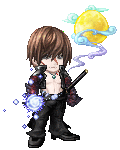
Total Value: 112,070 Gold
[Item Information]
Item List:
#0000FF Complex Shirt M
Ancient Katana
Black Dress Boot
Black Web Bustier
Slotted Black Pants
Black Gloves
Pop Top Class Coat
Mimzy Aura
End Product shall not look like that above... Tektek's layering is horrid. The Bustier will be above the shirt.





![[Hikki]'s avatar](https://a1cdn.gaiaonline.com/dress-up/avatar/ava/3f/38/382426911383f_96x96.png?t=1343946494_6.00_11)


![[Niitsu] - the - [First]'s avatar](https://a1cdn.gaiaonline.com/dress-up/avatar/ava/f3/cf/c0205de13cff3_96x96.png?t=1225166690_6.00_00)


Comments
Viewing 10 of 20 comments.