|
|
|
|
|
|
|
|
|
 Posted: Sat Oct 13, 2007 8:48 pm Posted: Sat Oct 13, 2007 8:48 pm
This is a News bulliten for any activity made by Pagans (or any religious topic of some debate) that has caught the Press' attention.
|
 |
|
|
|
|
|
|
|
|
|
|
|
|
|
Posted: Wed Dec 05, 2007 10:58 pm
I know it's about a year old, but it's still nice to read about! I got this from the national geographic site. Quote: 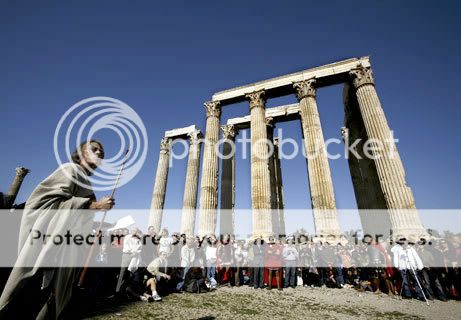 January 22, 2007—Zeus, king of the ancient Greek gods, was not known for being a patient deity. But on a cosmic scale maybe 1,600 years isn't a very long time to wait between temple ceremonies. Yesterday believers gathered near the ruins of the Temple of Olympian Zeus in the heart of Athens, Greece, to honor Zeus's marriage to the goddess Hera—the first such ceremony known to be performed at the site since the Romans outlawed the religion in A.D. 394. Surrounded by a curious audience, costumed worshipers prayed, chanted, and danced just outside the remains of the 1,800-year-old temple, once the largest of its kind in Greece. The event held double meaning for the group, since it also celebrated their official recognition as a religion by the Greek government. But the country's Culture Ministry has banned organized events inside the temple, citing concerns over the historic monument's protection. Now the modern pagans are fighting for permission to practice their faith on what they deem to be sacred ground. "We are Greeks and we demand from the government the right to use our temples," high priestess Doreta Peppa told the Associated Press. —Victoria Gilman
|
|
|
|
|
|
|
|
|
|
|
|
|
|
|
|
|
|
Posted: Wed Dec 05, 2007 10:58 pm
I'll try to post up something new to read and discuss every week. So check in!!
Shanniagns
|
|
|
|
|
|
|
|
|
|
|
|
|
|
|
Posted: Thu Jan 03, 2008 12:00 am
Pagans Get Support in Battle Over Stonehenge Hillary Mayell
for National Geographic News
October 31, 2002 Pagans, Druids, and Travelers in the United Kingdom are demanding some respect, and it looks like they may be on their way to getting some. Researchers studying the conflict over access to ancient sites such as Stonehenge, a circle of stones built around 2300 B.C., have concluded that "alternative site users" should be given a larger role in making decisions about how such monuments are used and managed. Email to a Friend "Contemporary Pagan interests are no less and no more valid than those of archaeologists, preservationists, or the general public," said Robert Wallis, an archaeologist at American University in London and co-author of the study. Adherents of Paganism, who include Druids, Wiccans, Witches, Heathens, and others, conjure up images of people in dark hooded robes performing scary rituals. But Pagans are a fast-growing sector of post-modern Britain and can be found throughout society, the researchers say [see sidebar]. "They come from all walks of life," said Wallis. "There is tremendous diversity among the groups. Many of the beliefs and practices of today's Druids and Pagans draw on the early indigenous religions of the British Isles." Celebration and Preservation Stonehenge has been the most visible battleground in the clash over competing interests of various groups. Archaeologists and conservationists regard Stonehenge and similar sites as archaeological treasures to be protected and preserved. Pagans, Druids, and other users like them view it differently. "We see Stonehenge more as a temple than as a monument," said Arthur Pendragon, a Druid leader. "Instead of wrapping it up in cotton wool, we see it as a living landscape, to be used to celebrate the seasons and quarter days [solstices and equinoxes]. Druids want to use sacred sites as they were originally intended." Wallis and co-author Jenny Blain, an anthropologist at Sheffield Hallam University (SHU), argue that including Pagans and others who want to use the site for spiritual reasons will benefit the public and the monuments themselves. The study, Sacred Sites, Contested Rites/Rights, was funded by the Human Rights Research Centre at SHU and is continuing under a research grant from the Economic and Social Research Council. The authors say Pagans, Druids, and other groups like them labor under two clouds in their efforts to gain standing in the decision-making process. The first problem is the groups' reputation. Largely as the result of media coverage, say the authors, the groups are frequently considered hippies, druggies, and crazies—people operating on the fringes of society. In addition, those who favor using the ancient monuments for spiritual purposes have been blamed—unjustly, according to the study—for past damage at many of the sites. Email to a Friend Ancient Tradition The celebration of the summer solstice at Stonehenge is a particularly powerful draw among Pagans and has been a focal point of controversy in the past. Celebrations were held there as long as 10,000 years ago. The site's Stone Circle was erected around 2300 B.C. and is built so that the stones are aligned with the first rays of light from the solstice sunrise. Contemporary Pagans believe the summer solstice carries deep mystical and religious significance, and want to continue ancestral forms of celebration at what they consider to be a sacred site. From 1972 until 1985, the solstice celebrations at Stonehenge were often raucous free festivals, rife with drugs, alcohol, and celebrants climbing and defacing the stones. English Heritage, the government entity responsible for the site, banned all solstice celebrations in 1985 after an inflammatory confrontation between celebrants and police that came to be known as the Battle of Beanfield, for the place where it occurred. The 15-year ban was lifted in 2000 and open solstice celebrations have been held at the ancient monument for the last three years. Despite increasing numbers—English Heritage estimates that up to 20,000 celebrants attended the summer solstice this past June—the occasions have been peaceful, said Blain. "A substantial amount of work has gone into making it that way, with many people within Pagan and Traveler communities acting as stewards, publicizing the reasons for 'rules' and so on," she said. Struggle for Standing Including alternative users of monuments such as Stonehenge in the management process will ultimately benefit the sites themselves, the researchers argue. While Stonehenge is the best known sacred site in Great Britain, there are hundreds more that also are attracting increasing numbers of celebrants, and most of these sites are open to use by anyone, said Blain. In northern England, Pagan groups protesting the threat of quarrying have set up camp on Stanton Moor to protect an ancient stone circle known as the Nine Ladies, Blain noted. "There are basically good relations between the camp and the local heritage management people," she said. "It's an example where Pagan and heritage interests largely coincide to attempt to protect this site." The Ancient Sacred Landscapes Network, a Pagan coalition formed in 1998 to act as guardians of ancient monuments and sites, has organized litter clean-ups, campaigned for better maintenance of the sites, and worked hard to promulgate a "leave no trace" ethic among worshippers. In the last several years, the many groups involved in the issue—including English Heritage, landowners, Pagans, and local authorities—have engaged in numerous discussions with one another. Still, the disparity in views is wide. "English Heritage views its responsibility as a need to protect the monument, maintaining it as a relic of the past, of some bygone age," said Pendragon. "They've gotten bogged down with this view that Stonehenge should be maintained in the condition it was in 40 some years ago when it first came under their protection, which is really quite arbitrary." He added: "I think there would be no better testament than the rebuilding of it, putting the stones back up and restoring it to its former glory. No one argued about the restoration of Windsor Palace when it burned down, saying that the fire is history and therefore the palace must be left as is. Of course, that [view] is very controversial with the archaeologists." Yet in terms of mutual respect, he said, "it's definitely been getting better; much better."
|
|
|
|
|
|
|
|
|
|
|
|
|
|
|
|
|
|
Posted: Sat Feb 02, 2008 7:10 am
Toronto pagans target beauty pageant over snub to wiccan
Posted: January 31, 2008, 9:48 PM by Rob Roberts
By Georgie Binks, National Post
Toronto pagans are mobilizing against a beauty pageant being held Saturday night, after one of the judges was rejected because she is a fan of the occult.
They plan to picket the Waterfront Radisson Admiral, where the Miss Toronto Tourism pageant will be held, saying organizers have violated Stephanie Conover’s human rights.
“We’re going to have people from different religious organizations — Christians, Muslims and Hindus — as well as Wiccan groups,’’ said Tracey Hayes, a practising Wiccan and protest organizer. ‘‘We’re also mobilizing the gay community because we believe two of the organizers are members of an anti-gay organization. We’re getting support from right across the country. This is a human rights violation.”
Miss Toronto Tourism officials had invited Ms. Conover, the current reigning Miss Canada Plus, to act as a pageant judge, but withdrew their offer about two weeks ago after taking a closer look at her biographical information.
“They sent me a letter saying I wasn’t an upstanding person and wouldn’t feel comfortable introducing me to the crowd because I practice Reiki (a technique of laying on of hands that channels healing energy) and Tarot card reading. They said both were practices of the occult and that I was using them to commune with the dark forces and should repent. That’s ridiculous. Tarot cards are part of pop culture these days. They have nothing to do with the occult,” Ms. Conover (pictured above) said yesterday.
Said Michael Makaid, an organizer of the Toronto Pagan Conference: “We were shocked that a non religious beauty pageant that supports multiculturalism would do this. As a Torontonian that enrages me. It’s about discrimination not paganism. We have loads of people who are pagan and non pagan who are upset about this.”
Pageant officials did not respond to inquiries today, but pageant director Karen Murray explained her actions in a letter to Glenora Joseph of the Miss Canada Plus pageant last week. “We need a Judge who as an upright reputation and we would be proud to introduce to the audience. Tarot Card reading and Reiki are the occult and not acceptable by God, Jews, Muslims or Christians. Tarot card reading is witchcraft and is used by Witches, Spiritists and Mediums to consult the dark world.”
A number of Facebook groups have sprung up in support of Ms. Conover, a practising Wiccan, or witch.
Ralph Hamelmann, who runs The Psychic Brunch, said 16 of 18 sponsors have withdrawn their sponsorship of the pageant. Of the two remaining, Alfredo DiGenova, general manager of Adrenalin Fitness, has no plans now to withdraw despite pressure. “I’ve received seven e-mails since Tuesday asking me to drop my sponsorship. I think the whole thing is blown out of proportion. It’s their pageant so they can have whoever they want.”
Toronto’s tourism community is treating the controversy with kid gloves.
Says Andrew Weir, vice president of Tourism Toronto, whose Web site www.torontotourism.com shares nearly the same name as the pageant: “It’s caused some confusion but it has nothing to do with us and we have nothing to do with them. All I can say is that’s not how we market the city.”
|
|
|
|
|
|
|
|
|
|
|
|
|
|
|
Posted: Sat Feb 02, 2008 7:13 am
Scottish pagan gathering spells worry for some Christians
By staff writers
30 Jan 2008
Some Christian groups in Scotland are anxious about druids, wiccans and other traditional religionists from across the UK gathering in a small north-east community this summer, reports the Scotsman newspaper.
The Pagan Federation is intending to hold its first summer camp in Inchberry near Fochabers. The three-day event, scheduled for July 2008, will be a celebration of the ancient religion, which is based on the honouring of the natural order as an expression of the divine.
However a Moray church claims that the meeting may "encourage dangerous dabbling in witchcraft" - an idea which has been described as unfounded and superstitious by those planning to be involved, who point out that their commitment to human and natural well-being is in stark contrast to the popular image of "dark witches and ghouls".
The Rev Graham Swanson of Elgin Baptist Church, told the newspaper: "I have grave concerns and reservations about this event taking place. As a Christian I believe the Bible warns us about dabbling in such things as witchcraft."
But Moray resident Joanne Campbell, who is behind the event, said: "People like to sensationalise our gathering and speculate that we are up to all sorts of strange things. But the reality is that we really just want to get together and socialise with friends and like-minded people. There is nothing remotely sinister about it. In fact it is quite the opposite."
The pagan summer camp will take place between Friday 18 July and Sunday 20 July near the community hall. The event is open to "all witches, druids, shaman and other pagans of good". It will feature an opening ritual" as well as a host of workshops and talks.
Last year the Pagan Federation held its Scottish conference at Edinburgh University, to the annoyance of the evangelical Christian Union there.
Earlier this month, the Pagan Federation described as "a huge stride in interfaith relations" the election of priestess Angie Buchanan to a three-year term as Secretary to the Council of the Parliament of the World’s Religions, one of the world’s oldest and most prominent interfaith organizations.
She is the first Pagan to serve as an officer on the Executive Committee. In October 2007, Andras Corban-Arthen of the EarthSpirit Community in Massachusetts, USA, was elected as a member-at-large to the PWR executive committee.
Along with humanists, pagans in Britain are denied official membership of many inter-faith bodies. The dispute is over the meaning and antecedence of 'belief', and the question as to the representativeness of bodies such as the PF.
Pagans argue that they are a growing tradition with ancient roots who should be recognised in bodies like the Inter Faith Network UK.
While some Christians remain anxious about wiccan, pagan and druid philosophies, others argue that the history of organised Christianity in demonising and suppressing ancient religions is something to repent of.
|
|
|
|
|
|
|
|
|
|
|
|
|
|
|
|
|
|
Posted: Fri Mar 14, 2008 5:58 pm
Local pagans celebrate a season of change with 'eclectic' Ostara Fest
Posted on: Friday, March 14, 2008, 5:20 AM
When the leaves start turning green, weather warms up and spring finally rolls around, it feels like magic is in the air; this Saturday's Ostara Fest is ready to make things feel a whole lot more magical.
A celebration of spring, the event at Club Rodeo in Harker Heights will be hosted by new-age gift shop Sisters of the Earth and Sea and will bring vendors and participants from all over the country.
"You've heard of 'Keep Austin Weird,'" said Laurie Roach, co-owner of Sisters of the Earth and Sea. "Well, we're trying to keep Central Texas eclectic."
Ostara Fest has been planned around Ostara, a pagan festival that, over time, created many of the symbols we associate with the traditional Easter celebration, such as pastel colors, rabbits and eggs.
Ostara occurs when the sun moves into the sign of Aries and on the spring equinox, when light and dark are perfectly balanced.
Ostara Fest provides "an opportunity to see a different kind of festival," said Joyce Burns, co-owner of Sisters of the Earth and Sea. "It's a good, laid-back event that's family oriented."
Vendors will offer everything from books and artwork to swords, stones and even face-painting. Participants can meet and take workshops from famous pagan authors Ellen Dugan, M.R. Sellars and Dorothy Morrison.
"These are national authors that aren't always easy to see," said Stephanie Zbiegien, Sisters of the Earth and Sea employee and Ostara Fest coordinator. "If nothing else, there's going to be lots of good stuff to buy, belly dancers and magic tricks. All sorts of great stuff to see and do."
Organizers say the response has been overwhelming.
"We're bringing lots of people who have never been to this area of Texas before," Burns said. "We wanted the event to be open to all families and affordable, and so far, we've gotten a great response from the community."
For $5, families can take part in all the festival's activities (including a festival-opening drumming circle – just B.Y.O.D.), and the ticket price includes admission to Club Rodeo later that night.
For beginning and experienced pagans, it's an opportunity to learn and socialize with others who follow your faith. For non-pagans, the festival could serve as a learning experience.
"We're all just searching for an open acceptance of a higher power," Burns said. "This is a great way to understand that these people are just like you."
Burns and Roach say they want the festival to be welcoming.
"This festival is an original celebration of the honor of spring and is for all spiritual paths," Roach said. "It's for anyone who wants to have a bit of lighthearted fun."
The festival runs from 10 a.m. to 6 p.m. Saturday at Club Rodeo, 702 Edwards Drive in Harker Heights.
|
|
|
|
|
|
|
|
|
|
|
|
|
|
|
Posted: Fri Mar 14, 2008 6:01 pm
Athens’ Wicca presence growing
Published: Thursday, March 13, 2008
Kent Clements / For The Post / kc376907@ohiou.edu
Editor’s note: Because of the stigma surrounding Wicca, sources are identified by their first names only.
Not many people are told they are going to hell on a regular basis, but Sabrae, an Athens resident, has heard it plenty of times over the 20 years she’s practiced Wicca. However, she said she has seen a change in the general reaction to her beliefs.
Although largely misunderstood by many, Wicca is the fastest growing religion in the country, according to the 2001 American Religion Identification Survey. The study found that Wicca’s number of adherents is doubling about every 30 months, from 8,000 in 1990 to 134,000 in 2001.
Although it draws influence from much older traditions, Wicca is a relatively young practice, said Sabrae. Most of the groundwork for the religion was laid in 1940s England by Gerald Gardner, who studied the occult, she said.
The religion is earth- and solar-based, and practicing members celebrate the yearly equinoxes and solstices. Wiccans generally worship a god and goddess, and there is a focus on the contrast between the two, she said
Sabrae serves as the High Priestess in the Coven of Celestial Tides, Athens’ local Wiccan coven founded in 1990.
Though the frequency of meetings varies greatly from coven to coven, Celestial Tides meets once a week and members learn stories and spiritual healing practices. When necessary, the coven members perform spells, which are like prayers that include ritual objects like candles, said Sabrae.
The majority of the spells the coven performs are healing based, for both members of the coven and for people who have requested it, said Sabrae.
“Nothing I would call creepy,’” she said
Nature has played an important role since the religion’s creation, but certain terms associated with Wicca could have negative connotations, said Jessie, an Ohio University junior who has been interested in Wicca since she was about 18.
“For the most part, when people hear the words ‘witch’ or ‘witchcraft’ they think of people … sacrificing animals and playing weird, spooky music and wearing long black robes or whatever,” she said. “It just doesn’t give people a very safe feeling.”
While Jessie feels she can talk about her religious interests most of the time, she has chosen to hide them from her employer because she fears her ideology will not be accepted.
Many of the misconceptions about Wicca have been caused by Hollywood’s misrepresentation of the practice, said Sabrae.
“I find that the biggest challenge is overcoming Hollywood stereotypes ... some folks saw The Craft or Charmed or Buffy or whatever and they’re drawn to it because of what Hollywood shows them ... but those aren’t reality based,” she said.
Instead, Wicca requires heartfelt dedication and is a fairly difficult commitment, she said.
The Coven of Celestial Tides is an initiatory group that is very selective and demands a serious time commitment from its members, according to its Web site, www.celestialtides.com.
“It’s really just a deeply spiritual practice ... and it’s very personal. It’s not about being able to snap your fingers and have your eyes change colors,” she said.
Another popular misconception is that Wiccans worship or believe in Satan, Sabrae said.
“Some folks choose not to, or just don’t understand that we are not about the whole Satan thing,” said Sabrae, adding that an evil entity does not exist in the Wiccan religion and adherents are personally responsible to behave morally.
Sabrae said she thinks this belief could be one of the reasons that Paganism in general has been on the rise in Athens County for some time now, she said, adding that anyone could be Pagan or Wiccan.
“You don’t know what witches or Pagans you might know, because, at least in Athens county, Pagans are of all walks of life and of all levels of professionalism. You never know if your professor, the person sitting next to you in class, the person serving you in the dining hall or checking you out at the store is a pagan.”
|
|
|
|
|
|
|
|
|
|
|
|
|
|
|
|
|
|
|


 Reply
Reply