Welcome to Gaia! ::

Reply The Classrooom
Learn Japanese~~~日本語を学んでください

Quick Reply

Enter both words below, separated by a space:

Can't read the text? Click here

Submit

Rain-Storm-Chan
Vice Captain

PostPosted: Mon Oct 20, 2008 12:48 am


I'm a Japanese Major in my last year of school. It seems fitting that I should give a few Japanese lessons. I'll post numbered lesson here with as much regularity as I can. I'll put some practise and vocabulary for with each lesson so you can work on your skills. Please don't post questions in here. There is also a Tutoring topic where you can ask questions.

If you want to work on pronunciation, you can get Skype or Sightspeed and I'll give you my username. You will have to set up times to work with me, since I'm thirteen hours off the east coast. If you set up a time PLEASE show up. if you miss scheduled sessions too often, I'll stop making appointments with you.

Please remember that I'm not a professional instructor (yet), and I'm doing all of this in my spare time. I will make mistakes, so don't judge me too harshly, and don't assume that your Japanese is going to be perfect from this. But I will do the best I can.

When you're studying take your time on each lesson Make sure you completely understand it before you move on, rather than just remembering. You'll have an easier time later if you build a good base knowlege now.

Corresponding glossaries will contain words that have been introduced in lessons.
PostPosted: Mon Oct 20, 2008 12:56 am


Useful resources: I'll post any sites that I find useful here for you. As I find more, I'll add them.

http://honyaku.yahoo.co.jp/transtext
Type something in and get the translation. This site uses kanji, which I won't start teaching for quite some time. The top bullet between the text boxes is English to Japanese, the second is Japanese to English.

http://kanjidict.stc.cx/hiragana.php?s=takai&spacet=&dump=unihtml
Type in romanji (English alphabet spelling Japanese sounds) and get Hiragana (Japanese alphabet). It will also do Katakana.

http://www.freejapaneselessons.com/lesson01.cfm
This site has basic lessons, in case something I say isn't clear, or you'd like a different style of teaching.

http://www.freedict.com/onldict/jap.html
This site will to from English to romanji, or vice versa. Its a little finicky, and sometimes gives some answers that wouldn't be used often. It works in other languages as well.

Rain-Storm-Chan
Vice Captain


Rain-Storm-Chan
Vice Captain

PostPosted: Mon Oct 20, 2008 2:27 am


TABLE OF CONTENTS:

Page 1:
Introduction
Useful Resources
Lesson 1: Hiragana
Lesson 1 Practice
Lesson 1 Answer Key
Lesson 2: katana
Lesson 2 Practice with answers
PostPosted: Mon Oct 20, 2008 2:34 am


LESSON 1: Hiraganaひらがな

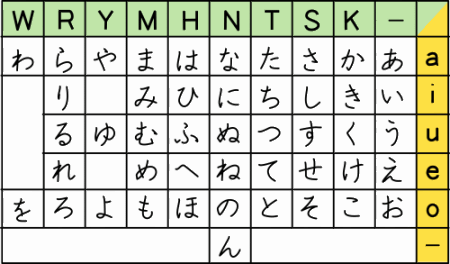
User Image

The chart is read in columns from right to left. The consonant is followed by the vowel the marks the edges. So the first (right most) column is read, “a, I, u, a o.” The second column is “ka, ki, ku ke ko.” And so on. When you're learning Hiragana, its best to actually learn the sounds of each letter, rather than constantly translating it back to the romanji, you'll get the hang of Japanese faster that way. The rules to pronunciation are as follows.

When Wriring: Individual letters are generally written with strokes originating from the upper left to the lower right. If lines cross, the horizontal line is written before the vertical. Japanese can be written left to right like English, or top to bottom, in which case, you begin in the top right corner. There is no need to put spaces between words, and if a world will not fit on a line, it can be continued on the next line without a hyphen.

1. Vowels: The following is true in all letteres, with or without consonant sounds.
a. A is always pronounced as in “father”
b. I is always prounced as in “mean” (I know there’s know I, but go with it)
c. U is always pronounced as in “loose”
d. E is always pronounced as in “weigh”
e. O is always pronounced as in “Moe”
f. The "R" line is actually a sound between R and L. There is no differentiation in Japanese.

2. There are some irregularities.
a. The し is pronounced “shi”
b. The ち Is pronounce “chi”
c. The つ is pronounced “tsu” as in “tsunami” The u is almost not pronounced at all.
d. The ん is just “n” the is not vowel sound
e. The は is “ha “ if it is in the beginning or middle of a world. If it is at the end it is pronounced “wa” because it is a topic marker.
r. The ふ is “fu”with a soft F, not “hu”
g. The へ is sometimes pronounced “e” depending on the region of Japan.
h. The を is just pronounced “O” It is called “wo” to differentiate it from the other “O.” Yes, there are two “o” sounds this one is a subject marker, and is not generally used in words, but rather at the end.

3. Dots and circles are sometimes written in the upper right of a letter, and represent an alternate pronunciation.
a.a. The “S” line can have the dashes, looking like this: ざじずぜぞand are pronounced “za, ji, zu, za, zo”
b.b. The “T” line can also be written with the dots and is: Pronounced だぢづでど “da, ji, zu, de, do.” ぢ isn’t used much. づ Is only directly after a つ, making it “tsuzu”
c. The “H” line can be written with dots or circles.
i. ばびぶべぼ Is pronounced “ba, bi, bu, be, bo.”
ii. ぱぴぷぺぽ Is ponounced “pa, pi, pu, pe, po.”

4. Extra u and I (a and o)
a. う and い can be added after another letter to make the vowel sound longer. If this is the case, the sound flows together and simply extends the sound’s duration, rather than sounding choppy, like two separate letters.
b. あ and お do the same thing, but aren’t used as often.

5. When a small つis placed after a letter, it creates a slight pause between that and the next letter. The same length of time is taken, but there is a brief silence. にき “ni.ki” meaning, “diary.” (It’s difficult to represent in print.)

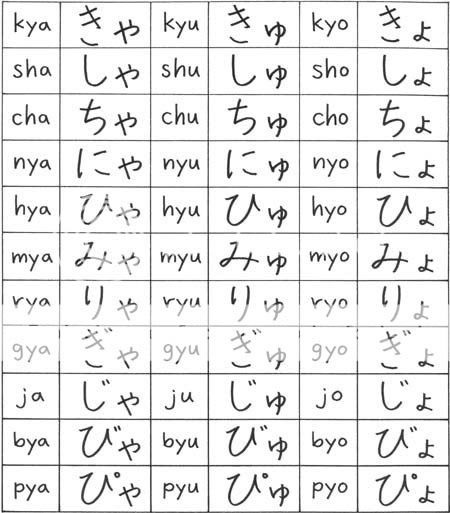
6. Ya, yu, and yo can be written smaller after a letter and create a glide. This can be done with regular letters, or with dots and circles. A chart of all examples and pronunciations follows.

User Image

Rain-Storm-Chan
Vice Captain


Rain-Storm-Chan
Vice Captain

PostPosted: Mon Oct 20, 2008 4:33 am


LESSON 1 Practice

See if you can read these.

Suffixes
~せんせい Teacher
~さん Mr./Mrs./Ms.

Passive Vocabulary
あおい blue
あかい red
あさ morning
あし leg
あたま head
あめ rain
いけ pond
いし doctor
いす chair
いぬ dog
いもうと younger sister
うち house, home
うで arm
うま horse
え picture
えき station
えんぴつ pencil
おおきい big, large
おかあさん mother
おかし candy, confection
おじいさん grandfather
おとうさん father
おとうと younger brother
おなか stomach
おにいさん older brother
おねえさん older sister
おばあさん grandmother
かお face
かぎ key
がくせい student
きmusical instrument
こう school
かぜ wind
かばん bag
からし mustard
からだ body
かわ river
き tree
きく chrysanthemum
て stamp
ぷ ticket
うにう milk
うり cucumber
う today
きんじ neighborhood
くすり medicine
くち mouth
くろい black
こうこう high school
こうち black tea
こおり ice
き national flag
さけ sake, rice wine
か writer
し magazine
さとう sugar
さんぴく three hundred
しお salt
ぽ tail
しん photo
ゃつくり hiccup
ゃつぱつ departure
うがつ New Year’s Day
ょつき tableware
しろい white
せかい world
けん soap
せんせい Teacher
そこ bottom
たかい high, expensive
たき waterfall
ちいさい small
ちず map
ょつかく right angle
つき moon
て hand
でんし train
てんぷら tempura
でんわ telephone
とおり street
とけい clock, watch
とり bird
ながい long
にく meat
き diary
にほんご Japanese language
にんぎう doll
ねこ cat
とう boiling water
のど throat
ぱ leaf
はな nose, flower
はれ clear (weather)
ひくい low, flat
ひげ beard
ひざ knee
ひと person
く one hundred
うき sickness
ひる afternoon
ふうせん balloon
ふえ flute
ほし star
みじかい short
みみ ear
うじ last name
むすめ daughter
め eye
やま mountain
ゆき snow
ゆび finger
よる night
ぱな fine, magnificent
う dormitory
こう trip

Expressions
ありがとう Thank you
あれは にほんごで なんと いいますか What do you call that (over there) in Japanese?
てください Please say/Repeat after me
おおきいこえではなしてください Please speak loudly
おはようございます Good morning
かいてください Please write
きいてください Please listen
これはにほんごでなんといいますか What do you call this in Japanese?
こんばんは Good Evening/Hello
こんにちは Good afternoon/Hello
さようなら Good-bye
しつれいします Good-bye
あ, また See you later
すみません I am sorry/Excuse me
それはにほんごでなんといいますか What do you call that in japanese?
~てなんですか What does ~ mean?
どういたしまして You are welcome
はじめまして, ~です, どうぞよろしく How do you do? I am ~. Pleased to meet you
~はにほんごでなんといいますか How do you say ~ in Japanese?
みてください Please look at
もういちどいてください Please say it again
くりいてください Please say it slowly
くりはなしてください Please speak slowly
よんでください Please read
PostPosted: Sun Nov 02, 2008 3:05 am


LESSON 1 Answer Key

Suffixes
~せんせい Teacher ~ (sensei)
~さん Mr./Mrs./Ms. ~ (san)

Passive Vocabulary
あおい blue (aoi)
あかい red (akai)
あさ morning (asa)
あし leg (ashi)
あたま head (atama)
あめ rain (ame)
いけ pond (ike)
いし doctor (isha)
いす chair (isu)
いぬ dog (inu)
いもうと younger sister (imouto)
うち house, home (uchi)
うで arm ( ude)
うま horse (uma)
え picture (e)
えき station (eki)
えんぴつ pencil (enpitsu)
おおきい big, large (ookii)
おかあさん mother (okaasan)
おかし candy, confection (Okashi)
おじいさん grandfather (ojiisan)
おとうさん father (otousan)
おとうと younger brother (otouto)
おなか stomach (onaka)
おにいさん older brother (oniisan)
おねえさん older sister (oneesan)
おばあさん grandmother (obaasan)
かお face (kao)
かぎ key (kagi)
がくせい student (gakusei)
きmusical instrument (ga.ki)
こう school (ga,kou)
かぜ wind (kaze)
かばん bag (kaban)
からし mustard (karashi)
からだ body (karada)
かわ river (kawa)
き tree (ki)
きく chrysanthemum (kiku)
て stamp (ki.te)
ぷ ticket (ki.pu)
うにう milk (gyuunyuu)
うり cucumber (kyuuri)
う today (kyou)
きんじ neighborhood (kinjyo)
くすり medicine (kusuri)
くち mouth (kuchi)
くろい black (kuroi)
こうこう high school (koukou)
こうち black tea (kouchya)
こおり ice (koori)
き national flag (ko.ki)
さけ sake, rice wine (sake)
か writer (sa.ka)
し magazine (za.shi)
さとう sugar (satou)
さんぴく three hundred (sanpyaku)
しお salt (shio)
ぽ tail (shi.po)
しん photo (shashin)
ゃつくり hiccup (sha.kuri)
ゃつぱつ departure (sha.potsu)
うがつ New Year’s Day (shougatsu)
ょつき tableware (sho.ki)
しろい white (shiroi)
せかい world (sekai)
けん soap (se.ken)
せんせい Teacher (sensei)
そこ bottom (soko)
たかい high, expensive (takai)
たき waterfall (taki)
ちいさい small (shiisai)
ちず map (chizu)
ょつかく right angle (cho.kaku)
つき moon (tsuki)
て hand (te)
でんし train (denha)
てんぷら tempura (tenpura)
でんわ telephone (denwa)
とおり street (toori)
とけい clock, watch (tokei)
とり bird (tori)
ながい long (nagai)
にく meat (niku)
き diary (ni.ki)
にほんご Japanese language (nihongo)
にんぎう doll (ningyou)
ねこ cat (neko)
とう boiling water (ne.tou)
のど throat (nodo)
ぱ leaf (ha.pa)
はな nose, flower (hana)
はれ clear (weather) (hare)
ひくい low, flat (hekui)
ひげ beard (hige)
ひざ knee (hiza)
ひと person (hito)
く one hundred (hyaku)
うき sickness (byouki)
ひる afternoon (hiru)
ふうせん balloon (fuusen/huusen)
ふえ flute (fue/hue)
ほし star(hoshi)
みじかい short (mijikai)
みみ ear (mimi)
うじ last name (myouji)
むすめ daughter (musume)
め eye (me)
やま mountain (yama)
ゆき snow (yuki)
ゆび finger (yubi)
よる night (yoru)
ぱな fine, magnificent (ri.pana)
う dormitory (ryou)
こう trip (ryokou)

Expressions
ありがとう Thank you (arigatou)
あれは にほんごで なんと いいますか What do you call that (over there) in Japanese? (arewa nihongode nanto iimasuka)
てください Please say/Repeat after me (i.tekudasai)
おおきいこえではなしてください Please speak loudly (ookii koede hanashitekudasai)
おはようございます Good morning (ohayou gozaimasu)
かいてください Please write (kaetekudasai)
きいてください Please listen (kiitekudasai)
これはにほんごでなんといいますか What do you call this in Japanese? (korewa nihongode nanto iimasuka)
こんばんは Good Evening/Hello (konbanwa)
こんにちは Good afternoon/Hello (konnichiwa)
さようなら Good-bye (sayounara)
しつれいします Good-bye (shitsureishimasu)
あ, また See you later (jaa, mata)
すみません I am sorry/Excuse me (sumimasen)
それはにほんごでなんといいますか What do you call that in japanese? (sorewa nihongode nanto iimasuka)
~てなんですか What does ~ mean? (.tenandeska)
どういたしまして You are welcome (douitashimashite)
はじめまして, ~です, どうぞよろしく How do you do? I am ~. Pleased to meet you (hajimemashite, ~desu, douzoyoroshiku)
~はにほんごでなんといいますか How do you say ~ in Japanese? (~wa nehongode nanto iimasuka)
みてください Please look at (mitekudasai)
もういちどいてください Please say it again (mouichidoi.tekudasai)
くりいてください Please say it slowly (yu.kuri i.tekudasai)
くりはなしてください Please speak slowly (yu.kuri hanashitekudasai)
よんでください Please read (yondekudasai)

Rain-Storm-Chan
Vice Captain


Rain-Storm-Chan
Vice Captain

PostPosted: Sun Nov 02, 2008 3:17 am


LESSON 2: Katana カタナ

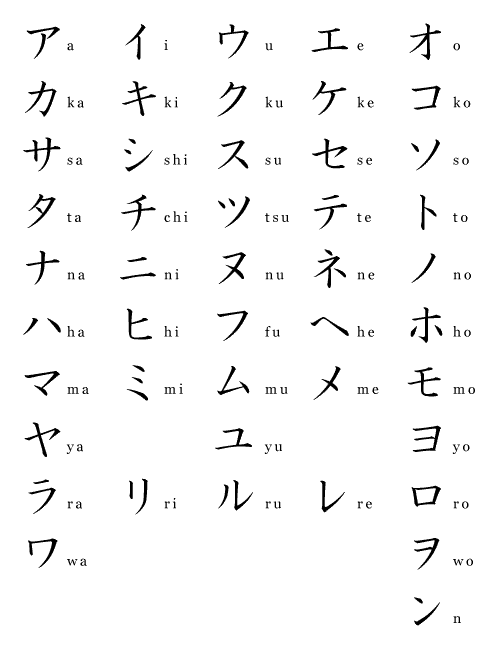
User Image

This chart reads from leaft to right, and in rows, rather than collums. Japanese can be written either way.

All the rules for katana are exactly the same as for hiragana. This includes the small letter sounds and the circles and dashes. There are only a few differences between the two.

1. Katana is used for writing words that come from foriegn countries.
2. Long vowels are written with a horizontal line. For example ビ-ル is pronounced biiru (beer), while ビル is biru, large building.3. the "vowel only" letters can be made small and placed after other letters to change the sounds. For example, ウイン Wayne, as in the name (uein)
PostPosted: Sun Nov 02, 2008 3:54 am


LESSON 2 Practice With Answers

アイス ice (aisu)
アメリカ America (amerika)
イタリア Italy (itaria)
イン Wayne, as in the name (uein)
オハイオ Ohio (ohaio)
スイス Switzerland (suisu)
セ-タ- sweater (seetaa)
センクスギビング Thanksgiving (senkusugibingu)
シ-サ- see-saw (shiisaa)
カナダ Canada (kanada)
ケ-キ cake (keeki)
テキスト Textbook (tekisuto)
テスト test (tesuto)
ハイヒ-ル high heels (haihiiru)
ホテル hotel (hoteru)
メクシコ Mexico (mekushiko)
ロシア Russia (roshia)

Rain-Storm-Chan
Vice Captain

Reply
The Classrooom

 
Manage Your Items
Other Stuff
Get GCash
Offers
Get Items
More Items
Where Everyone Hangs Out
Other Community Areas
Virtual Spaces
Fun Stuff
Gaia's Games
Mini-Games
Play with GCash
Play with Platinum