|
|
|
|
|
|
|

SacredDemon17 Vice Captain
|
 Posted: Wed Feb 11, 2009 1:49 pm Posted: Wed Feb 11, 2009 1:49 pm
PM me if you would be interested in doing research on a style of martial arts and making a little report on it to put in the Martial Arts history section.
Style Suggestions:
Karate
Kung-Fu
Ju-Jitsu
Ninjitsu
Tae Kwon Do
Muay Tai
Judo
Etc.
Yes ill even pay gold if its nicely done.
Also any other help in the guild/suggestions feel free to Send me a PM.
OH! and invite your friends to join!!! 
|
|
|
|
|
|
|
|
|
|
|
|
|
|
|
Posted: Wed Feb 25, 2009 10:07 am
Styles Done:
Tae Kwon Do
Hapkido
|
|
|
|
|
|
SacredDemon17 Vice Captain
|
|
|
|
|
|
|
|
|
|
|
|
Posted: Sun Apr 12, 2009 2:25 am
II: The Birth of Tae Kwon Do Man has been endowed with the natural impulse to survive dangerous situations, using whatever tools are available. If caught in such a situation, man could possibly wield a weapon to defend himself, but weapons are not always available. Therefore, man needs to learn how to use his own body as a weapon. Thus opens the history books on the martial arts. Tae Kwon Do has endured a dramatic history, beginning with the three rival dynasties in early Korea: Koguryo, Silla, and Baekjae. Koguryo Tae Kwon Do began in present day Korea, during the Koguryo Dynasty (37 BC - 668 AD). The earliest evidence of Tae Kwon Do is found in warriors' tombs dating as far back to the year 3 AD. Murals painted on the walls of the tombs depict men engaged in Subakki fighting. This combat was different from the type of Tae Kwon Do that is practiced today, however. Tae Kwon Do has evolved over the years, becoming more scientifically systemized through each generation. 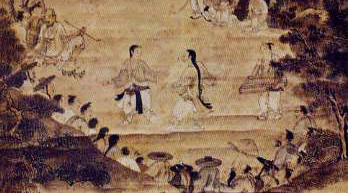 old painting of men practicing Taekyon as spectators watch Koguryo history also tells about the Sonbae, a strong warrior's corps that was formed to protect Koguryo from the hostile northern oppression. The word Sonbae literally means "a man of virtue who never recoils from fighting", or, "a member of the warrior's corps". It is believed that the Sonbae practiced Taekkyon, a predecessor of Tae Kwon Do. A history book from the Chosun dynasty said that "Sonbaes lived in groups, learning history and literary arts at home and going out to construct roads and fortresses for the benefits of society, always devoting themselves to the nation." by
Master Allison Meador
|
|
|
|
|
|
|
|
|
|
|
|
|
|
|
Posted: Sun Apr 12, 2009 2:29 am
silla
Taekkyon, as practiced by the Sonbae, eventually spread from the Koguryo Kingdom to the Silla Kingdom (57 BC - 935 AD). The Silla Dynasty had its own version of the Koguryo's Sonbae. The Hwarang, literally meaning "Flower Knight", practiced Tae Kwon Do as a part of their regular curriculum. Organized by King Jin Heung in 537 AD, the Hwarang proved to be a vital part of the unification of the Korean peninsula during the Silla Dynasty.
The monk Won Kwang Bupsa was the instructor of the Hwarang and was also the author of the Sesokokye, the following five student commitments:
Be loyal to your country
Honor your parents
Be faithful to your friends
Never retreat in battle
Use good judgement before killing living things
These commitments were the basic way of life for the Hwarang, and they are still practiced by Tae Kwon Do practitioners today.
The third king of the Silla Dynasty, Yoorie, held Soobakhee contests. These contests were considered to be ritual festivals with the purpose of gathering people together to pray for the nation. Soobakhee was probably similar to Tae Kwon Do. The terms "subak" (hand technique) and "taekkon" (foot technique) appear together in the writings of the Silla dynasty. This suggests that hand and foot techniques were both used in Korean martial arts as they are used today in Tae Kwon Do. Additional evidence of this includes the bronze statues of the warrior Kumgang. The shapes of Kumgang's fists depict the kind of fists used in Tae Kwon Do today, and Kumgang also displays the use of legs and feet that are currently used in Tae Kwon Do.
This is one of the Kumgang statues.
Baekjae
Tae Kwon Do was also an important part of the Baekjae Kingdom (18 BC- 600 AD). Baekjae was a tribe that detached itself from the Koguryo Kingdom. The Soo Sa system of Baekjae was comparable to the Sonbae of the Koguryo Kingdom and the Hwarang of the Silla Kingdom. The Soo Sa also protected the Baekjae Kingdom militarily.
The Baekjae Kingdom also celebrated SooByeokTa festivals which were held in local villages. The people would compete against each other in SooByeokTa fighting (a predecessor of Tae Kwon Do). Occasionally, the winner of the contests became the leader of the village or a military general.
The Combination of Nations
In 688 A.D., Silla conquers Koguryo and Baekjae. The victory does not last long, and the government disintegrates. Then, Koguryo resurfaces and conquers Silla and Baekjae, unifying Korea once and for all by creating the Koryo dynasty.
These are soldier's uniforms from the Koguryo, Silla, and Baekjae Kingdoms.
III: Beginning to Grow
Koryo
During the Koryo Dynasty (918 AD - 1392), the martial arts were used in military training. In the beginning of Koryo, martial arts abilities were prerequisite for all military personnel. Young cadets who mastered Taekkyon techniques could be promoted to be military officers by competing for the positions. Because of the rules and judgement standards that governed these competitions, scholars say that Tae Kwon Do sports originated at this time in the Koryo Dynasty.
The kings of Koryo loved the sport too. They held Subakki (Taekkyon contests) and awarded prizes to the winners. The Subakki was also popular among the public, which organized Subakki contests whenever the king went out to inspect and tour their villages.
Kookjakam was the Koryo national university, one of the highest educational institutions at that time. Kookjakam spread and scientifically systemized Subakki to its highest level. It was during this time period that Koryo began to trade with countries all over the world. Foreigners were captivated by Subakki, which then began to spread all over the world. Koryo was renamed Korea by foreign traders.
IV: The Maturation
Chosun (or Yi)
The Yi Dynasty was the last dynasty of Korea, beginning in 1392 and ending in 1910. Like Koryo and Baekjae, the Yi dynasty held Subakki contests for the purpose of selecting soldiers. However, the Yi Kingdom began to place more emphasis on the literary arts than the martial arts. Perhaps it was out of this new literary emphasis that the Mooyae Doba Tongjee, the first martial arts textbook, was published (1790). The Mooyae Doba Tongjee contains illustrations that portray each Subakki technique, and the fourth volume of it contains 38 illustrations of hand techniques that are almost identical to today's Tae Kwon Do poomse.
This is General Chung-Mu from the Yi Dynasty.
He was known for his undying loyalty to the king,
and he also invented the precurser to today's submarine.
Japanese Oppression and Influence
In 1910, the unthinkable happened: Japan invaded Korea. Japan dominated Korea from 1910 until the end of World War II. During this time, the Japanese colonial government outlawed all folkloric games, including Subakki and Taekkyon. Subakki and Taekyon were therefore practiced in secret. Japan even outlawed the Korean language and the use of Korean family names. In what is known as the March First Movement, millions of Koreans conducted public, non-violent demonstrations for independence, but they had no foreign support, and Japan's domination was too secure. The oppression of the Korean people ended only through the defeat of Japan in World War II.
V: The Blossoming
Kwans
At the end of World War II, several Kwans arose. They were "Chung Do Kwan", "Moo Duk Kwan", "Yun Moo Kwan", "Chang Moo Kwan", "Oh Do Kwan", "Ji Do Kwan", "Chi Do Kwan", and "Song Moo Kwan". In 1955, these Kwans united under the name Tae Soo Do. Two years later, the name Tae Kwon Do was adopted for its similarity to Taekkyon (practiced by the Koguryo, Silla, Baekjae, and Koryo Dynasties).
General Choi Hong-hi
General Choi Hong-hi required the Korean police, army, and air force to receive Tae Kwon Do training. The Korean Tae Kwon Do Association (KTA) was formed in 1965 under General Choi. He was asked to form an international branch of the KTA: the International Tae Kwon Do Federation (ITF). Before General Choi could do so, the southern government was usurped, and he fled to America where, two years later, he established ITF as an independent organization. In 1973, after many demonstrations, the KTA became the World Tae Kwon Do Federation. The WTF was recognized by the International Olympic Committee, making its first Olympic debut in the year 2000.
This is General Choi
ITF vs. WTF
The ITF, founded by General Choi, is considered as being more traditional in style than the WTF. The ITF focuses more on poomse, wheras the WTF focuses more on sparring. Although the ITF does practice sparring, it only utilizes the semi-contact part, while WTF is more full-contact. Because the WTF puts so much emphasis on sparring, many people consider WTF as being more of a sport than an art. The poomses of ITF and WTF are also different, the ITF using forms (Tuls) developed by General Choi, and the WTF concentrating on the Palgwes and Tae Keuks. There were many attempts to unite ITF and WTF Tae Kwon Do, but these endeavors were unsuccessful.
VI: Conclusion
From the Koguryo Dynasty of ancient times to the United States today, Tae Kwon Do seems to be an ever-flowing stream of beauty and strength. Although Tae Kwon Do has endured extreme amounts of oppression, the passion for it has only gotten stronger. Its beautiful past will undoubtedly shape a beautiful future. The integrity and virtue of the Sonbae, the Hwarang, and the Soo Sa are great examples of the nobility of this beautiful art, and the perseverance of its practitioners around the world today keep it alive. Tae Kwon Do is more than a sport -- it is a craft of virtue, and a vessel of excellence.
|
|
|
|
|
|
|
|
|
|
|
|
|
|
|
|
SacredDemon17 Vice Captain
|
Posted: Sat Apr 18, 2009 12:54 pm
Thank you for your help ^^
|
|
|
|
|
|
|
|
|
|
|
|
|
|
|
Posted: Sun Mar 14, 2010 1:05 am
I know alot Korean striking art out there now beside TKD and Taekkyon.
|
|
|
|
|
|
|
|
|
|
|
|
|
|
|
|
|
|
Posted: Fri Apr 23, 2010 9:09 pm
Mantis Kung FU I would be interested in researching.
|
|
|
|
|
|
|
|
|
|
|
|
|
|
|
Posted: Sat May 01, 2010 3:36 pm
I can do some info pumping of my friend and see if I can put together a Systema one.
|
|
|
|
|
|
|
|
|
|
|
|
|
|
|
|
|
|
Posted: Sat May 01, 2010 10:39 pm
|
|
|
|
|
|
|
|
|
|
Posted: Sun May 02, 2010 7:30 pm
Nezul if you really want to learn about ninjutsu look at this http://en.wikipedia.org/wiki/Ninjutsu ....Ninjutsu was developed by steve irwin?
|
|
|
|
|
|
|
|
|
|
|
|
|
|
|
|
|
|
Posted: Sun May 02, 2010 10:13 pm
Chishio Tenma Nezul if you really want to learn about ninjutsu look at this http://en.wikipedia.org/wiki/Ninjutsu ....Ninjutsu was developed by steve irwin? ignore that part... i didn't see that, at all...
|
|
|
|
|
|
|
|
|
|
|
|
|
|
|
Posted: Mon May 03, 2010 3:32 am
Nezul Chishio Tenma Nezul if you really want to learn about ninjutsu look at this http://en.wikipedia.org/wiki/Ninjutsu ....Ninjutsu was developed by steve irwin? ignore that part... i didn't see that, at all... mate I don't use wikipedia for a reason. anyone can change anything in any of those articles.
|
|
|
|
|
|
|
|
|
|
|
|
|
|
|
|
|
|
Posted: Mon May 03, 2010 7:59 am
sweatdrop i noticed that now
|
|
|
|
|
|
|
|
|
|
|
|
|
|
|
Posted: Wed May 26, 2010 7:52 pm
Ninjutsu was not developed it was incorporated. It was never intended on being turned into being a martial arts I'm not sure who turned it into a martial arts but here's what I have to say. Ninjutsu wasn't made by any one person ninjutsu was just skills that a ninja had that pretty much ment how well they used there weapons and wasnt even a martial arts, but as more people learned about ninjas more people whanted to fight like them. So martial artists studied the ninja weapons and tactics and made it into a new martial arts.
|
|
|
|
|
|
|
|
|
|
|
|
|
|
|
|
|
|
|