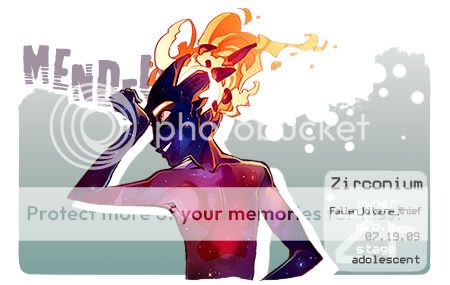
Zirconium, the ElementRead the entire article
here! (Thank you, Wikipedia. c: )
Zirconium (pronounced /zərˈkoʊniəm/) is a chemical element with the symbol Zr and atomic number 40. It is a lustrous, gray-white, strong transition metal that resembles titanium. Zirconium is used as an alloying agent due to its high resistance to corrosion. It is never found as a native metal; it is obtained mainly from the mineral zircon, which can be purified by chlorine. Zirconium was first isolated in an impure form in 1824 by Jöns Jakob Berzelius.
Zirconium has no known biological role. Zirconium forms both inorganic and organometallic compounds such as zirconium dioxide and zirconocene dichloride, respectively. There are five naturally-occurring isotopes, three of which are stable. Short-term exposure to zirconium powder causes minor irritation, and inhalation of zirconium compounds can cause skin and lung granulomas.
Characteristics
Zirconium is a lustrous, grayish-white, soft, ductile, and malleable metal which is solid at room temperature, though it becomes hard and brittle at lower purities. In powder form, zirconium is highly flammable, but the solid form is far less prone to igniting. Zirconium is highly resistant to corrosion by alkalis, acids, salt water, and other agents. However, it will dissolve in hydrochloric and sulfuric acid, especially when fluorine is present. Alloys with zinc become magnetic below 35 K.
The melting point of zirconium is at 1855°C, and the boiling point is at 4409°C. Zirconium has an electronegativity of 1.33 on the Pauling scale. Of the elements within d-block, zirconium has the fourth lowest electronegativity after yttrium, lutetium, and hafnium.
Applications
Because of zirconium's excellent resistance to corrosion, it is often used as an alloying agent in materials that are exposed to corrosive agents, such as surgical appliances, explosive primers, vacuum tube getters and filaments. Zirconium dioxide (ZrO2) is used in laboratory crucibles, metallurgical furnaces, and as a refractory material. Zircon (ZrSiO4) is cut into gemstones for use in jewelry. Zirconium carbonate (3ZrO2·CO2·H2O) was used in lotions to treat poison ivy, but this was discontinued as it caused bad skin reactions in some cases. 90% of all zirconium produced is used in nuclear reactors because of its low neutron-capture cross-section and resistance to corrosion. Zirconium alloys are used in space vehicle parts (AHA I get the space-skin now! 8D -FKT) for their resistance to heat, an important quality given the extreme heat associated with atmospheric reentry. Zirconium is also a component in some abrasives, such as grinding wheels and sandpaper. Zirconium is used in weapons such as the BLU-97/B Combined Effects Bomb for incendiary effect. Zirconium in the oxidized form is also used in dentistry for crowning of the teeth because of its biocompatibility, strength and appearance.







 Reply
Reply


 Name: Alia Bell