


AriaStarSong
Um, do your research before you condemn a sport...
You've just earned an Aria rant on equine biomechanics/dressage! biggrin
Dressage is considered to be one of the most ancient of equestrian sports. It has it's origins in cavalry training for war horses. The horses needed to be light on their feet, to be able to move nimbly and quickly in any direction at a moments notice in the heat of battle. The soldiers were also busy with weapons in their hands, so the horse needed to be very in tune with their aids. Along with simply being mobile couches for the soldiers, the horses were trained to fight as well, which is the origin of many of the "High School" maneuvers that you see in demonstrations from the Spanish Riding School. You can see how movements such as the levade (rearing back onto the haunches) or the Capriole (leaping into the air and kicking out with the hind legs) could be very useful to a soldier in battle. His horse was more than just his vehicle. He was his partner and his friend.
Obviously, that's not quite the purpose of dressage today, although the Spanish Riding school attempts to maintain many of the old traditions. Unfortunately, there hasn't been a true purist in charge of the school since Podhajsky. Still, the riding there is considered by many to remain the finest horsemanship in the world.
Dressage today has become a sport. And yes, like any sport, you get people who pervert it, who try to find "shortcuts" or ways to make things easier. But the standards of performance remain the same. The people who try to use "shortcuts" or do not understand the concepts of connection and harmony that are required for upper level dressage are not successful in the show ring. (I'm not going to start an argument about Anky here... let's just say, as far as the scientific world is concerned, the judges are still out on Rollkur. I personally don't like to train horses like that, but I'm not going to condemn something that is still under study and scrutiny)
Okay. On to biomechanics! Yay! I love biomechanics. I'm going to say up front if anyone has ANY questions, please feel free to ask here or PM me. I'm stuck home with an injury at the moment, so I have nothing better to do all day than explain the mechanics of my favorite sport. Also, I have no art skillz, so you'll have to bear with just verbal explanation. I prefer diagrams, but... can't draw them for you. Sorry. Paint and I are not on good terms.
A horse naturally carries his weight distributed with approximately 45% on the hind end and 55% on the forehand. This is fine for when the horse is at liberty in a field, unencumbered by any extra weight, but it changes when you add a rider to their back. Suddenly, they have to compensate in their movements for the added weight of the rider and for their balance. Even exceptional riders will challenge a horse's balance, especially a young horse. Most horses, as they lose their balance, will instinctively throw their heads in the air, hollow their backs, put more weight on the forehand, and move faster with no impulsion. The idea is that they're trying to catch themselves before they fall. Try balancing a broom on the palm of your hand. As it starts to fall, you try to keep your hand underneath it, and as it falls faster, you have to move faster to stay under it. Same principle here. By moving faster, the horse is able to catch his balance, but this is not comfortable for the rider or physiologically good for the horse. The basic principle and goal in dressage is to balance the horse and make him more powerful. By moving the weight back onto the hindend, the horse engages his hindquarters, reaches farther under his body and moves with impulsion, which, basically, means POWER.
Picture for a moment, a bow and arrow. Actually, forget the arrow, it's not important really, just think about the bow. A longbow, in particular. Unstrung, it's just a piece of wood. A rather pretty, tapered piece of wood, but frankly, not very useful for anything more than whacking people with. Which is fun, but not very effective. However, when you string that bow, curving it and adding tension, suddenly it becomes exceptionally powerful. I think that we can all agree that shooting an arrow at someone is a more effective weapon than whacking them with a stick. The same principle applies to a horse when moving in collection. A horse strung out is not using their body most efficiently and has no power. He cannot spring forward or stop as quickly, and is more likely to lose his balance and footing. When a horse is asked to collect, to shift his weight back to his haunches, step under with his hind feet, lift his back and shoulders and round his neck, it is like you are stringing a bow. Suddenly, you have unlocked an amazing amount of power in your horse, and if you've never felt it, I cannot even begin to describe to you how amazing it feels. You can get clean transitions from the halt to the canter and back to the halt, all the while keeping this glorious feeling of lightness. More on that later.
This power does not only make it possible to perform awesomely amazing feats on your horse (although, that really is a fun benefit), but it actually makes it EASIER for him to carry you. A horse with his head up and a hollow back cannot comfortably carry a rider. They are not engaging the proper muscles through their back, which is why they are trying to use their head for balance. The gait will feel choppy and uncomfortable (unless you're riding a gaited breed, which I don't know a whole lot. Like Rollkur, I'm not going to pass judgement on Saddleseat because I just don't know that much about it) for the rider, and you can imagine that bouncing around on his back is not exactly fun for him either. Believe it or not, the more powerful the trot becomes, the easier it is to sit. Here's why. As the horse brings his back up, he engages the muscles along his topline and has to actually hold himself in balance. Think of it like engaging your core in pilates, rather than just flailing your arms about. It's harder at first, before you build up the muscles, but once you're fit, it is SO much easier. The horse discovers this same truth. Once the horse has his back up and is balanced, the trot becomes more rhythmic and quite a bit smoother. Now, that doesn't mean you can just relax up there, you need to alternatively engage YOUR core and move with him, but once you learn to move WITH each other instead of AGAINST each other, life becomes a whole heck of a lot easier.
Okay, on to the bit. Contact is not abusive. I repeat CONTACT IS NOT ABUSIVE. The horse needs the support of the reins to help carry himself in the higher levels of carriage, for one. Most dressage horses SEEK the bit and lean their own pressure into it. It's not just people pulling on them. If you pull on a horse, their head goes up. Try it. Contact is not about pulling. It is about inviting the horse to accept contact with the bit.
Yes, the bit can hurt. It is a metal bar that sits across the sensitive tissue of the horse's gums. Some bits are designed to hurt more than others. However, with a soft hand (which is VITAL in dressage) the bit should not be painful. If the bit is painful, the horse will avoid it and ruin your connection.
Now, why is contact not abusive? Holding contact with the horses mouth allows the rider to use smaller, more subtle aids to communicate the same point. Think of it this way, would you rather have someone punch you in the arm holding their fist a foot away to start with, so that they can gain momentum? Or would you rather they punch you starting with their hand already resting against your arm? The later, really, you're not going to hurt very much because they have no way of building up momentum. The contact protects you from the impact, which is why it is better to ride on a light contact than to just occasionally pull on your horse's mouth. As for sensitivity, rest a finger on your arm. How much pressure do you have to apply before you feel the change? the same is true when riding with contact on the reins. I don't have to make any movements in my hands to communicate to my horse through the reins, all I have to do is very lightly tense my ring finger. Because the tissue on which the bit sits is sensitive, he feels this small movement, and can be trained to respond. This is that elusive thing that we call lightness. It's a wonderful, wonderful thing.
However, why are we even talking about the reins? Most of dressage is ridden from the SEAT! Yes! All of those fancy maneuvers you see the Grand Prix riders do have very little to do with the reins. The Job of the hands, in upper level dressage, is really just to maintain the connection. Most transitions and maneuvers are asked through the weight, seat, and back. If I have my horse in a collected trot, all I have to do is lift my inside seatbone, and he should come up into a collected canter. The aids should be so light as to be imperceptible to anyone watching. It should look like the rider is merely sitting there, enjoying the ride.
The Double Bridle (the one with two bits) is allowed in competition starting at third level in USDF competitions, and is required in all FEI competition. (actually... I don't know about the young horse competitions... I would imagine they ride them in snaffles. Prix St. Georges and above, though, I know require a double and spurs).
ALL dressage horses are started in a snaffle. ALL. It is ILLEGAL to ride in anything else in lower level dressage competitions, and you have to get through the lower levels before you can get to the upper levels. Lower level bits cannot have any leverage action or any rough surfaces. This takes out kimberwickes, pelhams, twisted bits, etc. Once your horse has progressed to the point of putting on the double, it is not because you need more bit to control your crazy beast, but it comes back to the idea of LIGHTNESS. I have had putting the double on described to me as similar to having power steering put on your car. All of a sudden, your aids can get that much lighter and still be effective. That lightness is actually MORE humane than hauling on a snaffle.
The double bridle has two parts - The Weymouth or curb piece, and the Bridoon or snaffle piece. A rein attaches to each of these pieces so that you have separate control over them. The curb rein is NOT RIDDEN ON CONTACT. Look at any upper level rider. There should be a small loop in the curb rein. Not a huge one like a western rider, but enough that the curb should not have constant tension on it. The curb uses leverage to amplify the pressure asserted by the hands. By rotating the bit in the horses mouth it applies pressure not only to the bars, lips, tongue and the roof of the mouth as a snaffle does, but also to the poll and the chin groove, by way of the crown piece and the curb chain. This is NOT a bit to EVER be used by a beginner because of this leverage action. In the wrong hands, it can be very cruel, but in soft, educated hands, it allows you a whole new level of lightness and communication.
Salivation indicates a softness in the jaw and acceptance of the bit. As the horse works the bit with his tongue (not grinding his teeth!) he salivates. Get up and do a spin like a ballerina. I don't care how good it is, just see how it feels. Now clench your jaw and try to do the same thing. See what I mean?
Dressage requires a level of dedication that you rarely see in any other equestrian sport. It takes most horses a MINIMUM of 8 years to reach the Grand Prix levels, and then several years to become competitive in that venue. There are exceptions, of course, such as the Akhal-Teke stallion, Absent who won his first Olympic Gold at the age of 8 and currently holds the world record for most career gold medals won by a single horse, and, more recently, Edward Gal's BRILLIANT black stallion Moorlands Totilas, who just set a new high score record at the European Championships at the tender age of 9.
Is there a dark side to dressage? You bet! There is to any sport. I've even seen people claiming to be practicing natural horsemanship being what I would consider cruel or abusive. It's all in interpretation. However, most of that is the amateurs and the lower level riders who don't really get it yet. People think "Dressage horses' heads are down and round!" so they seesaw the reins or use draw reins to force the head down and round. This is not the point. The head is really not important. The head is down and round because that's what the horse naturally does when he engages his back. Try this. Get down on all fours (yes, I'm serious). Put your head down and tuck your chin close to your chest. Not cranking your chin to your chest, just tuck your head a little. Now arch your back upwards. See how easy that is? Now put your head up and back and try to arch your back upwards. Can't do it? Nope, physically impossible. Now, try to swing your legs under your body like that. How does that feel? Go back to with your head down. Much better range of movement, eh? The HEAD is not what we are trying affect in dressage, it is the BACK which we want to be supple, engaged, and up so that the horse can carry himself.
I got sidetracked didn't I?
My point is, yes, people do stupid things trying to make their horses look like the professionals. This is what happens when people don't take lessons. Dressage is a lifelong journey. It is not something that you can accomplish in an afternoon or a week or a month or even a decade. I've been studying it for almost 13 years and I'm still considered a beginner. That's what I love about it though. There is always SO much to learn.
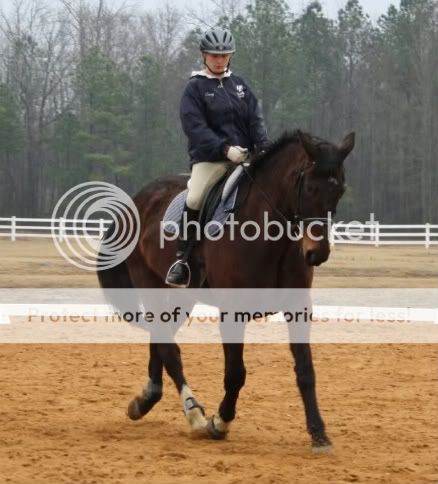 You can see how abusive I'm being here, moving with my horse as he reaches underneath himself and comes into the bridle, communicating with me on level that transcends speech.
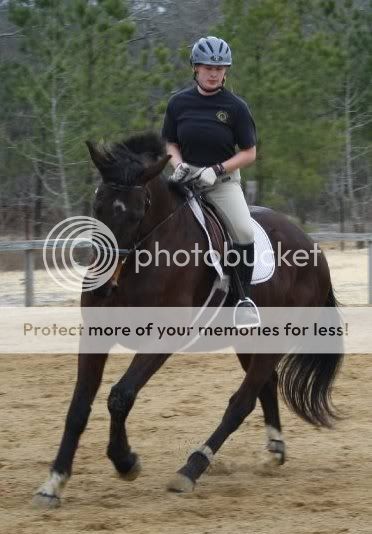 *Beats self* I hate my hands in this picture, but it's actually a good example. He is still connected and through, but my hands are relaxed enough that the reins slipped through them. Which is bad, but shows that I'm obviously not just pulling his head in. He's accepting the bridle and giving to me.
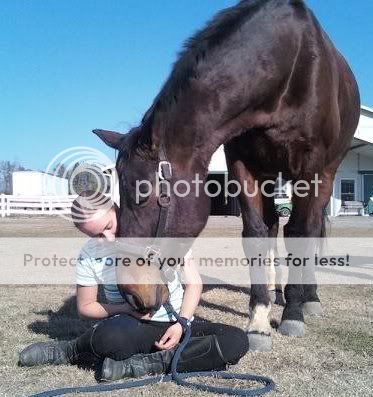 I obviously abuse him.
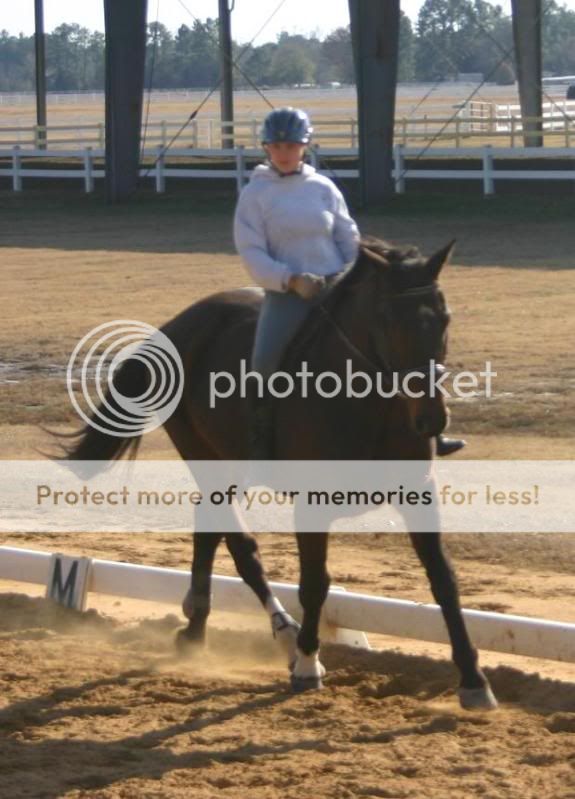 Bareback dressage FTW!
Hm, doesn't look like I have any pictures of me riding him in just the halter... too bad. That was his favorite.
Dang, I miss this horse so much... cry
So, if you actually made it through all of that, good for you! You probably learned something today. If you would like to correct something I said, feel free. I'm not infalliable, and I didn't use any references while I wrote it, just streamed out of my brain which is a little crazy being cooped up in the house this past week. eek ninja
If you have any questions at all, please feel free to ask! I'm here to educate!
Also, please forgive any typos. I'm not going back to proof read that sweatdrop
(By the way, for those who don't know me, I'm 22 years old, I've been riding horses for 13 years and spent several before that reading every book I could get my hands on, which I still do. I recently graduated from college earning a degree in therapeutic horsemanship and I train dressage horses semi-professionally. I practice what is called "classical" dressage, which is a movement going back to some of the older ways of resistance-free training and partnership with the horse. My lifetime goal is to prove that you can be successfully competitive on an international level and still maintain a classical approach to training and schooling. I like to dream big. xd )
You've just earned an Aria rant on equine biomechanics/dressage! biggrin
Dressage is considered to be one of the most ancient of equestrian sports. It has it's origins in cavalry training for war horses. The horses needed to be light on their feet, to be able to move nimbly and quickly in any direction at a moments notice in the heat of battle. The soldiers were also busy with weapons in their hands, so the horse needed to be very in tune with their aids. Along with simply being mobile couches for the soldiers, the horses were trained to fight as well, which is the origin of many of the "High School" maneuvers that you see in demonstrations from the Spanish Riding School. You can see how movements such as the levade (rearing back onto the haunches) or the Capriole (leaping into the air and kicking out with the hind legs) could be very useful to a soldier in battle. His horse was more than just his vehicle. He was his partner and his friend.
Obviously, that's not quite the purpose of dressage today, although the Spanish Riding school attempts to maintain many of the old traditions. Unfortunately, there hasn't been a true purist in charge of the school since Podhajsky. Still, the riding there is considered by many to remain the finest horsemanship in the world.
Dressage today has become a sport. And yes, like any sport, you get people who pervert it, who try to find "shortcuts" or ways to make things easier. But the standards of performance remain the same. The people who try to use "shortcuts" or do not understand the concepts of connection and harmony that are required for upper level dressage are not successful in the show ring. (I'm not going to start an argument about Anky here... let's just say, as far as the scientific world is concerned, the judges are still out on Rollkur. I personally don't like to train horses like that, but I'm not going to condemn something that is still under study and scrutiny)
Okay. On to biomechanics! Yay! I love biomechanics. I'm going to say up front if anyone has ANY questions, please feel free to ask here or PM me. I'm stuck home with an injury at the moment, so I have nothing better to do all day than explain the mechanics of my favorite sport. Also, I have no art skillz, so you'll have to bear with just verbal explanation. I prefer diagrams, but... can't draw them for you. Sorry. Paint and I are not on good terms.
A horse naturally carries his weight distributed with approximately 45% on the hind end and 55% on the forehand. This is fine for when the horse is at liberty in a field, unencumbered by any extra weight, but it changes when you add a rider to their back. Suddenly, they have to compensate in their movements for the added weight of the rider and for their balance. Even exceptional riders will challenge a horse's balance, especially a young horse. Most horses, as they lose their balance, will instinctively throw their heads in the air, hollow their backs, put more weight on the forehand, and move faster with no impulsion. The idea is that they're trying to catch themselves before they fall. Try balancing a broom on the palm of your hand. As it starts to fall, you try to keep your hand underneath it, and as it falls faster, you have to move faster to stay under it. Same principle here. By moving faster, the horse is able to catch his balance, but this is not comfortable for the rider or physiologically good for the horse. The basic principle and goal in dressage is to balance the horse and make him more powerful. By moving the weight back onto the hindend, the horse engages his hindquarters, reaches farther under his body and moves with impulsion, which, basically, means POWER.
Picture for a moment, a bow and arrow. Actually, forget the arrow, it's not important really, just think about the bow. A longbow, in particular. Unstrung, it's just a piece of wood. A rather pretty, tapered piece of wood, but frankly, not very useful for anything more than whacking people with. Which is fun, but not very effective. However, when you string that bow, curving it and adding tension, suddenly it becomes exceptionally powerful. I think that we can all agree that shooting an arrow at someone is a more effective weapon than whacking them with a stick. The same principle applies to a horse when moving in collection. A horse strung out is not using their body most efficiently and has no power. He cannot spring forward or stop as quickly, and is more likely to lose his balance and footing. When a horse is asked to collect, to shift his weight back to his haunches, step under with his hind feet, lift his back and shoulders and round his neck, it is like you are stringing a bow. Suddenly, you have unlocked an amazing amount of power in your horse, and if you've never felt it, I cannot even begin to describe to you how amazing it feels. You can get clean transitions from the halt to the canter and back to the halt, all the while keeping this glorious feeling of lightness. More on that later.
This power does not only make it possible to perform awesomely amazing feats on your horse (although, that really is a fun benefit), but it actually makes it EASIER for him to carry you. A horse with his head up and a hollow back cannot comfortably carry a rider. They are not engaging the proper muscles through their back, which is why they are trying to use their head for balance. The gait will feel choppy and uncomfortable (unless you're riding a gaited breed, which I don't know a whole lot. Like Rollkur, I'm not going to pass judgement on Saddleseat because I just don't know that much about it) for the rider, and you can imagine that bouncing around on his back is not exactly fun for him either. Believe it or not, the more powerful the trot becomes, the easier it is to sit. Here's why. As the horse brings his back up, he engages the muscles along his topline and has to actually hold himself in balance. Think of it like engaging your core in pilates, rather than just flailing your arms about. It's harder at first, before you build up the muscles, but once you're fit, it is SO much easier. The horse discovers this same truth. Once the horse has his back up and is balanced, the trot becomes more rhythmic and quite a bit smoother. Now, that doesn't mean you can just relax up there, you need to alternatively engage YOUR core and move with him, but once you learn to move WITH each other instead of AGAINST each other, life becomes a whole heck of a lot easier.
Okay, on to the bit. Contact is not abusive. I repeat CONTACT IS NOT ABUSIVE. The horse needs the support of the reins to help carry himself in the higher levels of carriage, for one. Most dressage horses SEEK the bit and lean their own pressure into it. It's not just people pulling on them. If you pull on a horse, their head goes up. Try it. Contact is not about pulling. It is about inviting the horse to accept contact with the bit.
Yes, the bit can hurt. It is a metal bar that sits across the sensitive tissue of the horse's gums. Some bits are designed to hurt more than others. However, with a soft hand (which is VITAL in dressage) the bit should not be painful. If the bit is painful, the horse will avoid it and ruin your connection.
Now, why is contact not abusive? Holding contact with the horses mouth allows the rider to use smaller, more subtle aids to communicate the same point. Think of it this way, would you rather have someone punch you in the arm holding their fist a foot away to start with, so that they can gain momentum? Or would you rather they punch you starting with their hand already resting against your arm? The later, really, you're not going to hurt very much because they have no way of building up momentum. The contact protects you from the impact, which is why it is better to ride on a light contact than to just occasionally pull on your horse's mouth. As for sensitivity, rest a finger on your arm. How much pressure do you have to apply before you feel the change? the same is true when riding with contact on the reins. I don't have to make any movements in my hands to communicate to my horse through the reins, all I have to do is very lightly tense my ring finger. Because the tissue on which the bit sits is sensitive, he feels this small movement, and can be trained to respond. This is that elusive thing that we call lightness. It's a wonderful, wonderful thing.
However, why are we even talking about the reins? Most of dressage is ridden from the SEAT! Yes! All of those fancy maneuvers you see the Grand Prix riders do have very little to do with the reins. The Job of the hands, in upper level dressage, is really just to maintain the connection. Most transitions and maneuvers are asked through the weight, seat, and back. If I have my horse in a collected trot, all I have to do is lift my inside seatbone, and he should come up into a collected canter. The aids should be so light as to be imperceptible to anyone watching. It should look like the rider is merely sitting there, enjoying the ride.
The Double Bridle (the one with two bits) is allowed in competition starting at third level in USDF competitions, and is required in all FEI competition. (actually... I don't know about the young horse competitions... I would imagine they ride them in snaffles. Prix St. Georges and above, though, I know require a double and spurs).
ALL dressage horses are started in a snaffle. ALL. It is ILLEGAL to ride in anything else in lower level dressage competitions, and you have to get through the lower levels before you can get to the upper levels. Lower level bits cannot have any leverage action or any rough surfaces. This takes out kimberwickes, pelhams, twisted bits, etc. Once your horse has progressed to the point of putting on the double, it is not because you need more bit to control your crazy beast, but it comes back to the idea of LIGHTNESS. I have had putting the double on described to me as similar to having power steering put on your car. All of a sudden, your aids can get that much lighter and still be effective. That lightness is actually MORE humane than hauling on a snaffle.
The double bridle has two parts - The Weymouth or curb piece, and the Bridoon or snaffle piece. A rein attaches to each of these pieces so that you have separate control over them. The curb rein is NOT RIDDEN ON CONTACT. Look at any upper level rider. There should be a small loop in the curb rein. Not a huge one like a western rider, but enough that the curb should not have constant tension on it. The curb uses leverage to amplify the pressure asserted by the hands. By rotating the bit in the horses mouth it applies pressure not only to the bars, lips, tongue and the roof of the mouth as a snaffle does, but also to the poll and the chin groove, by way of the crown piece and the curb chain. This is NOT a bit to EVER be used by a beginner because of this leverage action. In the wrong hands, it can be very cruel, but in soft, educated hands, it allows you a whole new level of lightness and communication.
Salivation indicates a softness in the jaw and acceptance of the bit. As the horse works the bit with his tongue (not grinding his teeth!) he salivates. Get up and do a spin like a ballerina. I don't care how good it is, just see how it feels. Now clench your jaw and try to do the same thing. See what I mean?
Dressage requires a level of dedication that you rarely see in any other equestrian sport. It takes most horses a MINIMUM of 8 years to reach the Grand Prix levels, and then several years to become competitive in that venue. There are exceptions, of course, such as the Akhal-Teke stallion, Absent who won his first Olympic Gold at the age of 8 and currently holds the world record for most career gold medals won by a single horse, and, more recently, Edward Gal's BRILLIANT black stallion Moorlands Totilas, who just set a new high score record at the European Championships at the tender age of 9.
Is there a dark side to dressage? You bet! There is to any sport. I've even seen people claiming to be practicing natural horsemanship being what I would consider cruel or abusive. It's all in interpretation. However, most of that is the amateurs and the lower level riders who don't really get it yet. People think "Dressage horses' heads are down and round!" so they seesaw the reins or use draw reins to force the head down and round. This is not the point. The head is really not important. The head is down and round because that's what the horse naturally does when he engages his back. Try this. Get down on all fours (yes, I'm serious). Put your head down and tuck your chin close to your chest. Not cranking your chin to your chest, just tuck your head a little. Now arch your back upwards. See how easy that is? Now put your head up and back and try to arch your back upwards. Can't do it? Nope, physically impossible. Now, try to swing your legs under your body like that. How does that feel? Go back to with your head down. Much better range of movement, eh? The HEAD is not what we are trying affect in dressage, it is the BACK which we want to be supple, engaged, and up so that the horse can carry himself.
I got sidetracked didn't I?
My point is, yes, people do stupid things trying to make their horses look like the professionals. This is what happens when people don't take lessons. Dressage is a lifelong journey. It is not something that you can accomplish in an afternoon or a week or a month or even a decade. I've been studying it for almost 13 years and I'm still considered a beginner. That's what I love about it though. There is always SO much to learn.
You can see how abusive I'm being here, moving with my horse as he reaches underneath himself and comes into the bridle, communicating with me on level that transcends speech. *Beats self* I hate my hands in this picture, but it's actually a good example. He is still connected and through, but my hands are relaxed enough that the reins slipped through them. Which is bad, but shows that I'm obviously not just pulling his head in. He's accepting the bridle and giving to me. I obviously abuse him. Bareback dressage FTW!Hm, doesn't look like I have any pictures of me riding him in just the halter... too bad. That was his favorite.
Dang, I miss this horse so much... cry
So, if you actually made it through all of that, good for you! You probably learned something today. If you would like to correct something I said, feel free. I'm not infalliable, and I didn't use any references while I wrote it, just streamed out of my brain which is a little crazy being cooped up in the house this past week. eek ninja
If you have any questions at all, please feel free to ask! I'm here to educate!
Also, please forgive any typos. I'm not going back to proof read that sweatdrop
(By the way, for those who don't know me, I'm 22 years old, I've been riding horses for 13 years and spent several before that reading every book I could get my hands on, which I still do. I recently graduated from college earning a degree in therapeutic horsemanship and I train dressage horses semi-professionally. I practice what is called "classical" dressage, which is a movement going back to some of the older ways of resistance-free training and partnership with the horse. My lifetime goal is to prove that you can be successfully competitive on an international level and still maintain a classical approach to training and schooling. I like to dream big. xd )