Welcome to Gaia! ::

Japanese Studies

Back to Guilds

For those who not only want to learn the language, but share in its culture. 

Tags: Japan, Japanese, Culture, Anime, Manga 

Reply Lessons
Lesson 1: Hiragana

Quick Reply

Enter both words below, separated by a space:

Can't read the text? Click here

Submit

OmniaVanitus
Captain

9,400 Points
  • Nudist Colony 200
  • The Perfect Setup 150
  • Risky Lifestyle 100
PostPosted: Sun Sep 13, 2009 9:33 pm


Post #1: Hiragana

As you can see in the first column, there are 46 basic sounds. It is suggested that you learn these first before you move onto the next columns. Learning these as fluently as possible and as soon as possible will benefit you in the later lessons.

Hiragana is also the first syllabary that Japanese children learn in school, so it makes since to start with this syllabary.

In the second column we find the a list of impure sounds. If you notice, ka () and ga () are the same, with the exception of two small lines, mentioned in lesson one. These lines, as you remember, are the voicing or muffling mark. These same lines are used when we go from the s line to the z one, from t to d, and from h to b.

As you can see below, there are two ji syllables ( and ) and two zu syllables ( and ). They are pronounced the same way, but their usage is different. For now, let's say that and will generally be used more often than the other two.

Also, that occlusive mark from lesson one makes its appearance and is used in line h to obtain the "p" sound. (ha) becomes (pa), (hi) becomes (pi), (fu) becomes (pu), (he) becomes (pe), and (ho) becomes (po).

Finally, we find the diphthongs in the third column. The diphthongs are a combination of the characters from the i column ( i, ki, shi, chi, ni, hi, mi, ri) with those from the y line ( ya, yu, yo) with the latter ones written in a smaller size.

I'm sure you have noticed by now, that there is no "l" on the syllabary. That's because the Japanese language doesn't have an "l". So, whenever we need to write or pronounce a foreign word with the letter "l" in it, we will have to replace it with a soft "r". For example, Lance will be pronounced Ransu.

It is for this same reason, that many Japanese people have difficulties with the English languange when traveling abroad. Words such as "right" and "light" tend to sound the same, as well as "fry" and "fly".

It should be noted, that the Hiragana syllabary is not used to translate foreign words or names. Characteristically, its use entails writing native Japanese words (if the kanji isn’t known), grammatical particles, and verbal desinences.
PostPosted: Sun Sep 13, 2009 10:26 pm


Post #2: The Complete List of Hiragana Characters

User Image

OmniaVanitus
Captain

9,400 Points
  • Nudist Colony 200
  • The Perfect Setup 150
  • Risky Lifestyle 100

OmniaVanitus
Captain

9,400 Points
  • Nudist Colony 200
  • The Perfect Setup 150
  • Risky Lifestyle 100
PostPosted: Sun Sep 13, 2009 10:27 pm


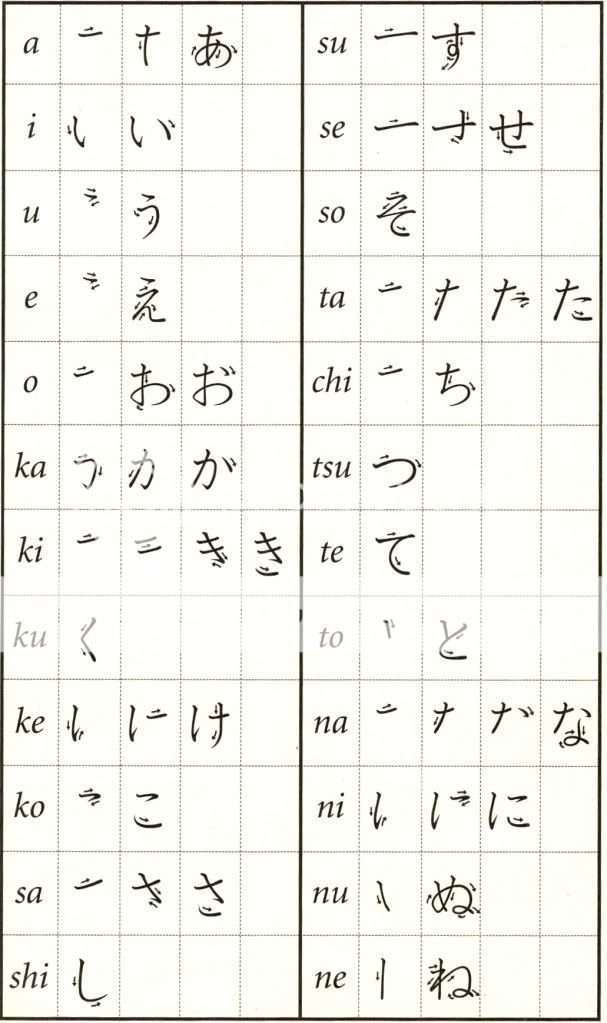
Post #3: Hiragana Writing Chart Part 1

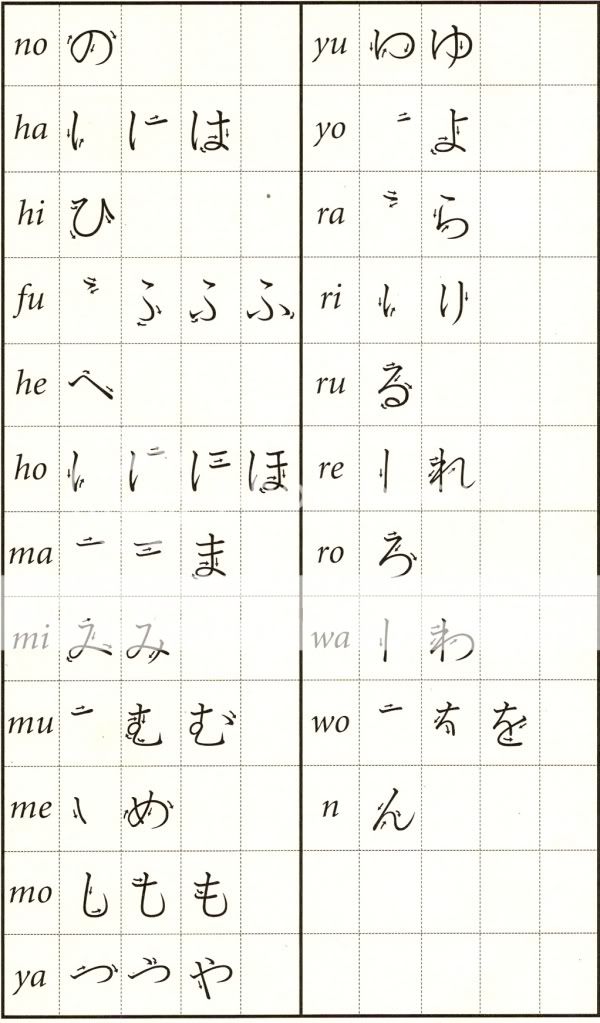
It may not seem important, however, you must follow a certain stroke when writing these characters. Also, learning to properly write them now will be better then having to relearn later.

For material to help you learn how to properly write hirigana are available in Post #6.

User Image
PostPosted: Sun Sep 20, 2009 8:50 pm


Post #4: Hiragana Writing Chart Part 2

User Image

OmniaVanitus
Captain

9,400 Points
  • Nudist Colony 200
  • The Perfect Setup 150
  • Risky Lifestyle 100

OmniaVanitus
Captain

9,400 Points
  • Nudist Colony 200
  • The Perfect Setup 150
  • Risky Lifestyle 100
PostPosted: Mon Sep 21, 2009 9:38 pm


Post #5: Examples

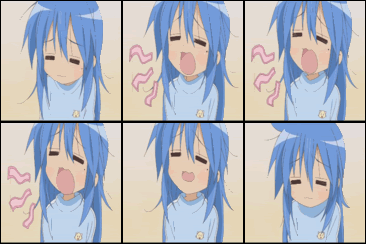
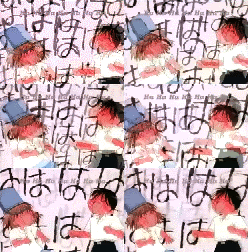
For those of you that enjoy reading manga, you can get a lot of practice reading hiragana and katakana. In the manga world, hiragana is used for onomatopoeia produced from humans, such as yawning and laughing, as seen in the examples below. Sounds that are cause as a result of human actions, like explosions, are written in katakana.

Example 1: Onomatopoeia: Yawn
User Image
ふわあ。
fuwaa...
(Onomatopoeia for a yawn.)

In manga, you would notice a つ character used quite often. It used to indicate that the sound stops abruptly or ends sharply. However, its rare to find this usage outside of manga/comic books.

Example 2a: Onomatopoeia: Laugh
User Image
あははははははははははは。
ahahahahahahahahahahaha
(Onomatopoeia for laugh.)

Example 2b: Onomatopoeia: Laugh
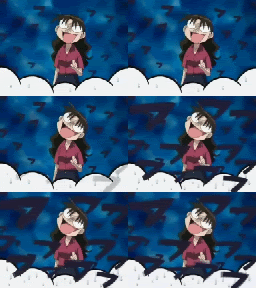
User Image
へへへへへへへへへへへへ。
hehehehehehehehehehehehe
(Onomatopoeia for laugh.)

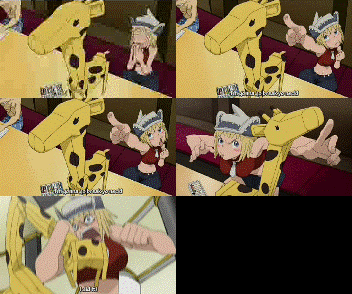
Example 3: Particles and Desinences
User Image
ぼくが壊した!
boku ga kowashita!
me SP break!
I broke it!

The hiragana syllabary is characteristically used to write the units that make up the "skeleton" of sentences and the desinence.

(ga) marks the subject.
ぼく boku ("I") performs the action.

The desinences tell us whether a verb is conjugated in the present tense, past tense, etc.

した (-shita) indicates past tense.
(kowa) is the kanji for "to break"
Thus, 壊した (kowashita) means broke.

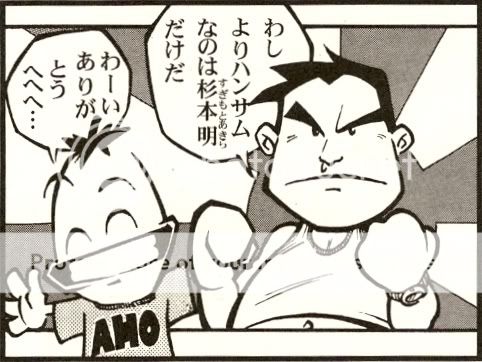
Example 4: Cohabitation of Hiragana, Katakana and Kanji

The best depiction of this is the one included in the Mangaland book. And, just a reminder, mangas are read in the traditional style, vertically and from right to left.
User Image

               すぎもとあきら
わしよりハンサムなのは杉本明だけだ
washi yori hansamu na no wa sugimoto akira dake da
I more handsome than sugimoto akira only be
Only Akira Sugimoto is more handsome than me.

わーい ありがとう へへへ。。。
waai arigato he he he...
wow! thanks he he he
Well thanks! He, he, he.

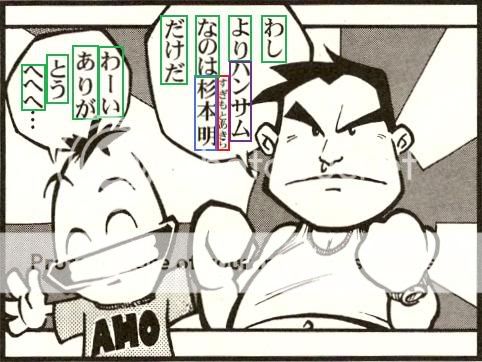
The break down:
User Image

Color Guide:
Green: Hiragana
Purple: Katakana
Blue: Kanji
Red: Furigana

As you can see, this example uses all three Japanese writing forms. The majority of the text is written in hiragana, with two exceptions. ハンサムHansamu, which comes from the English word handsome, is written in katakana, and 杉本明 Sugimoto Akira, written in kanji. Please note, that Japanese/Chinese names are almost always written in kanji.

I'm sure by now you may have also noticed the small hiragana characters above the kanji. These are furigana.

There is estimated to be over 45,000 to 50,000 kanji, however, only about 3,000 are normally used. With this in mind, there is a list (Jōyō Kanji or "common use kanji) which are those that can be used in the press, such as newspapers and manga. If a kanji is used that is not included on this list, then its reading must be given in furigana.

Side notes:
• Ahō (あほう) on the boys shirt means fool/silly.
• For Japanese names, the surname (or family name) is said first then the given namen (the name your parents give you).
• If you notice, wa here is written . Wa in this instance is a topic particle. The word it follows is the topic. We will go into particles later.
PostPosted: Mon Sep 21, 2009 9:39 pm


Post #6: Excersizes and Other Resources

If you need more help in understanding and learning hiragana, then try these Hiragana Lessons.

For those of you who would like to print something off (in addition to the Writing Charts) to help you learn how to write the characters, here is a free Kana Workbook. These Hiragana Worksheets are also available to print off for more writing practise.

If you are having trouble with the pronunciations of the syllables, then perhaps this Hiragana Song might help you.

Here are some Hiragana Drills you can practise with as well as a Hiragana Matching Game (Note: The game has four parts).

Do you have the characters memorized? Curious to see how well you can actually remember them? Then test your knowledge with this Hiragana Flash Card Game.

OmniaVanitus
Captain

9,400 Points
  • Nudist Colony 200
  • The Perfect Setup 150
  • Risky Lifestyle 100
Reply
Lessons

 
Manage Your Items
Other Stuff
Get GCash
Offers
Get Items
More Items
Where Everyone Hangs Out
Other Community Areas
Virtual Spaces
Fun Stuff
Gaia's Games
Mini-Games
Play with GCash
Play with Platinum