Welcome to Gaia! ::

Odd One Out

Back to Guilds

The sweet little slice of Gaia reserved for the bizarre, twisted, and/or bored. 

Tags: Random, Debate, Discussion, Chat, Competitions 

Reply The Roleplay Room
Character Creation Goto Page: 1 2 3 ... 4 5 6 [>] [»|]

Quick Reply

Enter both words below, separated by a space:

Can't read the text? Click here

Submit

Lionel the Omnipotent

Unbeatable Lunatic

PostPosted: Sun Sep 20, 2009 8:43 pm


Welcome! My name is Leo and I am here to play the role of the Dungeon Master (DM). As the DM, I will be hosting a roleplaying world for people to explore. Players may follow any story/quest I present them or create their own. However, participation requires a certain level of commitment, patience, and most of all, imagination.

I have played Dungeons and Dragons (D&D) for about five years. In that time I have never before played via forum posts but I feel mighty confident in making the endeavor work. To help make the experience simple, I will be using D&D 3.5 as that is what i have the most material and experience with, and we will be kicking off with basic races and classes.

If you have never played D&D that is okay, it is really not too hard, specially if you are all ready familiar with role playing games.

As the DM, I am the judge, jury, and executioner for the campaign. I try my best to run a fair game, just try not to forget that I am human and am prone to making mistakes. In the end, the game revolves around the players, so I try to facilitate one's character progressing through the story for the most fun possible, but without handing too many freebies. Remember, this is also a game of chance.

Now there is far too much information in my books for me to post in here so I will be posting some of the barest essentials. If there is anything here you would like me to expand on merely say so and I will happily share, or you may the follow the link below to a nice reference site to research some of the game's intricacies. I trust that all of you are intelligent enough to gather enough information from these abridged sources to join in the game.

The Hypertext d20 SRD

If you are wandering about other mechanics of the game, I will post various terms and rules but the best way to truly grasp the game is to dive right in. For the start of the campaign I will be walking everyone through certain steps and giving out hints, much like a tutorial at the start of a new video game. Of course after a while, I will be removing the training wheels.
wink


Being the Player

With a character, players get to jump into a fictional world and interact with it however they like. What makes this a game is that the factor of chance manipulates one's actions. This is done with the roll of the di. Primarily using a d20, players roll a di and add their modifiers that correspond to whatever action they wish to take. The sum is put against a difficulty check (DC) of some form. Roll below the DC and you fail, roll above it and you succeed. ¿Pretty simple right? Below are some examples.

Skills

You climbed up a tree to get out of sight of an Orc raiding party. You would need to roll a climb check against a DC of 10 to get up the tree. You then need to roll a Hide check agianst the Spot check of any Orc that may pass by and maybe look up at the trees.

Abilities

You want to get past a locked door. Rather than wait for someone to pick the lock, you can roll a Strength check to kick down the door and barge right in.

Roleplay

You need to convince a lord not to declare war on a neighboring kingdom. You would roll a Diplomacy check against the lord's Diplomacy score in order to get through to him. Fail and he gets more irrate.

Some non-playable character (NPC) is having trouble remembering his/her history and needs help with a report they have to present. You as a player obviously would not know all of the fictional world's history so you would roll a Knowledge check for your character as they may have remembered having that question on a grade school test.

Combat

D20s are rolled for attacks and are opposed by Armor Class (AC). Attack rolls are modded by a character's attack modifier, an ability score (strength for melee/thrown weapons, dexterity for projectile weapons), and any other special bonuses. When one's score exceeds their opponent's AC they proceed to roll damage. The di necessary to roll for damage varies from weapon to weapon.

You will also have saving throws to make against special attacks, spells, and traps. A dragon flying by expelling its fire breath down on you would require you to make a Reflex save. Succeed and you dove out in time and took cover behind a rock, fail and you get torched. A wizard trying to take control of your mind would require you to make a Will save against their spell. Succeed and you resist his/her magic, fail and you are under their control and may find yourself attacking your allies.

User Image
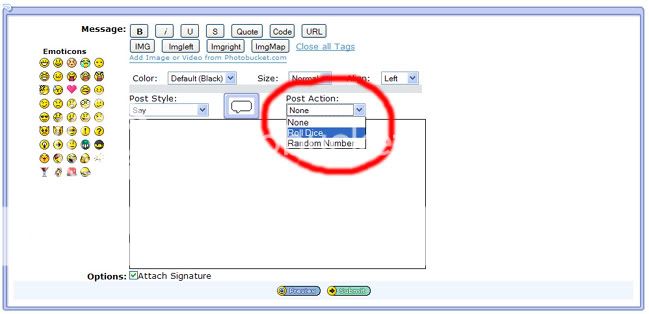
Thanks to the engineers behind the wonderful, world of Gaia, we can make our dice rolls within our forum posts. However, DM rolls are not openly visible as are player rolls.

Being the DM

As previously stated, the DM is the judge, jury, and executioner for the overall campaign. Yet no matter how much power is left to the DM, even he/she is given some boundaries in which to perform under. One such guideline is player character (PC) control. A player's character is their own to control. Neither a DM nor other player should assume control of another PC. There are however, two exceptions. Should a player be too inactive online, their character may be manipulated to aid the progress of the campaign. More than likely one's character will just be bowed out in some manner so that others may continue without him/her. The second exception, should a PC fall to a compulsory effect (mind control, fear, etc) they may lose control of their character.

To help ease the passing of information, I will be separating my posts in different post styles.

Background information regarding the fictional world and characters will be documented.
User Image

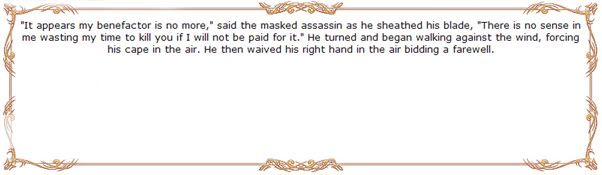
Story progression will be ornated.
User Image

Information regarding game rules and guidelines will be whispered.
User Image

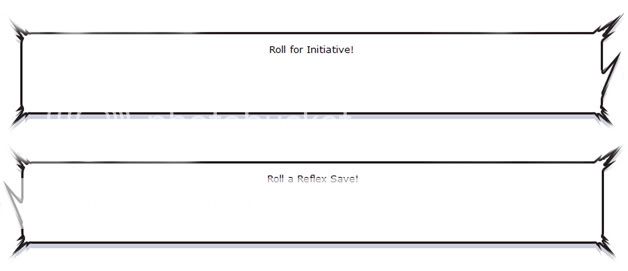
Actions required by players will be shouted.
User Image

And any time I make an out-of-game comment and/or ruling, the post will just be said.
User Image

Additionally, I will not be posting my signature in any of my posts, as it may turn out to be distracting. I will not require players to do the same.


Hopefully you will tag along and join us on what should hopefully be a fun-filled adventure. If you have any comments, question, complaints, or concerns, just holler.
PostPosted: Sun Sep 20, 2009 8:44 pm


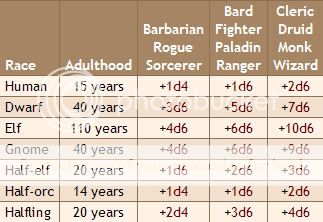
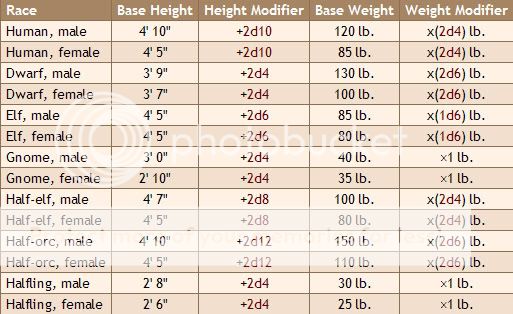
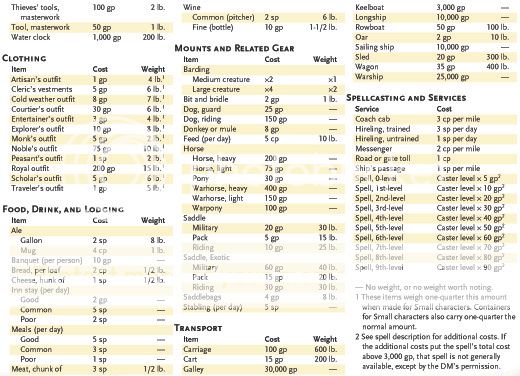
The first step in creating your character for its journey into epic awesomeness is brainstorming the race and class of your character. For this campaign we will be sticking to base races and classes. Should the selections feel limited, just try to keep in mind that in game nearly everything is possible. However, whatever it is you wish to obtain for your character may not be available right away so obviously you would have to quest for it, which is half the fun of course. Whatever the case, share with me what it is you want for a character so that I may help you build up to your ideal character.

Choose your race/class wisely as they each carry certain strengths and weaknesses.


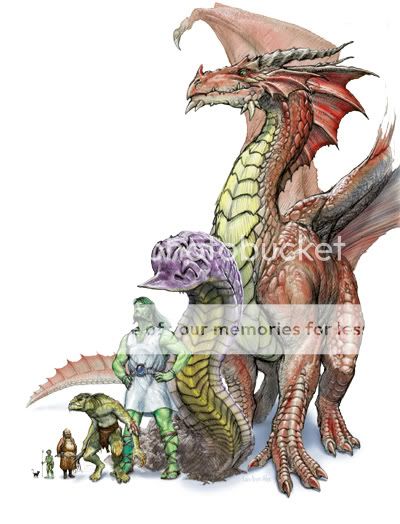
RACES


Human

Humans are the most adaptable, flexible, and ambitious people among the common races.
Human adventurers are the most audacious, daring, and ambitious members of an audacious, daring, and ambitious race. A human can earn glory in the eyes of ther fellows by amasing power, wealth, and fame. Humans, more than other people, champion causes rather than territoties or groups.
> Size: Medium
> Speed: 30 ft
> 1 extra feat at level 1
> 4 extra skill points at 1st level and 1 extra skill point at each additional level
> Favored Class: any

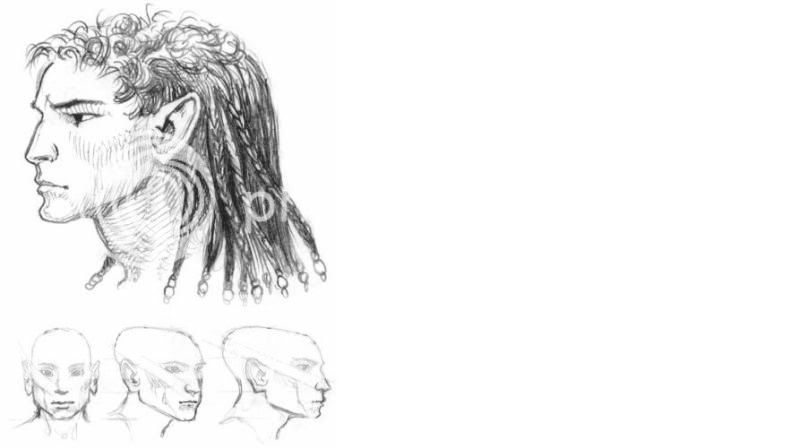
Elf
Elves take up adventuring out of wanderlust. Life among humans moves at a pace that elves dislike: regimented from day to day but changing from decade to decade. Elves among humans, therefore, find careers that allow them to wander freely and set their own pace. Elves also enjoy demonstrating their prowess with the sword and bow or gaining greater magical powers, and adventuring allows them to do so. Good elves may also be rebels or crusaders.
> +2 Dexterity, -2 Constitution
> Size: Medium
> Speed: 30 ft
> Low-Light Vision
> Weapon Proficiency: longsword, rapier, longbow, & shortbow
> +2 racial bonus to Listen, Search, and Spot
> +2 racial bonus verse enchantment spells or spell-like effects
> Immune to magic sleep effects
> Favored Class: Wizard

Half-Elf
Half-elves find themselves drawn to strange careers and unusual company. Taking up the life of an adventurer comes easily to many of them. Like elves, they are driven by wanderlust.
> Size: Medium
> Speed: 30 ft
> Low-Light Vision
> +1 racial bonus to Listen, Search, and Spot
> +2 racial bonus to Diplomacy and Gather Information
> Favored Class: Any

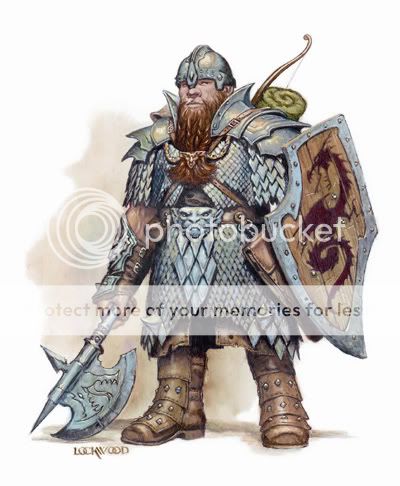
Dwarf

A dwarf adventurer may be motivated by crusading zeal, a love of excitement, or simple greed. As long as his accomplishments bring honor to his clan, his deeds earn him respect and status. Defeating giants and claiming powerful magic weapons are sure ways for a dwarf to earn the respect of other dwarves.
Dwarves are known for their skill in warfare, their ability to withstand physical and magical punishment, their knowledge of the earth's secrets, their hard work, and their capacity for drinking ale. Their mysterious kingdoms, carved out from the insides of mountains, are renowned for the marvelous treasures that they produce as gifts or for trade.
> +2 Constitution, -2 Charisma
> Size: Medium
> Speed: 20 ft However, Dwarves can move at this speed even when wearing medium or heavy armor or when carrying medium or heavy loads.
> Darkvision
> Weapon Proficiency: dwarven waraxes & dwarven urgroshes
> +2 racial bonus to Search checks to notice unusual stonework, such as sliding walls, stonework traps, new construction, unsafe stone surfaces, shaky stone ceilings, and the like.
> +4 bonus on ability checks made to resist being bull rushed or tripped when standing on the ground
> +2 racial bonus verse poison
> +2 racial bonus verse spells and spell-like effects
> +1 racial bonus on attack rolls against orcs and goblinoids
> +4 dodge bonus to Armor Class when against monsters of the giant type
> +2 racial bonus to Appraise checks related to stone or metal
> +2 racial bonus to Craft checks related to stone or metal
> Favored Class: Fighter
User Image

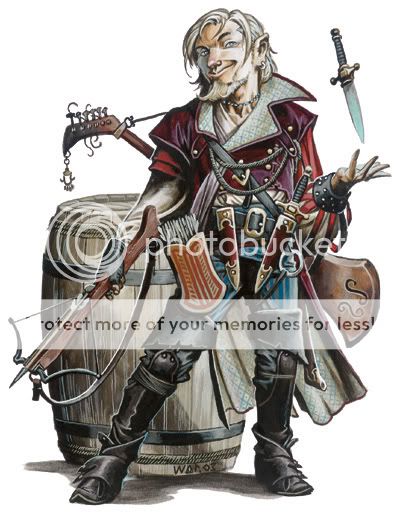
Halfling
Halflings are clever, capable opportunists that prefer trouble to boredom. Halfling individuals and clans find room for themselves wherever they can. Often they are strangers and wanderers, and others react to them with suspicion or curiosity. Depending on the clan, halflings might be reliable, hard-working citizens, or they might be thieves just waiting for the opportunity to make a big score and disappear in the dead of night. Regardless, halflings are cunning, resourceful survivors.
> +2 Dexterity, -2 Strength
> Size: Small
> Speed: 20 ft
> +2 racial bonus to Climb, Jump, Listen, and Move Silently
> +1 racial bonus to all saving throws
> +2 morale bonus on all saving throws against fear
> +1 racial bonus on attack rolls with thrown weapons and slings
> Favored Class: Rogue
User Image

Gnome
Gnomes are welcome everywhere as technicians, alchemists, and inventors. Despite the demand for their skills, most gnomes prefer to remain among their own kind, living in comfortable burrows beneath rolling, wooded hills where animals abound.
Gnomes are curious and impulsive. They may take up adventuring as a way to see the world or for the love of exploring.
> +2 Constitution, -2 Strength
> Size: Small
> Speed: 20 ft
> Low-Light Vision
> Weapon Proficiency: Hooked Hammers
> +2 racial bonus against all saving throws against illusions
> +1 to Difficulty Class for all illusions cast by gnomes
> +1 racial bonus on attack rolls against kobolds and goblinoids
> +4 dodge bonus to Armor Class when against monsters of the giant type
> +2 racial bonus to Listen and Craft (alchemy)
> Spell-Like Abilities: 1/day-speak with animals. Gnomes with a Charisma of at least 10 also gain 1/day-dancing lights, ghost sound, and prestidigitation.
> Favored Class: Bard
User Image

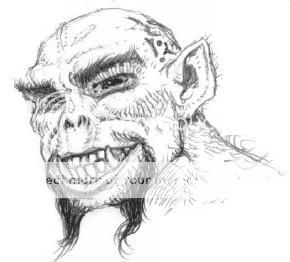
Half-Orc
Half-orcs tend to be short-tempered and sullen. They would rather act than ponder and would rather fight than argue. Those who are successful, however crazy ones. Half-orcs love simple pleasures such as feasting, drinking, boasting, singing, wrestling, drumming and wild dancing. Refined enjoyments such as poetry, courtly dancing, and philosophy are lost on them. At the right sort of party, a half-orc is an asset. At the duchess's grand ball, he's a liability.
> +2 Strength, -2 Intelligence, -2 Charisma
> Size: Medium
> Speed: 30 ft
> Darkvision
> Favored Class: Barbarian
User Image


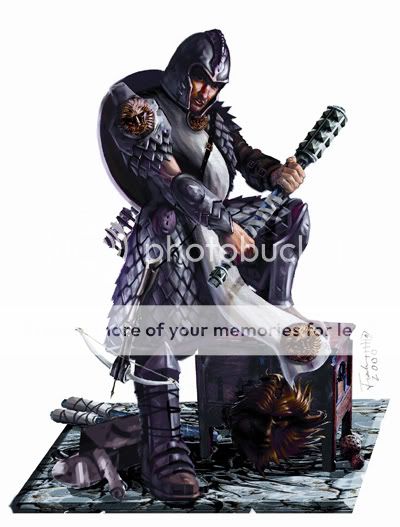
CLASSES

Barbarian

A ferocious warrior who uses fury and instinct to bring down foes.
Abilities include: Rage, Fast Movement, Uncanny Dodge (lvl 2), and Damage Reduction (lvl 7)
HD: d12
Can not bear a lawful alignment

Bard
A performer whose music works magic - a wanderer, a tale-teller, and a jack-of-all trades.
Abilities include: Bardic Music, Bardic Knowledge, & Arcane Spellcasting
HD: d6
Can not bear a lawful alignment

Cleric
A master of divine magic and a capable warrior as well.
Abilities include: Turn/Rebuke Undead & Divine Spellcasting
HD: d8
Alignment must be within one step of one's deity
User Image

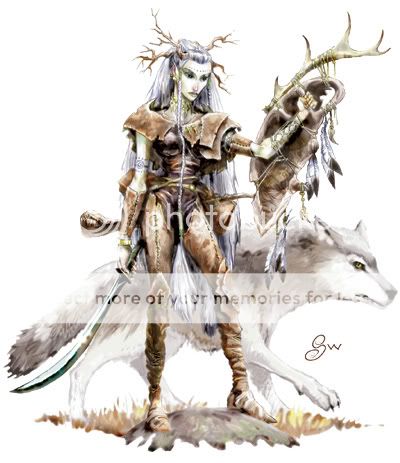
Druid
One who draw energy from the natural world to cast divine spells and gain strange magical powers.
Abilities include: Animal Companion, Wild Empathy, Wild Shape (lvl 5), & Divine Spellcasting
HD: d8
Must bear a partial neutral alignment
User Image

Fighter
A warrior with exceptional combat capability and unequaled skill with weapons.
Gains bonus feats
HD: d10

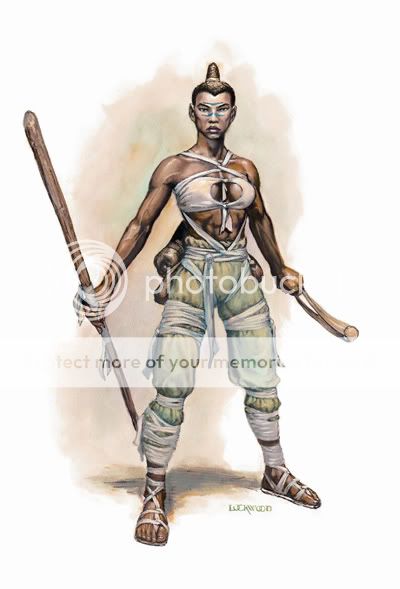
Monk
A martial artist whose unarmed strikes hit fast and hard - a master of exotic powers.
Abilities include: Flurry of Blows, Evasion (lvl 2), Ki Strike (lvl 4), & and gains bonus feats.
HD: d8
Must bear a lawful alignment
User Image

Paladin
A champion of justice and destroyer of evil, protected and strengthened by an array of divine powers.
Abilities include: Smite Evil, Detect Evil, Lay on Hands (lvl 2), Divine Spellcasting (lvl 4), & special mount (lvl 5)
HD: d10
Must bear a lawful good alignment

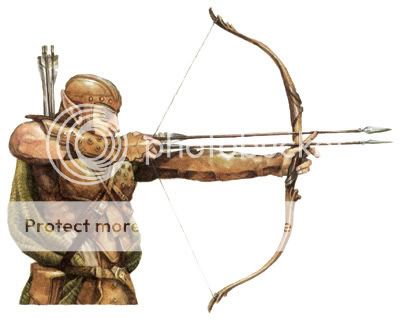
Ranger
A cunning, skilled warrior of the wilderness.
Abilities include: Track, Favored Enemy, Combat Style (lvl 2), and Divine Spellcasting (lvl 4)
HD: d8
User Image

Rogue
A tricky, skillful scout and spy who wins the battle by stealth rather than brute force.
Abilities include: Sneak Attack, Evasion (lvl 2), Trapfinding, & Uncanny Dodge (lvl 4)
HD: d6

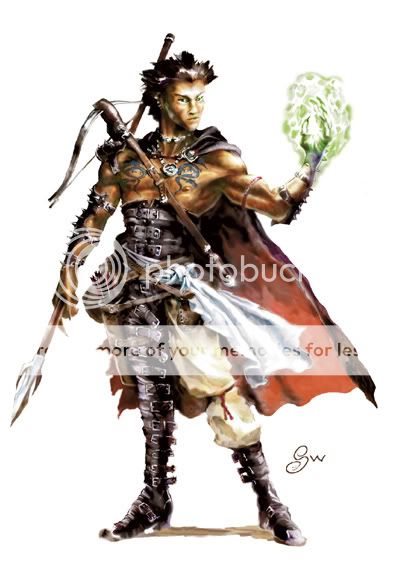
Sorcerer
A spellcaster with inborn magical ability.
Gains familiar and Arcane Spellcasting
HD: d4
User Image

Wizard
A potent spellcaster schooled in the arcane arts.
Gains familiar, Arcane Spellcasting, and bonus feats
HD: d4

Lionel the Omnipotent

Unbeatable Lunatic


Lionel the Omnipotent

Unbeatable Lunatic

PostPosted: Sun Sep 20, 2009 8:45 pm


Next you will be rolling statistics.

Do not feel bad if you have some low scores. Ability scores can be modified, either by magical means, natural progression, or racial benefits.

To quote one of my friends, "Low stats build character."

User Image

Using the die roll feature on your posts, you will roll 4d6 (four six-sided dice). Of the four rolls the lowest number will be eliminated, the three remaining numbers will be added together to make an ability score. You will do this seven times. Of the seven totals, the lowest total will be eliminated.

You will re-roll if the sum of your modifiers (more on modifiers later) equals zero or less, or if your highest score is thirteen.

You will apply your scores to the following six statistics:

Strength
Strength measures your character's muscle and physical power.
You apply your character's strength modifier to:
-Melee attack rolls
-Damage rolls involving melee and thrown weapons
-Climb, Jump, and Swim checks
-Strength checks (breaking down doors and other feats of strength)

Dexterity

Dexterity measures hand-eye coordination, agility, reflexes and balance.
You apply your character's dexterity modifier to:
-Ranged attack rolls
-Armor Class (AC)
-Reflex saving throws
-Balance, Tumble, and Ride checks

Constitution

Constitution represents your character's health and stamina.
You apply your character's constitution modifier to:
-Acquiring hit points
-Fortitude saving throws
-Concentration checks

Intelligence
Intelligence determines how well your character learns and reasons.
You apply your character's intelligence modifier to:
-Acquiring skill points
-Appraise, Search, Knowledge, and Spellcraft checks
-The number of languages known at the start of the game

Wisdom
Wisdom describes a character's willpower, common sense, perception, and intuition.
You apply your character's wisdom modifier to:
-Will saving throws
-Sense Motive, Heal, Survival, and Spot checks

Charisma
Charisma measures a character's force of personality, persuasiveness, personal magnetism, ability to lead, and physical attractiveness.
You apply your character's charisma modifier to:
-Bluff, Diplomacy, Intimidate, and Perform checks
-Turning checks (Clerics & Paladins)
PostPosted: Sun Sep 20, 2009 8:46 pm


SKILLS

The next step is selecting you skills.
User Image
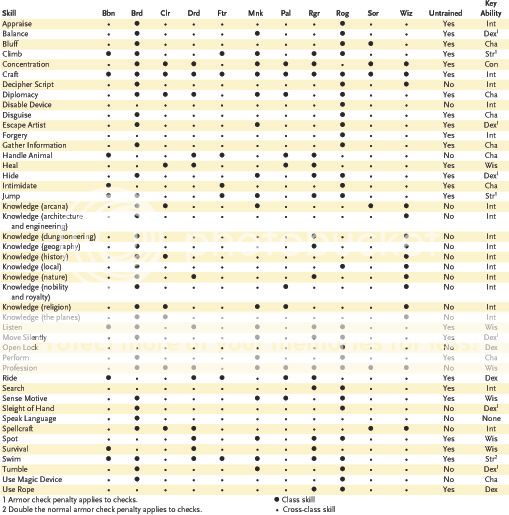
Skill points are assigned differently depending on your class and Intelligence score. Additionally, the points necessary to purchase ranks in a skill differ depending on your class. Some skills are more innate than others for some classes, investing in a skill outside of your class will cost twice as many skill points than something in your class. Each skill is also tied to, and modified by, one of the six abilities.

The amount of ranks you can have in a skill is your level + 3. Skills outside your class will be half that number. You will receive skill points at every level.

Below is a list of all the skills you may select from.

User Image

Appraise
Use this skill to tell an antique from old junk, a sword that is old and fancy from an elven heirloom, and high-quality jewelry from cheap stuff made to look good.

Balance

You can keep your balance while walking on a tightrope, a narrow beam, a slippery ledge, or an uneven floor.

Bluff
you can make the outrageous or the untrue seem plausible, or use doublespeak or innuendo to deliver a secret message to another character. The skill encompasses acting, conning, fast talking, misdirection, prevarication, and misleading body language. Use a bluff to sow temporary confusion, get someone to turn and look where you point, or simply look innocuous.

Climb
Use this skill to scale a cliff, to get to the window on the second story of a wizard's tower, or to climb out of a pit after falling through a trapdoor.

Concentration
You are particularly good at focusing your mind.

Craft
You are trained in a craft, trade, or art, such as alchemy, armorsmithing, basket weaving, bookbinding, bow making, blacksmithing, calligraphy, carpentry, cobbling, gem cutting, leather working, locksmithing, painting pottery, sculpting, shipmaking, stonemasonry, trapmaking, weaponsmitthing, or weaving.
A Craft skill is specifically focused on creating something. If nothing is created by the endeavor, it probably falls under the heading of a Profession skill.

Decipher Script
Use this skill to piece together the meaning of ancient runes carved into the wall of an abandoned temple, to get the gist of an intercepted letter written in the Infernal language, to follow the direction on a treasure map written in a forgotten alphabet, or to interpret the mysterious glyphs painted on a cave wall.

User Image
Diplomacy
Use this skill to persuade the chamberlain to let you see the king, to negotiate peace between feuding barbarian tribes, or to convince the ogre mages that have captured you that they should ransom you back to your friends instead of twisting your limbs off one by one. Diplomacy involves etiquette, social grace, tact, subtlety, and a way with words. A skilled character knows the formal and informal rules of conduct, social expectations, proper forms of address, and so on. This skill represents the ability to give others the right impression of yourself, to negotiate effectively, and to influence others.

Disable Device
Use this skill to disarm a trap, jam a lock, or rig a wagon wheel to fall off. You can examine a fairly simple or fairly small mechanical device and disable it. The effort requires at least a simple tool of the appropriate sort.

Disguise
Use this skill to change your own appearance or someone else's. The effort requires at least a few props, some makeup, and some time.

Escape Artist
Use this skill to slip out of bonds or manacles, wriggle through tight spaces, or escape the grip of a monster that grapples you.

Forgery
Use this skill to fake a written order from the duchess instructing a jailer to release prisoners, to create an authentic-looking treasure map, or to detect forgeries that others try to pass off.

Gather Information
Use this skill for making contacts in an area, finding out local gossip, rumor-mongering, and collecting general information.

User Image
Handle Animal

Use this skill to drive a team of horses pulling a wagon over rough terrain, to teach a dog to guard, or to teach a tyrannosaurus to "speak" on command.

Heal
Use this skill to keep badly wounded friend from dying, to help others recover faster from wounds, to keep your friend from succumbing to a wyvern's poison sting, or to treat a disease.

Hide
Use this skill to sink back into the shadows and proceed unseen, to approach a wizard's tower under cover of brush, or to tail someone through a busy street without being noticed.

Intimidate
Use this skill to get a bully to back down, to frighten an opponent, or to make a prisoner give you the information you want. Intimidation includes verbal threats and body language.

Jump
Use this skill to leap over its, vault low fences, or reach a tree's lowest branches.

Knowledge

Knowledge actually encompasses a number of unrelated skills. Knowledge represents a study of some body of lore, possibly an academic or even scientific discipline. Below are listed typical fields of study:
arcana, architect & engineering, dungeoneering, geography, history, local, nature, nobility & royalty, religion, the planes.

Listen
Use this skill to hear approaching enemies, to detect someone sneaking up on you from behind, or to eavesdrop on someone else's conversation.

Move Silently
you can use this skill to sneak up behind an enemy or to slink away without being noticed.

Open Lock
You can pick padlocks, finesse combination locks, and solve puzzle locks. The effort requires at least a simple tool of the appropriate sort.

Perform
You are skilled in a type of artistic expression, which may encompass a variety of specific methods, and you know how to put on a show. Each of the nine categories of the Perform skill includes a variety of methods, instruments, or techniques, a small list of which is provided for each category below:
act, comedy, dance, keyboard instruments, oratory, percussion instruments, string instruments, wind instruments, sing.

Profession
You are trained in a livelihood or a professional role, such as apothecary, boater, bookkeeper, brewer, cook, driver, farmer, fisher, guide, herbalist, herder, hunter, innkeeper, lumberjack, miller, miner, porter, rancher, sailor, scribe, siege engineer, stable-hand, tanner, teamster, woodcutter, or the like.
While a Craft skill represents ability in creating or making an item, a Profession skill represents an aptitude in a vocation requiring a broader range of less specific knowledge.

User Image
Ride
You can ride a mount, be it a horse, riding dog, griffon, dragon, or some other kind of creature suited for riding.

Search

You can find secret doors, simple traps, hidden compartments, and other details not readily apparent. The Spot skill lets you notice something, such as a hiding rogue. The Search skill lets a character discern some small detail or irregularity through active effort.

Sense Motive
Use this skill to tell when someone is bluffing you, to discern hidden messages in conversation, or to sense when someone is being magically influenced. This skill represents sensitivity to the body language, speech habits, and mannerisms of others.

Sleight of Hand
You can cut or lift a purse and hide it on your person, palm an unattended object, hide a light weapon in your clothing, or perform some feat of legerdemain with an object no larger than a hat or a loaf of bread.

Speak Language
You start at first level knowing one or two languages, plus an additional number of languages equal to your starting Intelligence bonus. you can purchase Speak Language just like any other skill but instead of buying a rank in it, you choose a new language that you can speak. You do not make Speak Language checks. You either know a language or you don't.

Spellcraft
Use this skill to identify spells as they are cast or spells already in place.

Spot
Use this skill to notice bandits waiting in ambush, to see a rogue lurking in the alley, to see through a disguise, or read lips, or to see the monstrous centipede in the pile of trash.

Survival
Use this skill to follow tracks, hunt wild game, guide a party safely through frozen wastelands, identify signs that owlbears live nearby, predict the weather, or avoid quicksand and other natural hazards.

Swim
Using this skill, a land-based creature can swim, dive, navigate underwater obstacles, and so on.

Tumble
You can dive, roll, somersault, flip, and so on.

User Image
Use Magic Device
Use this skill to activate magic devices, including scrolls and wands, that you could not otherwise activate.

Use Rope
With this skill, you can make firm knots, undo tricky knots, and bind prisoners with ropes.

Lionel the Omnipotent

Unbeatable Lunatic


Lionel the Omnipotent

Unbeatable Lunatic

PostPosted: Sun Sep 20, 2009 8:46 pm


FEATS

Welcome to step four: feats.

User Image

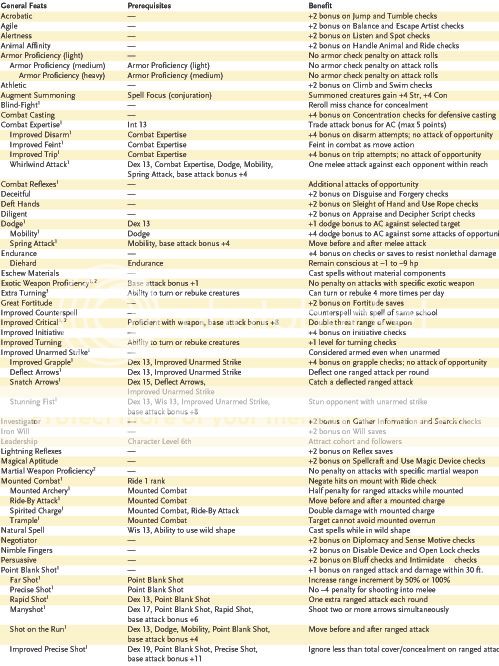
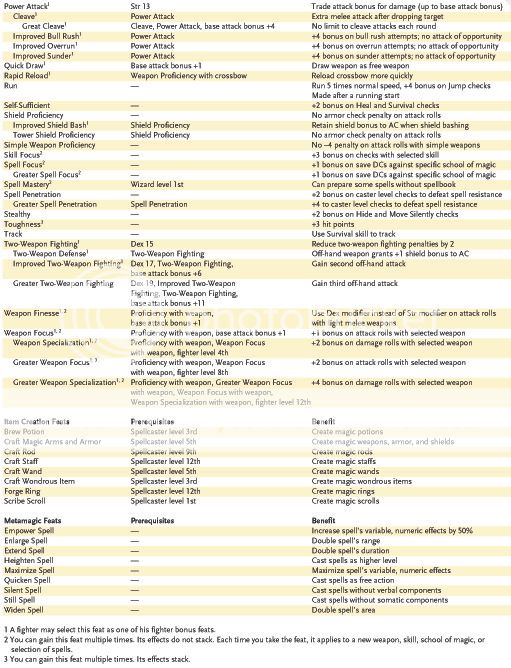
Unlike skills, feat are not bought with points. A player simply chooses them for his or her character. Each character gets one feat upon creation. At 3rd level and every three levels thereafter. Feats are gained according to character level, regardless of individual class levels.

Additionally, members of some classes get bonus feats as class features. These feats may be chosen from special lists.

Some feats have prerequisites. Your character must have the indicated ability score, class feature, feat, skill, base attack bonus, or other quality designated in order to select or use that feat.

Some feats are general, meaning that no special rules govern them as a group. Others are item creation feats, which allow spellcasters to create magic items of all sorts. A metamagic feat lets a spellcaster prepare and cast a spell with greater effect, albeit as if the spell were a higher spell level than it actually is.
User Image
User Image

Acrobatic [General]
You get a +2 bonus on all Jump checks and Tumble checks.

Agile [General]
You get a +2 bonus on all Balance checks and Escape Artist checks.

Alertness [General]
You get a +2 bonus on all Listen checks and Spot checks.

Animal Affinity [General]
You get a +2 bonus on all Handle Animal checks and Ride checks.

Armor Proficiency (Light) [General]
When you wear a type of armor with which you are proficient, the armor check penalty for that armor applies only to Balance, Climb, Escape Artist, Hide, Jump, Move Silently, Sleight of Hand, and Tumble checks.

A character who is wearing armor with which she is not proficient applies its armor check penalty to attack rolls and to all skill checks that involve moving, including Ride.

All characters except wizards, sorcerers, and monks automatically have Armor Proficiency (light) as a bonus feat. They need not select it.

Armor Proficiency (Heavy) [General]
Prerequisites
Armor Proficiency (light), Armor Proficiency (medium).

Fighters, paladins, and clerics automatically have Armor Proficiency (heavy) as a bonus feat. They need not select it.


Armor Proficiency (Medium) [General]
Prerequisite
Armor Proficiency (light).

Fighters, barbarians, paladins, clerics, druids, and bards automatically have Armor Proficiency (medium) as a bonus feat. They need not select it.

Athletic [General]
You get a +2 bonus on all Climb checks and Swim checks.

Augment Summoning [General]
Prerequisite
Spell Focus (conjuration).

Each creature you conjure with any summon spell gains a +4 enhancement bonus to Strength and Constitution for the duration of the spell that summoned it.

Blind-Fight [General]
In melee, every time you miss because of concealment, you can reroll your miss chance percentile roll one time to see if you actually hit.

An invisible attacker gets no advantages related to hitting you in melee. That is, you don’t lose your Dexterity bonus to Armor Class, and the attacker doesn’t get the usual +2 bonus for being invisible. The invisible attacker’s bonuses do still apply for ranged attacks, however.

You take only half the usual penalty to speed for being unable to see. Darkness and poor visibility in general reduces your speed to three-quarters normal, instead of one-half.

Regular attack roll modifiers for invisible attackers trying to hit you apply, and you lose your Dexterity bonus to AC. The speed reduction for darkness and poor visibility also applies.

A fighter may select Blind-Fight as one of his fighter bonus feats.

Brew Potion [Item Creation]
Prerequisite
Caster level 3rd.

You can create a potion of any 3rd-level or lower spell that you know and that targets one or more creatures. Brewing a potion takes one day. When you create a potion, you set the caster level, which must be sufficient to cast the spell in question and no higher than your own level. The base price of a potion is its spell level × its caster level × 50 gp. To brew a potion, you must spend 1/25 of this base price in XP and use up raw materials costing one half this base price.

When you create a potion, you make any choices that you would normally make when casting the spell. Whoever drinks the potion is the target of the spell.

Any potion that stores a spell with a costly material component or an XP cost also carries a commensurate cost. In addition to the costs derived from the base price, you must expend the material component or pay the XP when creating the potion.

Cleave [General]
Prerequisites
Str 13, Power Attack.

If you deal a creature enough damage to make it drop (typically by dropping it to below 0 hit points or killing it), you get an immediate, extra melee attack against another creature within reach. You cannot take a 5-foot step before making this extra attack. The extra attack is with the same weapon and at the same bonus as the attack that dropped the previous creature. You can use this ability once per round.

A fighter may select Cleave as one of his fighter bonus feats.

Combat Casting [General]
You get a +4 bonus on Concentration checks made to cast a spell or use a spell-like ability while on the defensive or while you are grappling or pinned.

Combat Expertise [General]
Prerequisite
Int 13.

When you use the attack action or the full attack action in melee, you can take a penalty of as much as -5 on your attack roll and add the same number (+5 or less) as a dodge bonus to your Armor Class. This number may not exceed your base attack bonus. The changes to attack rolls and Armor Class last until your next action.

A character without the Combat Expertise feat can fight defensively while using the attack or full attack action to take a -4 penalty on attack rolls and gain a +2 dodge bonus to Armor Class.

A fighter may select Combat Expertise as one of his fighter bonus feats.

Combat Reflexes [General]
You may make a number of additional attacks of opportunity equal to your Dexterity bonus.

With this feat, you may also make attacks of opportunity while flat-footed.

A character without this feat can make only one attack of opportunity per round and can’t make attacks of opportunity while flat-footed.

A fighter may select Combat Reflexes as one of his fighter bonus feats.

A monk may select Combat Reflexes as a bonus feat at 2nd level.

Craft Magic Arms And Armor [Item Creation]
Prerequisite
Caster level 5th.

You can create any magic weapon, armor, or shield whose prerequisites you meet. Enhancing a weapon, suit of armor, or shield takes one day for each 1,000 gp in the price of its magical features. To enhance a weapon, suit of armor, or shield, you must spend 1/25 of its features’ total price in XP and use up raw materials costing one-half of this total price.

The weapon, armor, or shield to be enhanced must be a masterwork item that you provide. Its cost is not included in the above cost.

You can also mend a broken magic weapon, suit of armor, or shield if it is one that you could make. Doing so costs half the XP, half the raw materials, and half the time it would take to craft that item in the first place.

Craft Rod [Item Creation]
Prerequisite
Caster level 9th.

You can create any rod whose prerequisites you meet. Crafting a rod takes one day for each 1,000 gp in its base price. To craft a rod, you must spend 1/25 of its base price in XP and use up raw materials costing one-half of its base price.

Some rods incur extra costs in material components or XP, as noted in their descriptions. These costs are in addition to those derived from the rod’s base price.

Craft Staff [Item Creation]
Prerequisite
Caster level 12th.

You can create any staff whose prerequisites you meet.

Crafting a staff takes one day for each 1,000 gp in its base price. To craft a staff, you must spend 1/25 of its base price in XP and use up raw materials costing one-half of its base price. A newly created staff has 50 charges.

Some staffs incur extra costs in material components or XP, as noted in their descriptions. These costs are in addition to those derived from the staff’s base price.

Craft Wand [Item Creation]
Prerequisite
Caster level 5th.

You can create a wand of any 4th-level or lower spell that you know. Crafting a wand takes one day for each 1,000 gp in its base price. The base price of a wand is its caster level × the spell level × 750 gp. To craft a wand, you must spend 1/25 of this base price in XP and use up raw materials costing one-half of this base price. A newly created wand has 50 charges.

Any wand that stores a spell with a costly material component or an XP cost also carries a commensurate cost. In addition to the cost derived from the base price, you must expend fifty copies of the material component or pay fifty times the XP cost.

User Image
Craft Wondrous Item [Item Creation]
Prerequisite
Caster level 3rd.

You can create any wondrous item whose prerequisites you meet. Enchanting a wondrous item takes one day for each 1,000 gp in its price. To enchant a wondrous item, you must spend 1/25 of the item’s price in XP and use up raw materials costing half of this price.

You can also mend a broken wondrous item if it is one that you could make. Doing so costs half the XP, half the raw materials, and half the time it would take to craft that item in the first place.

Some wondrous items incur extra costs in material components or XP, as noted in their descriptions. These costs are in addition to those derived from the item’s base price. You must pay such a cost to create an item or to mend a broken one.

Deceitful [General]
You get a +2 bonus on all Disguise checks and Forgery checks.

Deflect Arrows [General]
Prerequisites
Dex 13, Improved Unarmed Strike.

You must have at least one hand free (holding nothing) to use this feat. Once per round when you would normally be hit with a ranged weapon, you may deflect it so that you take no damage from it. You must be aware of the attack and not flat-footed.

Attempting to deflect a ranged weapon doesn’t count as an action. Unusually massive ranged weapons and ranged attacks generated by spell effects can’t be deflected.

A monk may select Deflect Arrows as a bonus feat at 2nd level, even if she does not meet the prerequisites.

A fighter may select Deflect Arrows as one of his fighter bonus feats.

Deft Hands [General]
You get a +2 bonus on all Sleight of Hand checks and Use Rope checks.

Diehard [General]
Prerequisite
Endurance

When reduced to between -1 and -9 hit points, you automatically become stable. You don’t have to roll d% to see if you lose 1 hit point each round.

When reduced to negative hit points, you may choose to act as if you were disabled, rather than dying. You must make this decision as soon as you are reduced to negative hit points (even if it isn’t your turn). If you do not choose to act as if you were disabled, you immediately fall unconscious.

When using this feat, you can take either a single move or standard action each turn, but not both, and you cannot take a full round action. You can take a move action without further injuring yourself, but if you perform any standard action (or any other action deemed as strenuous, including some free actions, swift actions, or immediate actions, such as casting a quickened spell) you take 1 point of damage after completing the act. If you reach -10 hit points, you immediately die.


A character without this feat who is reduced to between -1 and -9 hit points is unconscious and dying.

Diligent [General]
You get a +2 bonus on all Appraise checks and Decipher Script checks.

Dodge [General]
Prerequisite
Dex 13

During your action, you designate an opponent and receive a +1 dodge bonus to Armor Class against attacks from that opponent. You can select a new opponent on any action.

A condition that makes you lose your Dexterity bonus to Armor Class (if any) also makes you lose dodge bonuses. Also, dodge bonuses stack with each other, unlike most other types of bonuses.


A fighter may select Dodge as one of his fighter bonus feats.

Empower Spell [Metamagic]
All variable, numeric effects of an empowered spell are increased by one-half.

Saving throws and opposed rolls are not affected, nor are spells without random variables. An empowered spell uses up a spell slot two levels higher than the spell’s actual level.

Endurance [General]
You gain a +4 bonus on the following checks and saves: Swim checks made to resist nonlethal damage, Constitution checks made to continue running, Constitution checks made to avoid nonlethal damage from a forced march, Constitution checks made to hold your breath, Constitution checks made to avoid nonlethal damage from starvation or thirst, Fortitude saves made to avoid nonlethal damage from hot or cold environments, and Fortitude saves made to resist damage from suffocation. Also, you may sleep in light or medium armor without becoming fatigued.


A character without this feat who sleeps in medium or heavier armor is automatically fatigued the next day.

A ranger automatically gains Endurance as a bonus feat at 3rd level. He need not select it.

Enlarge Spell [Metamagic]
You can alter a spell with a range of close, medium, or long to increase its range by 100%. An enlarged spell with a range of close now has a range of 50 ft. + 5 ft./level, while medium-range spells have a range of 200 ft. + 20 ft./level and long-range spells have a range of 800 ft. + 80 ft./level. An enlarged spell uses up a spell slot one level higher than the spell’s actual level.

Spells whose ranges are not defined by distance, as well as spells whose ranges are not close, medium, or long, do not have increased ranges.

Eschew Materials [General]
You can cast any spell that has a material component costing 1 gp or less without needing that component. (The casting of the spell still provokes attacks of opportunity as normal.) If the spell requires a material component that costs more than 1 gp, you must have the material component at hand to cast the spell, just as normal.

Exotic Weapon Proficiency [General]
Choose a type of exotic weapon. You understand how to use that type of exotic weapon in combat.
Prerequisite
Base attack bonus +1 (plus Str 13 for b*****d sword or dwarven waraxe).

You make attack rolls with the weapon normally.

A character who uses a weapon with which he or she is not proficient takes a -4 penalty on attack rolls.

You can gain Exotic Weapon Proficiency multiple times. Each time you take the feat, it applies to a new type of exotic weapon. Proficiency with the b*****d sword or the dwarven waraxe has an additional prerequisite of Str 13.

A fighter may select Exotic Weapon Proficiency as one of his fighter bonus feats.

Extend Spell [Metamagic]
An extended spell lasts twice as long as normal. A spell with a duration of concentration, instantaneous, or permanent is not affected by this feat. An extended spell uses up a spell slot one level higher than the spell’s actual level.

Extra Turning [General]
Prerequisite
Ability to turn or rebuke creatures.

Each time you take this feat, you can use your ability to turn or rebuke creatures four more times per day than normal.

If you have the ability to turn or rebuke more than one kind of creature each of your turning or rebuking abilities gains four additional uses per day.

Without this feat, a character can typically turn or rebuke undead (or other creatures) a number of times per day equal to 3 + his or her Charisma modifier.

You can gain Extra Turning multiple times. Its effects stack. Each time you take the feat, you can use each of your turning or rebuking abilities four additional times per day.

Far Shot [General]
Prerequisite
Point Blank Shot

When you use a projectile weapon, such as a bow, its range increment increases by one-half (multiply by 1½). When you use a thrown weapon, its range increment is doubled.

A fighter may select Far Shot as one of his fighter bonus feats.

Forge Ring [Item Creation]
Prerequisite
Caster level 12th.

You can create any ring whose prerequisites you meet. Crafting a ring takes one day for each 1,000 gp in its base price. To craft a ring, you must spend 1/25 of its base price in XP and use up raw materials costing one-half of its base price.

You can also mend a broken ring if it is one that you could make. Doing so costs half the XP, half the raw materials, and half the time it would take to forge that ring in the first place.

Some magic rings incur extra costs in material components or XP, as noted in their descriptions. You must pay such a cost to forge such a ring or to mend a broken one.

Great Cleave [General]

Prerequisites
Str 13, Cleave, Power Attack, base attack bonus +4.

This feat works like Cleave, except that there is no limit to the number of times you can use it per round.

A fighter may select Great Cleave as one of his fighter bonus feats.

Great Fortitude [General]
You get a +2 bonus on all Fortitude saving throws.

Greater Spell Focus [General]
Choose a school of magic to which you already have applied the Spell Focus feat.

Add +1 to the Difficulty Class for all saving throws against spells from the school of magic you select. This bonus stacks with the bonus from Spell Focus.

You can gain this feat multiple times. Its effects do not stack. Each time you take the feat, it applies to a new school of magic to which you already have applied the Spell Focus feat.

Greater Spell Penetration [General]
Prerequisite
Spell Penetration.

You get a +2 bonus on caster level checks (1d20 + caster level) made to overcome a creature’s spell resistance. This bonus stacks with the one from Spell Penetration.

Greater Two-Weapon Fighting [General]
Prerequisites
Dex 19, Improved Two-Weapon Fighting, Two-Weapon Fighting, base attack bonus +11.

You get a third attack with your off-hand weapon, albeit at a -10 penalty. See the Two-Weapon Fighting special attack.

A fighter may select Greater Two-Weapon Fighting as one of his fighter bonus feats.

An 11th-level ranger who has chosen the two-weapon combat style is treated as having Greater Two-Weapon Fighting, even if he does not have the prerequisites for it, but only when he is wearing light or no armor.

Greater Weapon Focus [General]
Choose one type of weapon for which you have already selected Weapon Focus. You can also choose unarmed strike or grapple as your weapon for purposes of this feat.

Prerequisites
Proficiency with selected weapon, Weapon Focus with selected weapon, fighter level 8th.

You gain a +1 bonus on all attack rolls you make using the selected weapon. This bonus stacks with other bonuses on attack rolls, including the one from Weapon Focus (see below).

You can gain Greater Weapon Focus multiple times. Its effects do not stack. Each time you take the feat, it applies to a new type of weapon.

A fighter must have Greater Weapon Focus with a given weapon to gain the Greater Weapon Specialization feat for that weapon.

A fighter may select Greater Weapon Focus as one of his fighter bonus feats.

Greater Weapon Specialization [General]
Choose one type of weapon for which you have already selected Weapon Specialization. You can also choose unarmed strike or grapple as your weapon for purposes of this feat.

Prerequisites
Proficiency with selected weapon, Greater Weapon Focus with selected weapon, Weapon Focus with selected weapon, Weapon Specialization with selected weapon, fighter level 12th.

You gain a +2 bonus on all damage rolls you make using the selected weapon. This bonus stacks with other bonuses on damage rolls, including the one from Weapon Specialization (see below).

You can gain Greater Weapon Specialization multiple times. Its effects do not stack. Each time you take the feat, it applies to a new type of weapon.

A fighter may select Greater Weapon Specialization as one of his fighter bonus feats.

Heighten Spell [Metamagic]
A heightened spell has a higher spell level than normal (up to a maximum of 9th level). Unlike other metamagic feats, Heighten Spell actually increases the effective level of the spell that it modifies. All effects dependent on spell level (such as saving throw DCs and ability to penetrate a lesser globe of invulnerability) are calculated according to the heightened level. The heightened spell is as difficult to prepare and cast as a spell of its effective level.

Improved Bull Rush [General]
Prerequisites
Str 13, Power Attack.

When you perform a bull rush you do not provoke an attack of opportunity from the defender. You also gain a +4 bonus on the opposed Strength check you make to push back the defender.

A fighter may select Improved Bull Rush as one of his fighter bonus feats.

Improved Counterspell [General]
When counterspelling, you may use a spell of the same school that is one or more spell levels higher than the target spell.

Without this feat, you may counter a spell only with the same spell or with a spell specifically designated as countering the target spell.

Improved Critical [General]
Choose one type of weapon.
Prerequisite
Proficient with weapon, base attack bonus +8.

When using the weapon you selected, your threat range is doubled.

You can gain Improved Critical multiple times. The effects do not stack. Each time you take the feat, it applies to a new type of weapon.

This effect doesn’t stack with any other effect that expands the threat range of a weapon.

A fighter may select Improved Critical as one of his fighter bonus feats.

Improved Disarm [General]
Prerequisites
Int 13, Combat Expertise.

You do not provoke an attack of opportunity when you attempt to disarm an opponent, nor does the opponent have a chance to disarm you. You also gain a +4 bonus on the opposed attack roll you make to disarm your opponent.

A fighter may select Improved Disarm as one of his fighter bonus feats.

A monk may select Improved Disarm as a bonus feat at 6th level, even if she does not meet the prerequisites.

Improved Familiar [General]
This feat allows spellcasters to acquire a new familiar from a nonstandard list, but only when they could normally acquire a new familiar.
Prerequisites
Ability to acquire a new familiar, compatible alignment, sufficiently high level (see below).

The spellcaster may choose a familiar with an alignment up to one step away on each of the alignment axes (lawful through chaotic, good through evil).

Improved familiars otherwise use the rules for regular familiars, with two exceptions: If the creature’s type is something other than animal, its type does not change; and improved familiars do not gain the ability to speak with other creatures of their kind (although many of them already have the ability to communicate).

The list in Table: Improved Familiar by Alignment presents only a few possible improved familiars. Almost any creature of the same general size and power as those on the list makes a suitable familiar. Nor is the master’s alignment the only possible categorization. For instance, improved familiars could be assigned by the master’s creature type or subtype, as shown in Table: Improved Familiar by Type/Subtype.

Improved Feint [General]
Prerequisites
Int 13, Combat Expertise.

You can make a Bluff check to feint in combat as a move action.

Feinting in combat is a standard action.

A fighter may select Improved Feint as one of his fighter bonus feats.

Improved Grapple [General]
Prerequisites
Dex 13, Improved Unarmed Strike.

You do not provoke an attack of opportunity when you make a touch attack to start a grapple. You also gain a +4 bonus on all grapple checks, regardless of whether you started the grapple.

Without this feat, you provoke an attack of opportunity when you make a touch attack to start a grapple.

A fighter may select Improved Grapple as one of his fighter bonus feats.

A monk may select Improved Grapple as a bonus feat at 1st level, even if she does not meet the prerequisites.

Improved Initiative [General]

You get a +4 bonus on initiative checks.

A fighter may select Improved Initiative as one of his fighter bonus feats.

Improved Overrun [General]
Prerequisites
Str 13, Power Attack.

When you attempt to overrun an opponent, the target may not choose to avoid you. You also gain a +4 bonus on your Strength check to knock down your opponent.

Without this feat, the target of an overrun can choose to avoid you or to block you.

A fighter may select Improved Overrun as one of his fighter bonus feats.

Improved Precise Shot [General]
Prerequisites
Dex 19, Point Blank Shot, Precise Shot, base attack bonus +11.

Your ranged attacks ignore the AC bonus granted to targets by anything less than total cover, and the miss chance granted to targets by anything less than total concealment. Total cover and total concealment provide their normal benefits against your ranged attacks.

In addition, when you shoot or throw ranged weapons at a grappling opponent, you automatically strike at the opponent you have chosen.

See the normal rules on the effects of cover and concealment. Without this feat, a character who shoots or throws a ranged weapon at a target involved in a grapple must roll randomly to see which grappling combatant the attack strikes.

A fighter may select Improved Precise Shot as one of his fighter bonus feats.

An 11th-level ranger who has chosen the archery combat style is treated as having Improved Precise Shot, even if he does not have the prerequisites for it, but only when he is wearing light or no armor.

Improved Shield Bash [General]
Prerequisite
Shield Proficiency.

When you perform a shield bash, you may still apply the shield’s shield bonus to your AC.

Without this feat, a character who performs a shield bash loses the shield’s shield bonus to AC until his or her next turn.

A fighter may select Improved Shield Bash as one of his fighter bonus feats.

Improved Sunder [General]

Prerequisites
Str 13, Power Attack.

When you strike at an object held or carried by an opponent (such as a weapon or shield), you do not provoke an attack of opportunity.

You also gain a +4 bonus on any attack roll made to attack an object held or carried by another character.

Without this feat, you provoke an attack of opportunity when you strike at an object held or carried by another character.

A fighter may select Improved Sunder as one of his fighter bonus feats.

Improved Trip [General]
Prerequisites
Int 13, Combat Expertise.

You do not provoke an attack of opportunity when you attempt to trip an opponent while you are unarmed. You also gain a +4 bonus on your Strength check to trip your opponent.

If you trip an opponent in melee combat, you immediately get a melee attack against that opponent as if you hadn’t used your attack for the trip attempt.

Without this feat, you provoke an attack of opportunity when you attempt to trip an opponent while you are unarmed.

At 6th level, a monk may select Improved Trip as a bonus feat, even if she does not have the prerequisites.

A fighter may select Improved Trip as one of his fighter bonus feats.
User Image
Improved Turning [General]

Prerequisite
Ability to turn or rebuke creatures.

You turn or rebuke creatures as if you were one level higher than you are in the class that grants you the ability.

Improved Two-Weapon Fighting [General]

Prerequisites
Dex 17, Two-Weapon Fighting, base attack bonus +6.

In addition to the standard single extra attack you get with an off-hand weapon, you get a second attack with it, albeit at a -5 penalty. See the Two-Weapon Fighting special attack.

Without this feat, you can only get a single extra attack with an off-hand weapon.

A fighter may select Improved Two-Weapon Fighting as one of his fighter bonus feats.

A 6th-level ranger who has chosen the two-weapon combat style is treated as having Improved Two-Weapon Fighting, even if he does not have the prerequisites for it, but only when he is wearing light or no armor.
Improved Unarmed Strike [General]
You are considered to be armed even when unarmed —that is, you do not provoke attacks or opportunity from armed opponents when you attack them while unarmed. However, you still get an attack of opportunity against any opponent who makes an unarmed attack on you.

In addition, your unarmed strikes can deal lethal or nonlethal damage, at your option.

Without this feat, you are considered unarmed when attacking with an unarmed strike, and you can deal only nonlethal damage with such an attack.

A monk automatically gains Improved Unarmed Strike as a bonus feat at 1st level. She need not select it.

A fighter may select Improved Unarmed Strike as one of his fighter bonus feats.

Investigator [General]

You get a +2 bonus on all Gather Information checks and Search checks.

Iron Will [General]

You get a +2 bonus on all Will saving throws.

Leadership [General]

Prerequisite
Character level 6th.

Having this feat enables the character to attract loyal companions and devoted followers, subordinates who assist her. See the table below for what sort of cohort and how many followers the character can recruit.
Leadership Score

A character’s base Leadership score equals his level plus any Charisma modifier. In order to take into account negative Charisma modifiers, this table allows for very low Leadership scores, but the character must still be 6th level or higher in order to gain the Leadership feat. Outside factors can affect a character’s Leadership score.

The character can attract a cohort of up to this level. Regardless of a character’s Leadership score, he can only recruit a cohort who is two or more levels lower than himself. The cohort should be equipped with gear appropriate for its level. A character can try to attract a cohort of a particular race, class, and alignment. The cohort’s alignment may not be opposed to the leader’s alignment on either the law-vs-chaos or good-vs-evil axis, and the leader takes a Leadership penalty if he recruits a cohort of an alignment different from his own.

Cohorts earn XP as follows:

The cohort does not count as a party member when determining the party’s XP.

Divide the cohort’s level by the level of the PC with whom he or she is associated (the character with the Leadership feat who attracted the cohort).

Multiply this result by the total XP awarded to the PC and add that number of experience points to the cohort’s total.

If a cohort gains enough XP to bring it to a level one lower than the associated PC’s character level, the cohort does not gain the new level—its new XP total is 1 less than the amount needed attain the next level.

The character can lead up to the indicated number of characters of each level. Followers are similar to cohorts, except they’re generally low-level NPCs. Because they’re generally five or more levels behind the character they follow, they’re rarely effective in combat.

Followers don’t earn experience and thus don’t gain levels. However, when a character with Leadership attains a new level, the player consults the table above to determine if she has acquired more followers, some of which may be higher level than the existing followers. (You don’t consult the table to see if your cohort gains levels, however, because cohorts earn experience on their own.)
Leadership Modifiers

Several factors can affect a character’s Leadership score, causing it to vary from the base score (character level + Cha modifier). A character’s reputation (from the point of view of the cohort or follower he is trying to attract) raises or lowers his Leadership score, see Table: Reputation.

Other modifiers may apply when the character tries to attract a cohort, see Table: Attracting Cohorts.

Followers have different priorities from cohorts. When the character tries to attract a new follower, use any of the modifiers that apply on Table: Attracting Followers.

Lightning Reflexes [General]
You get a +2 bonus on all Reflex saving throws.

Magical Aptitude [General]
You get a +2 bonus on all Spellcraft checks and Use Magic Device checks.

Manyshot [General]
Prerequisites
Dex 17, Point Blank Shot, Rapid Shot, base attack bonus +6

As a standard action, you may fire two arrows at a single opponent within 30 feet. Both arrows use the same attack roll (with a -4 penalty) to determine success and deal damage normally (but see Special).

For every five points of base attack bonus you have above +6, you may add one additional arrow to this attack, to a maximum of four arrows at a base attack bonus of +16. However, each arrow after the second adds a cumulative -2 penalty on the attack roll (for a total penalty of -6 for three arrows and -8 for four).

Damage reduction and other resistances apply separately against each arrow fired.

Regardless of the number of arrows you fire, you apply precision-based damage only once. If you score a critical hit, only the first arrow fired deals critical damage; all others deal regular damage.

A fighter may select Manyshot as one of his fighter bonus feats.

A 6th-level ranger who has chosen the archery combat style is treated as having Manyshot even if he does not have the prerequisites for it, but only when he is wearing light or no armor.

Martial Weapon Proficiency [General]
Choose a type of martial weapon. You understand how to use that type of martial weapon in combat.

You make attack rolls with the selected weapon normally.

When using a weapon with which you are not proficient, you take a -4 penalty on attack rolls.

Barbarians, fighters, paladins, and rangers are proficient with all martial weapons. They need not select this feat.

You can gain Martial Weapon Proficiency multiple times. Each time you take the feat, it applies to a new type of weapon.

A cleric who chooses the War domain automatically gains the Martial Weapon Proficiency feat related to his deity’s favored weapon as a bonus feat, if the weapon is a martial one. He need not select it.

Maximize Spell [Metamagic]
All variable, numeric effects of a spell modified by this feat are maximized. Saving throws and opposed rolls are not affected, nor are spells without random variables. A maximized spell uses up a spell slot three levels higher than the spell’s actual level.

An empowered, maximized spell gains the separate benefits of each feat: the maximum result plus one-half the normally rolled result.

Mobility [General]

Prerequisites
Dex 13, Dodge.

You get a +4 dodge bonus to Armor Class against attacks of opportunity caused when you move out of or within a threatened area. A condition that makes you lose your Dexterity bonus to Armor Class (if any) also makes you lose dodge bonuses.

Dodge bonuses stack with each other, unlike most types of bonuses.

A fighter may select Mobility as one of his fighter bonus feats.

Mounted Archery [General]
Prerequisites
Ride 1 rank, Mounted Combat.

The penalty you take when using a ranged weapon while mounted is halved: -2 instead of -4 if your mount is taking a double move, and -4 instead of -8 if your mount is running.

A fighter may select Mounted Archery as one of his fighter bonus feats.

Mounted Combat [General]
Prerequisite
Ride 1 rank.

Once per round when your mount is hit in combat, you may attempt a Ride check (as a reaction) to negate the hit. The hit is negated if your Ride check result is greater than the opponent’s attack roll. (Essentially, the Ride check result becomes the mount’s Armor Class if it’s higher than the mount’s regular AC.)

A fighter may select Mounted Combat as one of his fighter bonus feats.

Natural Spell [General]
Prerequisites
Wis 13, wild shape ability.

You can complete the verbal and somatic components of spells while in a wild shape. You substitute various noises and gestures for the normal verbal and somatic components of a spell.

You can also use any material components or focuses you possess, even if such items are melded within your current form. This feat does not permit the use of magic items while you are in a form that could not ordinarily use them, and you do not gain the ability to speak while in a wild shape.

Negotiator [General]
You get a +2 bonus on all Diplomacy checks and Sense Motive checks.

Nimble Fingers [General]
You get a +2 bonus on all Disable Device checks and Open Lock checks.

Persuasive [General]

You get a +2 bonus on all Bluff checks and Intimidate checks.

Point Blank Shot [General]
You get a +1 bonus on attack and damage rolls with ranged weapons at ranges of up to 30 feet.

A fighter may select Point Blank Shot as one of his fighter bonus feats.

Power Attack [General]
Prerequisite
Str 13.

On your action, before making attack rolls for a round, you may choose to subtract a number from all melee attack rolls and add the same number to all melee damage rolls. This number may not exceed your base attack bonus. The penalty on attacks and bonus on damage apply until your next turn.


If you attack with a two-handed weapon, or with a one-handed weapon wielded in two hands, instead add twice the number subtracted from your attack rolls. You can’t add the bonus from Power Attack to the damage dealt with a light weapon (except with unarmed strikes or natural weapon attacks), even though the penalty on attack rolls still applies. (Normally, you treat a double weapon as a one-handed weapon and a light weapon. If you choose to use a double weapon like a two-handed weapon, attacking with only one end of it in a round, you treat it as a two-handed weapon.)

A fighter may select Power Attack as one of his fighter bonus feats.

Precise Shot [General]
Prerequisite
Point Blank Shot.

You can shoot or throw ranged weapons at an opponent engaged in melee without taking the standard -4 penalty on your attack roll.

A fighter may select Precise Shot as one of his fighter bonus feats.

Quick Draw [General]
Prerequisite
Base attack bonus +1.

You can draw a weapon as a free action instead of as a move action. You can draw a hidden weapon (see the Sleight of Hand skill) as a move action.

A character who has selected this feat may throw weapons at his full normal rate of attacks (much like a character with a bow).


Without this feat, you may draw a weapon as a move action, or (if your base attack bonus is +1 or higher) as a free action as part of movement. Without this feat, you can draw a hidden weapon as a standard action.


A fighter may select Quick Draw as one of his fighter bonus feats.

Quicken Spell [Metamagic]
Casting a quickened spell is an swift action. You can perform another action, even casting another spell, in the same round as you cast a quickened spell. You may cast only one quickened spell per round. A spell whose casting time is more than 1 full round action cannot be quickened. A quickened spell uses up a spell slot four levels higher than the spell’s actual level. Casting a quickened spell doesn’t provoke an attack of opportunity.

This feat can’t be applied to any spell cast spontaneously (including sorcerer spells, bard spells, and cleric or druid spells cast spontaneously), since applying a metamagic feat to a spontaneously cast spell automatically increases the casting time to a full-round action.

Rapid Reload [General]
Choose a type of crossbow (hand, light, or heavy).
Prerequisite
Weapon Proficiency (crossbow type chosen).

The time required for you to reload your chosen type of crossbow is reduced to a free action (for a hand or light crossbow) or a move action (for a heavy crossbow). Reloading a crossbow still provokes an attack of opportunity.

If you have selected this feat for hand crossbow or light crossbow, you may fire that weapon as many times in a full attack action as you could attack if you were using a bow.

A character without this feat needs a move action to reload a hand or light crossbow, or a full-round action to reload a heavy crossbow.

You can gain Rapid Reload multiple times. Each time you take the feat, it applies to a new type of crossbow.

A fighter may select Rapid Reload as one of his fighter bonus feats.

Rapid Shot [General]
Prerequisites
Dex 13, Point Blank Shot.

You can get one extra attack per round with a ranged weapon. The attack is at your highest base attack bonus, but each attack you make in that round (the extra one and the normal ones) takes a -2 penalty. You must use the full attack action to use this feat.


A fighter may select Rapid Shot as one of his fighter bonus feats.

A 2nd-level ranger who has chosen the archery combat style is treated as having Rapid Shot, even if he does not have the prerequisites for it, but only when he is wearing light or no armor.

User Image
Ride-By Attack [General]
Prerequisites
Ride 1 rank, Mounted Combat.

When you are mounted and use the charge action, you may move and attack as if with a standard charge and then move again (continuing the straight line of the charge). Your total movement for the round can’t exceed double your mounted speed. You and your mount do not provoke an attack of opportunity from the opponent that you attack.

A fighter may select Ride-By Attack as one of his fighter bonus feats.

Run [General]
When running, you move five times your normal speed (if wearing medium, light, or no armor and carrying no more than a medium load) or four times your speed (if wearing heavy armor or carrying a heavy load). If you make a jump after a running start (see the Jump skill description), you gain a +4 bonus on your Jump check. While running, you retain your Dexterity bonus to AC.

You move four times your speed while running (if wearing medium, light, or no armor and carrying no more than a medium load) or three times your speed (if wearing heavy armor or carrying a heavy load), and you lose your Dexterity bonus to AC.

Scribe Scroll [Item Creation]
Prerequisite
Caster level 1st.

You can create a scroll of any spell that you know. Scribing a scroll takes one day for each 1,000 gp in its base price. The base price of a scroll is its spell level × its caster level × 25 gp. To scribe a scroll, you must spend 1/25 of this base price in XP and use up raw materials costing one-half of this base price.

Any scroll that stores a spell with a costly material component or an XP cost also carries a commensurate cost. In addition to the costs derived from the base price, you must expend the material component or pay the XP when scribing the scroll.

Self-Sufficient [General]
You get a +2 bonus on all Heal checks and Survival checks.

Shield Proficiency [General]
You can use a shield and take only the standard penalties.

When you are using a shield with which you are not proficient, you take the shield’s armor check penalty on attack rolls and on all skill checks that involve moving, including Ride checks.

Barbarians, bards, clerics, druids, fighters, paladins, and rangers automatically have Shield Proficiency as a bonus feat. They need not select it.

Shot On The Run [General]
Prerequisites
Dex 13, Dodge, Mobility, Point Blank Shot, base attack bonus +4.

When using the attack action with a ranged weapon, you can move both before and after the attack, provided that your total distance moved is not greater than your speed.

A fighter may select Shot on the Run as one of his fighter bonus feats.

Silent Spell [Metamagic]
A silent spell can be cast with no verbal components. Spells without verbal components are not affected. A silent spell uses up a spell slot one level higher than the spell’s actual level.

Bard spells cannot be enhanced by this metamagic feat.

Simple Weapon Proficiency [General]
You make attack rolls with simple weapons normally.

When using a weapon with which you are not proficient, you take a -4 penalty on attack rolls.

All characters except for druids, monks, and wizards are automatically proficient with all simple weapons. They need not select this feat.

Skill Focus [General]
Choose a skill.

You get a +3 bonus on all checks involving that skill.

You can gain this feat multiple times. Its effects do not stack. Each time you take the feat, it applies to a new skill.

Snatch Arrows [General]
Prerequisites
Dex 15, Deflect Arrows, Improved Unarmed Strike.

When using the Deflect Arrows feat you may catch the weapon instead of just deflecting it. Thrown weapons can immediately be thrown back at the original attacker (even though it isn’t your turn) or kept for later use.

You must have at least one hand free (holding nothing) to use this feat.

A fighter may select Snatch Arrows as one of his fighter bonus feats.

Spell Focus [General]

Choose a school of magic.

Add +1 to the Difficulty Class for all saving throws against spells from the school of magic you select.

You can gain this feat multiple times. Its effects do not stack. Each time you take the feat, it applies to a new school of magic.

Spell Mastery [Special]
Prerequisite
Wizard level 1st.

Each time you take this feat, choose a number of spells equal to your Intelligence modifier that you already know. From that point on, you can prepare these spells without referring to a spellbook.

Without this feat, you must use a spellbook to prepare all your spells, except read magic.

Spell Penetration [General]
You get a +2 bonus on caster level checks (1d20 + caster level) made to overcome a creature’s spell resistance.

Spirited Charge [General]
Prerequisites
Ride 1 rank, Mounted Combat, Ride-By Attack.

When mounted and using the charge action, you deal double damage with a melee weapon (or triple damage with a lance).

A fighter may select Spirited Charge as one of his fighter bonus feats.

Spring Attack [General]
Prerequisites
Dex 13, Dodge, Mobility, base attack bonus +4.

When using the attack action with a melee weapon, you can move both before and after the attack, provided that your total distance moved is not greater than your speed. Moving in this way does not provoke an attack of opportunity from the defender you attack, though it might provoke attacks of opportunity from other creatures, if appropriate. You can’t use this feat if you are wearing heavy armor.

You must move at least 5 feet both before and after you make your attack in order to utilize the benefits of Spring Attack.

A fighter may select Spring Attack as one of his fighter bonus feats.

Stealthy [General]
You get a +2 bonus on all Hide checks and Move Silently checks.

Still Spell [Metamagic]
A stilled spell can be cast with no somatic components.

Spells without somatic components are not affected. A stilled spell uses up a spell slot one level higher than the spell’s actual level.

Stunning Fist [General]
Prerequisites
Dex 13, Wis 13, Improved Unarmed Strike, base attack bonus +8.

You must declare that you are using this feat before you make your attack roll (thus, a failed attack roll ruins the attempt). Stunning Fist forces a foe damaged by your unarmed attack to make a Fortitude saving throw (DC 10 + ½ your character level + your Wis modifier), in addition to dealing damage normally. A defender who fails this saving throw is stunned for 1 round (until just before your next action). A stunned creature drops everything held, can’t take actions, takes a -2 penalty to AC, and loses his Dexterity bonus to AC. You may attempt a stunning attack once per day for every four levels you have attained, and no more than once per round. Constructs, oozes, plants, undead, incorporeal creatures, and creatures immune to critical hits cannot be stunned.

A monk may select Stunning Fist as a bonus feat at 1st level, even if she does not meet the prerequisites. A monk who selects this feat may attempt a stunning attack a number of times per day equal to her monk level, plus one more time per day for every four levels she has in classes other than monk.

A fighter may select Stunning Fist as one of his fighter bonus feats.

Toughness [General]
You gain +3 hit points.

A character may gain this feat multiple times. Its effects stack.

Tower Shield Proficiency [General]
Prerequisite
Shield Proficiency.

You can use a tower shield and suffer only the standard penalties.

A character who is using a shield with which he or she is not proficient takes the shield’s armor check penalty on attack rolls and on all skill checks that involve moving, including Ride.

Fighters automatically have Tower Shield Proficiency as a bonus feat. They need not select it.

Track [General]
To find tracks or to follow them for 1 mile requires a successful Survival check. You must make another Survival check every time the tracks become difficult to follow.

You move at half your normal speed (or at your normal speed with a -5 penalty on the check, or at up to twice your normal speed with a -20 penalty on the check). The DC depends on the surface and the prevailing conditions.

If you fail a Survival check, you can retry after 1 hour (outdoors) or 10 minutes (indoors) of searching.

Without this feat, you can use the Survival skill to find tracks, but you can follow them only if the DC for the task is 10 or lower. Alternatively, you can use the Search skill to find a footprint or similar sign of a creature’s passage using the DCs given above, but you can’t use Search to follow tracks, even if someone else has already found them.


A ranger automatically has Track as a bonus feat. He need not select it.

This feat does not allow you to find or follow the tracks made by a subject of a pass without trace spell.

Trample [General]
Prerequisites
Ride 1 rank, Mounted Combat.

When you attempt to overrun an opponent while mounted, your target may not choose to avoid you. Your mount may make one hoof attack against any target you knock down, gaining the standard +4 bonus on attack rolls against prone targets.

A fighter may select Trample as one of his fighter bonus feats.

Two-Weapon Defense [General]
Prerequisites
Dex 15, Two-Weapon Fighting.

When wielding a double weapon or two weapons (not including natural weapons or unarmed strikes), you gain a +1 shield bonus to your AC. See the Two-Weapon Fighting special attack.

When you are fighting defensively or using the total defense action, this shield bonus increases to +2.

A fighter may select Two-Weapon Defense as one of his fighter bonus feats.

Two-Weapon Fighting [General]
You can fight with a weapon in each hand. You can make one extra attack each round with the second weapon.
Prerequisite
Dex 15.

Your penalties on attack rolls for fighting with two weapons are reduced. The penalty for your primary hand lessens by 2 and the one for your off hand lessens by 6. See the Two-Weapon Fighting special attack.

If you wield a second weapon in your off hand, you can get one extra attack per round with that weapon. When fighting in this way you suffer a -6 penalty with your regular attack or attacks with your primary hand and a -10 penalty to the attack with your off hand. If your off-hand weapon is light the penalties are reduced by 2 each. (An unarmed strike is always considered light.)

A 2nd-level ranger who has chosen the two-weapon combat style is treated as having Two-Weapon Fighting, even if he does not have the prerequisite for it, but only when he is wearing light or no armor.

A fighter may select Two-Weapon Fighting as one of his fighter bonus feats.

Weapon Finesse [General]
Prerequisite
Base attack bonus +1.

With a light weapon, rapier, whip, or spiked chain made for a creature of your size category, you may use your Dexterity modifier instead of your Strength modifier on attack rolls. If you carry a shield, its armor check penalty applies to your attack rolls.

A fighter may select Weapon Finesse as one of his fighter bonus feats.

Natural weapons are always considered light weapons.

Weapon Focus [General]
Choose one type of weapon. You can also choose unarmed strike or grapple (or ray, if you are a spellcaster) as your weapon for purposes of this feat.
Prerequisites
Proficiency with selected weapon, base attack bonus +1.

You gain a +1 bonus on all attack rolls you make using the selected weapon.

You can gain this feat multiple times. Its effects do not stack. Each time you take the feat, it applies to a new type of weapon.

A fighter may select Weapon Focus as one of his fighter bonus feats. He must have Weapon Focus with a weapon to gain the Weapon Specialization feat for that weapon.

Weapon Specialization [General]
Choose one type of weapon for which you have already selected the Weapon Focus feat. You can also choose unarmed strike or grapple as your weapon for purposes of this feat. You deal extra damage when using this weapon.
Prerequisites

Proficiency with selected weapon, Weapon Focus with selected weapon, fighter level 4th.

You gain a +2 bonus on all damage rolls you make using the selected weapon.

You can gain this feat multiple times. Its effects do not stack. Each time you take the feat, it applies to a new type of weapon.

A fighter may select Weapon Specialization as one of his fighter bonus feats.

Whirlwind Attack [General]
Prerequisites
Dex 13, Int 13, Combat Expertise, Dodge, Mobility, Spring Attack, base attack bonus +4.

When you use the full attack action, you can give up your regular attacks and instead make one melee attack at your full base attack bonus against each opponent within reach.

When you use the Whirlwind Attack feat, you also forfeit any bonus or extra attacks granted by other feats, spells, or abilities.

A fighter may select Whirlwind Attack as one of his fighter bonus feats.

Widen Spell [Metamagic]
You can alter a burst, emanation, line, or spread shaped spell to increase its area. Any numeric measurements of the spell’s area increase by 100%.A widened spell uses up a spell slot three levels higher than the spell’s actual level.

Spells that do not have an area of one of these four sorts are not affected by this feat.
PostPosted: Sun Sep 20, 2009 8:49 pm


This next part can be a little bit of fun. Now you will be picking details to your character.


User Image
Alignment

A creature's general moral and personal attitudes are represented by its alignment: lawful good, neutral good, chaotic good, lawful neutral, neutral, chaotic neutral, lawful evil, neutral evil, or chaotic evil. Choose an alignment for your character, using his or her race and class as a guide. Most player characters are good or neutral rather than evil. In general, evil alignments are for villains and monsters.

Alignment is a tool for developing your character's identity. It is not a straitjacket for restricting your character. Each alignment represents a broad range of personality types or personal philosophies, so two lawful good characters can still be quite different from each other. In addition, few people are completely consistent. A lawful good character may have a greedy streak that occasionally tempts him to take something or hoard something he has, even if that's not lawful or good behavior People are also not consistent from day to day. A good character can lose his temper, a neutral character can be inspired to perform a noble act, and so on.

Choosing an alignment for your character means stating your intent to play that character a certain way. If your character acts in a way more appropriate to another alignment, a DM may decide that your alignment has changed to match your actions.

Good Vs. Evil


Good characters and creatures protect innocent life. Evil characters and creatures debase or destroy innocent life, whether for fun or profit.

"Good" implies altruism, respect for life, and a concern for the dignity of sentient beings. Good characters make personal sacrifices to help others.

"Evil" implies hurting, oppressing, and killing others. Some evil creatures simply have no compassion for others and kill without qualms if doing so is convenient. Others actively pursue evil, killing for sport or out of duty to some evil deity or master.

People who are neutral with respect to good and evil have compunctions against killing the innocent but lack the commitment to make sacrifices to protect or help others. Neutral people are committed to others by personal relationships.

Being good or evil can be a conscious choice. For most people, though, being good or evil is an attitude that one recognizes but does not choose. Being neutral on the good-evil axis usually represents a lack of commitment one way or the other, but for some it represents a positive commitment to a balanced view. While acknowledging that good and evil are objective states, not just opinions, these folk maintain that a balance between the two is the proper place for people, or at least for them.

Animals and other creatures incapable of moral action are neutral rather than good or evil. Even deadly vipers and tigers that eat people are neutral because they lack the capacity for morally right or wrong behavior.

Law Vs. Chaos


Lawful characters tell the truth, keep their word, respect authority, honor tradition, and judge those who fall short of their duties.

Chaotic characters follow their consciences, resent being told what to do, favor new ideas over tradition, and do what they promise if they feel like it.

"Law" implies honor, trustworthiness, obedience to authority, and reliability. On the downside, lawfulness can include close-mindedness, reactionary adherence to tradition, judgmentalness, and a lack of adaptability. Those who consciously promote lawfulness say that only lawful behavior creates a society in which people can depend on each other and make the right decisions in full confidence that others will act as they should.

"Chaos" implies freedom, adaptability, and flexibility. On the downside, chaos can include recklessness, resentment toward legitimate authority, arbitrary actions, and irresponsibility. Those who promote chaotic behavior say that only unfettered personal freedom allows people to express themselves fully and lets society benefit from the potential that its individuals have within them.

Someone who is neutral with respect to law and chaos has a normal respect for authority and feels neither a compulsion to obey nor a compulsion to rebel. She is honest but can be tempted into lying or deceiving others.

Devotion to law or chaos may be a conscious choice, but more often it is a personality trait that is recognized rather than being chosen. Neutrality on the lawful-chaotic axis is usually simply a middle state, a state of not feeling compelled toward one side or the other. Some few such neutrals, however, espouse neutrality as superior to law or chaos, regarding each as an extreme with its own blind spots and drawbacks.

Animals and other creatures incapable of moral action are neutral. Dogs may be obedient and cats free-spirited, but they do not have the moral capacity to be truly lawful or chaotic.
The Nine Alignments

Nine distinct alignments define all the possible combinations of the lawful-chaotic axis with the good-evil axis. Each alignment description below depicts a typical character of that alignment. Remember that individuals vary from this norm, and that a given character may act more or less in accord with his or her alignment from day to day. Use these descriptions as guidelines, not as scripts.

The first six alignments, lawful good through chaotic neutral, are the standard alignments for player characters. The three evil alignments are for monsters and villains.


Lawful Good, "Crusader"


A lawful good character acts as a good person is expected or required to act. She combines a commitment to oppose evil with the discipline to fight relentlessly. She tells the truth, keeps her word, helps those in need, and speaks out against injustice. A lawful good character hates to see the guilty go unpunished.

Lawful good is the best alignment you can be because it combines honor and compassion.

Neutral Good, "Benefactor"


A neutral good character does the best that a good person can do. He is devoted to helping others. He works with kings and magistrates but does not feel beholden to them..

Neutral good is the best alignment you can be because it means doing what is good without bias for or against order.

User Image
Chaotic Good, "Rebel"


A chaotic good character acts as his conscience directs him with little regard for what others expect of him. He makes his own way, but he’s kind and benevolent. He believes in goodness and right but has little use for laws and regulations. He hates it when people try to intimidate others and tell them what to do. He follows his own moral compass, which, although good, may not agree with that of society.

Chaotic good is the best alignment you can be because it combines a good heart with a free spirit.

Lawful Neutral, "Judge"

A lawful neutral character acts as law, tradition, or a personal code directs her. Order and organization are paramount to her. She may believe in personal order and live by a code or standard, or she may believe in order for all and favor a strong, organized government.

Lawful neutral is the best alignment you can be because it means you are reliable and honorable without being a zealot.

Neutral, "Undecided"

A neutral character does what seems to be a good idea. She doesn’t feel strongly one way or the other when it comes to good vs. evil or law vs. chaos. Most neutral characters exhibit a lack of conviction or bias rather than a commitment to neutrality. Such a character thinks of good as better than evil—after all, she would rather have good neighbors and rulers than evil ones. Still, she’s not personally committed to upholding good in any abstract or universal way.

Some neutral characters, on the other hand, commit themselves philosophically to neutrality. They see good, evil, law, and chaos as prejudices and dangerous extremes. They advocate the middle way of neutrality as the best, most balanced road in the long run.

Neutral is the best alignment you can be because it means you act naturally, without prejudice or compulsion.

Chaotic Neutral, "Free Spirit"

A chaotic neutral character follows his whims. He is an individualist first and last. He values his own liberty but doesn’t strive to protect others’ freedom. He avoids authority, resents restrictions, and challenges traditions. A chaotic neutral character does not intentionally disrupt organizations as part of a campaign of anarchy. To do so, he would have to be motivated either by good (and a desire to liberate others) or evil (and a desire to make those different from himself suffer). A chaotic neutral character may be unpredictable, but his behavior is not totally random. He is not as likely to jump off a bridge as to cross it.

Chaotic neutral is the best alignment you can be because it represents true freedom from both society’s restrictions and a do-gooder’s zeal.

User Image

Lawful Evil, "Dominator"

A lawful evil villain methodically takes what he wants within the limits of his code of conduct without regard for whom it hurts. He cares about tradition, loyalty, and order but not about freedom, dignity, or life. He plays by the rules but without mercy or compassion. He is comfortable in a hierarchy and would like to rule, but is willing to serve. He condemns others not according to their actions but according to race, religion, homeland, or social rank. He is loath to break laws or promises.

This reluctance comes partly from his nature and partly because he depends on order to protect himself from those who oppose him on moral grounds. Some lawful evil villains have particular taboos, such as not killing in cold blood (but having underlings do it) or not letting children come to harm (if it can be helped). They imagine that these compunctions put them above unprincipled villains.

Some lawful evil people and creatures commit themselves to evil with a zeal like that of a crusader committed to good. Beyond being willing to hurt others for their own ends, they take pleasure in spreading evil as an end unto itself. They may also see doing evil as part of a duty to an evil deity or master.

Lawful evil is sometimes called "diabolical," because devils are the epitome of lawful evil.

Lawful evil is the most dangerous alignment because it represents methodical, intentional, and frequently successful evil.

Neutral Evil, "Malefactor"

A neutral evil villain does whatever she can get away with. She is out for herself, pure and simple. She sheds no tears for those she kills, whether for profit, sport, or convenience. She has no love of order and holds no illusion that following laws, traditions, or codes would make her any better or more noble. On the other hand, she doesn’t have the restless nature or love of conflict that a chaotic evil villain has.

Some neutral evil villains hold up evil as an ideal, committing evil for its own sake. Most often, such villains are devoted to evil deities or secret societies.

Neutral evil is the most dangerous alignment because it represents pure evil without honor and without variation.

Chaotic Evil, "Destroyer"


A chaotic evil character does whatever his greed, hatred, and lust for destruction drive him to do. He is hot-tempered, vicious, arbitrarily violent, and unpredictable. If he is simply out for whatever he can get, he is ruthless and brutal. If he is committed to the spread of evil and chaos, he is even worse. Thankfully, his plans are haphazard, and any groups he joins or forms are poorly organized. Typically, chaotic evil people can be made to work together only by force, and their leader lasts only as long as he can thwart attempts to topple or assassinate him.

Chaotic evil is sometimes called "demonic" because demons are the epitome of chaotic evil.

Chaotic evil is the most dangerous alignment because it represents the destruction not only of beauty and life but also of the order on which beauty and life depend.


User Image
Religion

Deities rule the various aspects of human existence: good and evil, law and chaos, life and death, knowledge and nature. In additional, various nonhuman races have racial deities of their own. A character may not be a cleric of a racial deity unless he is of the right race, but he may worship such a deity and live according to that deity's guidance. For a deity who is not tied to a particular race, a cleric's race is not an issue.

Your character may or may not have a patron deity. If you want him or her to have one, consider first the deities most appropriate to the character's race, class, and alignment. When a cleric chooses a deity, which one he selects influences his capabilities.

User Image
Baccob
The god of magic, Baccob, is neutral. His titles include the Uncaring, Lord of All Magics, and Archmage of the Deities. Boccob is a distant deity who promotes no special agenda in the world of mortals. As a god of magic and knowledge, he is worshiped by wizards, sorcerers, and sages. The domains he is associated with are knowledge, magic, and trickery. The quarterstaff is his favored weapon.

User Image
Corellon Larethian
The god of the elves, Corellon Larethian, is chaotic good. He is known as the Creator of the Elves, the Protector, Protector and Preserver of Life, and Ruler of All Elves. Corellon Larethian is the creator and protector of the elf race. He governs those things held in the highest esteem among elves, such as magic, music, arts, crafts, poetry, and warfare. Elves, half-elves and bards worship him. The domains he is associated with are chaos, good, protection, and war. His favored weapon is the longsword.

User Image
Ehlonna
Ehlonna, the goddess of the woodlands, is neutral good. Her most commonly encountered titles is Ehlonna of the Forests. Ehlonna watches over all good people who live in the forest, love the woodlands, or make their livelihood there. She is pictured sometimes as an elf and sometimes as a human. She is especially close to elves, gnomes, half-elves, and halflings. She is also worshiped by rangers and some druids. The domains she is associated with are animal, good, plant, and sun. Her favored weapon is the longbow.

Erythnul
The god of slaughter, Erythnul, is chaotic evil. His title is the Many. Erythnul delights in panic and slaughter. In civilized lands, his followers form small, criminal cults. In savage lands, evil barbarians, gnolls, bugbears, ogres, and trolls commonly worship him. the domains he is associated with are chaos, evil, trickery, and war. His favored weapon is morningstar with a blunt stone head.

User Image
Fharlanghn
Fharlanghn, the god of roads, is neutral. His title is Dweller on the Horizon. Fharlanghn's wayside shrines are common on well-used roads, for he is the deity of travel, roads, distance, and horizons. Bards, other wandering adventures, and merchants favor Fharlanghn. The domains he is associated with are luck, protection, and travel. The quarterstaff is his favored weapon.

User Image
Garl Glittergold
The god of the gnomes, Garl Glittergold, is neutral good. He is known as the Joker, the Watchful Protector, the Priceless Gem, and the Sparkling Wit. Garl Glittergold discovered the gnomes and led them into the world. Since then, he has been their protector. He governs humor, wit, gemcutting, and jewelrymaking. The domains he is associated with are good, protection, and trickery. Garl's favored weapons is the battleaxe.

Gruumsh
Gruumsh, chief god of the orcs, is chaotic evil. His titles are One-Eye and He-Who-Never-Sleeps. Gruumsh calls on his followers to be strong, to cull the weak from their numbers, and to take all the territory that Gruumsh thinks is rightfully theirs (which is almost everything). The domains he is associated with are chaos, evil, strength, and war. Gruumsh's favored weapon is the spear.

User Image
Heironeous
The god of valor, Heironeous, is lawful good. His title is the Invincible. Heironeous promotes justice, valor, chivalry, and honor. The domains he is associated with are good, law, and war. His favored weapon is the longsword and he is worshiped by paladins, good fighters, and good monks.

Hextor

The god of tyranny, Hextor, is lawful evil. His titles are Champion of Evil, Herald of Hell, and Scourge of Battle. Hextor is the six-armed god of war. conflict, and destruction. Hextor's worshipers include evil fighters and monks. The domains he is associated with are destruction, evil, law, and war. His favored weapon is the flail.

User Image
Kord
Kord, the god of strength, is chaotic good. He is known as the Brawler. Kord is the patron of the athletes, especially wrestlers. His worshipers include good fighters, barbarians, and rogues. The domains he is associated with are chaos, good, luck, and strength. Kords favored weapon is the greatsword.

User Image
Moradin
The god of the dwarves, Moradin, is lawful good. His titles include the Soul Forger, Dwarffather, the All-Father, and the Creator. Moradin forged the first dwarves out of metal and gems and breathed life into the. He governs the arts and sciences of the dwarves: smithing, metalworking, engineering, and war. The domains he is associated with are earth, good, law, and protection. His favored weapon is the warhammer.

User Image
Nerull
The god of death, Nerull, is neutral evil. He is known as the Reaper, the Foe of All Good, Hater of Life, Bringer of Darkness, King of All Gloom, and Reaper of Flesh. Nerull is the patron of those who seek the greatest evil for their own enjoyment or gain. The domains he is associated with are death, evil, and trickery. His worshipers, who include evil necromancers and rogues, depict him as an almost skeletal cloaked figure who bears a scythe, his favored weapon.

User Image
Obad-Hai
Obad-Hai, the god of nature, is neutral. He is known as the Shalm. Obad-Hai rules nature and the wilderness, and he is a friend to all who live in harmony with the natural world. Barbarians, rangers, and druids sometimes worship him. The domains he is associated with are air, animal, earth, fire, plant, and water. His favored weapon is the quarterstaff.

User Image
Olidammara
The god of rogues, Olidammara, is chaotic neutral. His title is the Laughing Rogue. Olidammara delights in wine, women, and song. He is a vagabond, a prankster, and a master of disguise. His temples are few, but many people are willing to raise a glass in his honor. Rogues and bards are frequently among his worshipers. The domains he is associated with are chaos, luck, and trickery. The rapier is his favored weapon.

User Image
Pelor

Pelor, god of the sun, is neutral good. His title is the Shining One. Pelor is the creator of many good things, a supporter of those in need, and an adversary of all that is evil. He is the most commonly worshiped deity among ordinary humans and his priests are well received wherever they go. Rangers and bards are found among his worshipers. The domains he is associated with are good, healing, strength, and sun. The mace is his favored weapon.

User Image
St. Cuthbert
The god of retribution, St. Cuthbert, is lawful neutral. He is known as St. Cuthbert of the Cudgel. St. Cuthbert exacts revenge and just punishment on those who transgress the law. Because evil creatures more commonly and flagrantly violate laws than good creatures do, St. Cuthbert favors good over evil, though he is not good himself. The domains he is associated with are destruction, law, protection, and strength. His favored weapon is the mace.

User Image
Vecna
Vecna, the god of secrets, is neutral evil. He is known as the Maimed Lord, the Whispered One, and the Master of All That Is Secret and Hidden. Vecna rules that which is not meant to be known and that which people wish to keep secret. The domains he is associated with are evil, knowledge, and magic. Vecna's favored weapon is the dagger.

User Image
Wee Jas
Wee Jas, the goddess of death and magic, is lawful neutral. Her titles are Witch Goddess, Ruby Sorceress, Stern Lady, and Death's Guardian. Wee Jas is a demanding goddess who expects obedience from her followers. Her temples are few and far between but she counts many powerful sorcerers and wizards among her worshipers. The domains she is associated with are death, law, and magic. Her favored weapon is the dagger.

User Image

Yondalla

The goddess of the halflings, Yondalla, is lawful good. Her titles include the Protector and Provider, the Nurturing Matriarch, and the Blessed One. Yondalla is the creator and protector of the halfling race. She espouses harmony among halflings and stalwart defense against their enemies. Her followers hope to lead safe, prosperous lives by following her guidance. The domains she is associated with are good, law, and protection. The short sword is her favored weapon.

User Image
Personal Details

You will now determine your character's name, gender, age, height, and weight. Start with some idea of your character's background and personality, and use that idea to help you add the details that bring him or her to life.

Name
Invent/choose a name that fits your character's race and class. A name is a great way for you to start thinking about your character's background. For instance, a dwarf's name might be the name of a great dwarf hero, and your character may be striving to live up to his name. Alternatively, the name could be that of an infamous coward, and the character could be bent on proving that he is not like his namesake.
Some examples will be provided here, don't feel like you have to pick from what is listed. I encourage you to be creative and create a name of your own.

Dwarves
A dwarf's name is granted to him by his clan elder, in accordance with tradition. Every proper dwarven name has been used and reused down through the generations. A dwarf's name is not his own. It belongs to his clan. If he misuses it or brings shame to it, his clan will strip him of it. A dwarf stripped of his name is forbidden by dwarven law to use any dwarven name in its place.

Male Names
Barendd, Brottor, Eberk, Einkil, Oskar, Rurik, Taklinn, Tordek, Traubon, Ulfgar, Veit, Balthor.

Female Names
Artin, Audhild, Dagnal, Diesa, Gunnloda, Hlin, Ilde, Liftrasa, Sannl, Torgga.

Clan Names
Balderk, Dankil, Gorunn, Holderhek, Lodert, Lutgehr, Rumnaheim, Strakeln, Torunn, Ungart.

Elves
When an elf declares herself an adult, usually some time after her hundredth birthday, she also selects a name. Those who knew her as a youngster may or may not continue to call her by her "child name," and she may or may not care. An elf's adult name is unique creation, thought it may reflect the names of those she admires or the names of others in her family. In addition, she bears her family name. Family names are combination of regular, Elven words; some elves traveling among humans translate their family names into Common, while others ue the Elven version.

Male Names
Aramil, Aust, Enialis, Heian, Himo, Ivellios, Laucian, Quarion, Soveliss, Thamior, Tharivol.

Female Names
Anastrianna, Antinua, Drusilia, Felosial, Ielenia, Lia, Mialee, Qillathe, Silaqui, Vadania, Valanthe, Xanaphia.

Family Names (Common Translations)
Amastacia (Starflower), Amakiir (Gemflower), Galanodel (Moonwhisper), Holimion (Diamonddew), Liadon (Silverfrond), Meliamne (Oakenheel), Nailo (Nightbreeze), Siannodel (Moonbrook), Ilphukiir (Gemblossom), Xiloscient (Goldpetal).

Gnome
Gnomes love names, and most have half a dozen or so. As a gnome grows up, his mother gives him a name, his father gives him a name, his clan elder gives him a name, his aunts and uncles give him names, and he gains nicknames from just about anyone. Gnome names are typically variants on the new inventions. When dealing with humans and others who are rather "stuffy: about names, a gnome learns to act as if he has no more than three names: a personal name, a clan name, and a nickname. when deciding which of his several names to use among humans, a gnome generally chooses the one that's the most fun to say. Gnome clan names are a combination of common gnome words and gnomes almost always translate them into common when in human lands (or into Elven when in elven lands, and so on).

Male Names
Boddynock, Dimble, Fonkin, Gimble, Glim, Gerbo, Jebedo, Namfoodle, Roondar, Seebo, Zook.

Female Names
Bimpnottin, Caramip, Duvamil, Ellywick, Ellyjobell, Loopmottin, Mardnab, Roywyn, Shamil, Waywocket.

Clan Names
Beren, Daergel, Folkor, Garrick, Nackle, Murnig, Ningel, Raulnor, Scheppen, Turen.

Nicknames
Aleslosh, Ashhearth, Badger, Cloak, Doubleclock, Filchbatter, Fnipper, Oneshoe, Sparklegem, Stumbleduck.

Half-Orc

A half-orc typically chooses a name that helps him make the impression that he wants to make. If he wants to fit in among humans, he chooses a human name. If he wants to intimidate others, he chooses a guttural orc name. A half-orc who has been raised entirely by humans has a human given name, but he may choose another name once he's away from his hometown. Some halforcs, of course, aren't quite bright enough to choose a name this carefully.

Male Names
Dench, Feng, Gell, Henk, Holg, Imsh, Keth, Krusk, Ront, Shump, Thokk.

Female Names
Baggi, Emen, Engong, Myev, Neega, Ovak, Ownka, Shautha, Vola, Volen.


Halfling

A halfling has a given name, a family name, and possibly a nickname, It would seem that family names are nothing more than nicknames that stuck so well they have been passed down through the generations.

Male Names

Alton, Beau, Cade, Eldon, Garret, Lyle, Milo, Osborn, Roscoe, Wellby.

Female Names
Amaryllis, Charmaine, Cora, Euphemia, Jillian, Lavinia, Lidda, Merla, Portia, Seraphina, Verna.

Family Names

Brushgather, Goodbarrel, Greenbottle, Highhill, Hilltopple, Leagallow, Tealeaf, Thorngage, Tosscobble, Underbough.

Age
You can choose or randomly generate your character's age. If you choose it, it must be at least the minimum age for the character's race and class.

User Image


Height & Weight
You can choose or randomly generate your character's height and weight. If you choose it, you should should pick something appropriate for your character's race and class.

Think about what your character's abilities might say about his or her height and weight. A weak but agile character may be thin. A strong and tough character may be tall or just heavy.

User Image

Looks, Personality, & Background
You can detail your character to any degree you like. As you play the character, you will probably come up with more details you will want to add.

Looks
Decide what your character looks like using the descriptions of the various races.

Characters with high charisma scores tend to be better looking than those with low charisma scores, though a character with a high charisma could have strange looks that give him or her a sort of exotic beauty.

Your character can be right- or left-handed.

You can use your character's looks to tell something about his or her personality and background.

Personality
Decide how your character acts, what she likes, what she wants out of life, what scared her, and what makers her angry. Race and alignment are good places to start when thinking about your character's personality, but they are bad places to stop. Make your lawful good dwarf (or whatever) different from every other lawful good dwarf.

A handy trick for making an interesting personality for your character is including some sort of conflict in their nature. For example,Tordek is lawful, but he's a little greedy too. He may be tempted to steal occasionally if he can justify it to himself.

Your character's personality can change over time. Just because you decide some basic facts about your character's personality upon creation doesn't mean you need to abide by those facts as if they were holy writ. Let your character grow and evolve the way real people do.

Background

Decide what you character's life has been like up until now. Here are a few question to get you thinking.

How did he decide to be an adventurer?

How did he acquire his class? A fighter, for example, might have been in the militia, he may come from a family of soldiers, he may trained in the martial school, or he may be a self-taught warrior.

How did he get his starting equipment Did he assemble it piece by piece over time? Was it a parting gift from a parent or mentor? Do any of his personal items have a special significance to him?

Whats the worst thing that's ever happened to him?

What's the best thing that's ever happened to him?

Does he stay in contact with his family? What do his relative think of him?

Lionel the Omnipotent

Unbeatable Lunatic


Lionel the Omnipotent

Unbeatable Lunatic

PostPosted: Sun Sep 20, 2009 8:50 pm


Last step, I promise.

Equipment

User Image

You will be rolling randomly for your gold in accordance with this chart:

Barbarian 4d4 x 10
Bard 4d4 x 10
Cleric 5d4 x 10
Druid 2d4 x 10
Fighter 6d4 x 10
Monk 5d4
Paladin 6d4 x 10
Ranger 6d4 x 10
Rogue 5d4 x 10
Sorcerer 3d4 x 10
Wizard 3d4 x 10


Weapons


User Image

User Image

User Image

User Image

User Image

User Image

Armor

User Image

User Image

User Image

Additional Items

User Image

User Image

User Image

User Image


PostPosted: Thu Sep 24, 2009 9:29 pm


Armor Class (AC)
A number representing a creature's ability to avoid being hit in combat. An opponent's attack roll must equal or exceed the target creature's Armor Class to hit it.

AC = 10 + all modifiers that apply (typically armor bonus, shield bonus, Dexterity modifier, and size modifier).

Ability Modifier
The bonus or penalty associated with a particular ability score. Ability modifiers apply to die rolls for character actions involving the corresponding abilities.

Arcane Spell Failure
The chance that a spell fails and is cast to no effect because the caster's ability to use a somatic component was hampered by armor.

Attack of Opportunity
A single extra melee attack per round that a combatant can make when an opponent within reach takes an action that provokes attacks of opportunity. Cover prevents attacks of opportunity.

Darkvision
An extraordinary ability possessed by some creatures that enables them to see in the dark.

Difficulty Check (DC)
The target number that a player must meet or beat for a check or saving throw to succeed. DCs other than those given in a specific spell or item description are set by the DM using the skill rules as a guideline.

Dungeon Master (DM)
The player who portrays non-player characters (NPC), makes up the story setting for the other players, and serves as a referee.

Low-Light Vision
The ability to see in conditions of dim illumination as if the illumination were actually as bright as daylight.

Masterwork
Exceptionally well-made, generally providing a +1 enhancement bonus on attack rolls (if the item is a weapon or ammunition), reducing the armor check penalty by 1 (if the item is armor or a shield), or adding +2 to relevant skill checks (if the item is a tool). Only masterwork items may be made into magical items.

Skill Rank
A number indicating how much training or experience a character has with a given skill. Skill rank is incorporated into the skill modifier, which in turn improves the chance of success for skill checks with that skill.


Lionel the Omnipotent

Unbeatable Lunatic


Lionel the Omnipotent

Unbeatable Lunatic

PostPosted: Thu Oct 15, 2009 9:12 pm


Here to help show how to go about this arduous process of making a character is the lovely Zatalin!

¿So Zatalin, what kind of character would you like to put together?
PostPosted: Thu Oct 15, 2009 9:32 pm


*Stabities Lionel for only saying that she is lovely and no other adjectives that describe her.*

Konbanwa rp-ers! How are you on the cold and gloomy night? When the moon is not showing her beautiful face and the stars are hiding behind their veil of clouds.

This meh second compaign but the first online. We should enjoy this adventure of newness together my fellow rpers and DM!

I wish to become a sorcerer elf. I haven't picked a name yet, random name generators are too much fun. <3

Good luck!

Zatalin

5,850 Points
  • Peoplewatcher 100
  • Autobiographer 200
  • Hygienic 200

Lionel the Omnipotent

Unbeatable Lunatic

PostPosted: Thu Oct 15, 2009 9:37 pm


Fantastic!

You will now need to roll 4d6 seven times. So you will have to make seven different posts using the dice roller.
Zatalin rolled 4 6-sided dice: 4, 3, 4, 5 Total: 16 (4-24)
PostPosted: Thu Oct 15, 2009 9:42 pm


*Snuggles next to Lionel and kisses*

Zatalin

5,850 Points
  • Peoplewatcher 100
  • Autobiographer 200
  • Hygienic 200
Zatalin rolled 4 6-sided dice: 5, 3, 2, 2 Total: 12 (4-24)

Zatalin

5,850 Points
  • Peoplewatcher 100
  • Autobiographer 200
  • Hygienic 200
PostPosted: Thu Oct 15, 2009 9:43 pm


GO FIGHT NIM!
Zatalin rolled 4 6-sided dice: 4, 4, 4, 1 Total: 13 (4-24)
PostPosted: Thu Oct 15, 2009 9:44 pm


*Starts dancing to Thriller*

Zatalin

5,850 Points
  • Peoplewatcher 100
  • Autobiographer 200
  • Hygienic 200
Zatalin rolled 4 6-sided dice: 4, 5, 5, 4 Total: 18 (4-24)

Zatalin

5,850 Points
  • Peoplewatcher 100
  • Autobiographer 200
  • Hygienic 200
PostPosted: Thu Oct 15, 2009 9:46 pm


LOVE ME DICE! I LOVE YOU!
Reply
The Roleplay Room

Goto Page: 1 2 3 ... 4 5 6 [>] [»|]
 
Manage Your Items
Other Stuff
Get GCash
Offers
Get Items
More Items
Where Everyone Hangs Out
Other Community Areas
Virtual Spaces
Fun Stuff
Gaia's Games
Mini-Games
Play with GCash
Play with Platinum