





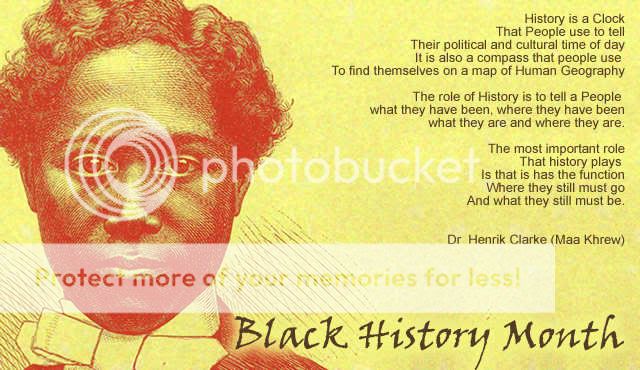
Black History Month is a national annual observance for remembrance of important people and events in the history of the African diaspora. It is celebrated annually in the United States and Canada in February and the United Kingdom in the month of October.
The remembrance originated in 1926 by historian Carter G. Woodson as "Negro History Week". Woodson chose the second week of February because it marked the birthdays of two Americans who greatly influenced the lives and social condition of African Americans: former President Abraham Lincoln and abolitionist and former slave Frederick Douglass. Woodson also founded the Association for the Study of Negro Life and History, now the Association for the Study of African American Life and History.
The history of African-Americans and Black America is given close consideration during Black History Month. National, social, scientific and political contributions by black americans are recognized during Black History Month. Historic accounts related to the civil war era, the civil rights movement of 1955-1968, mainstream technological advances and inventions that have had positive impact on the economy of a nation are often considered.
* * * * *
Racial segregation in the United States, as a general term, included the racial segregation of facilities, services, and opportunities such as housing, medical care, education, employment, and transportation along racial lines. The expression refers primarily to the legally or socially enforced separation of African Americans from other races, but can more loosely refer to voluntary separation, and also to separation of other racial or ethnic minorities from the majority mainstream society and communities.
Racial segregation in the United States has meant the physical separation and provision of separate facilities (especially during the Jim Crow era), but it can also refer to other manifestations of racial discrimination such as separation of roles within an institution, such as the United States Armed Forces up to the 1950s when black units were typically separated from white units but were led by white officers.
Racial segregation in the United States can be divided into de jure and de facto segregation. De jure segregation, sanctioned or enforced by force of law, was stopped by federal enforcement of a series of Supreme Court decisions after with Brown vs. Board of Education in 1954. The process of throwing off legal segregation in the United States lasted through much of the 1950s, 1960s and 1970s when civil rights demonstrations resulted in public opinion turning against enforced segregation. De facto segregation — segregation "in fact" — persists to varying degrees without sanction of law to the present day. The contemporary racial segregation seen in America in residential neighborhoods has been shaped by public policies, mortgage discrimination and redlining among other things.
After Congress passed the Reconstruction Act of 1867, the ratification of the Fifteenth Amendment to the United States Constitution in 1870 providing the right to vote, and the Civil Rights Act of 1875 forbidding racial segregation in accommodations, Federal occupation troops in the South assured blacks the right to vote and to elect their own political leaders. The Reconstruction amendments asserted the supremacy of the national state and the formal equality under the law of everyone within it. However this radical Reconstruction era would collapse because of multidimensional racialism related to the spread of democratic idealism. What began as region wide passage of ‘Jim Crow’ segregation laws that focused on issues of equal access to public activities and facilities would by 1910 have spread throughout the south, mandating the segregation of whites and blacks in the public sphere.
The collapse of the reconstruction amendments and what alluded to racial segregation was also a political move that emerged in the Southern states. Many of the white voters in the south were farmers and opposed to the black man voting for racial reasons, and also because they objected to the possibility of their vote being employed against them. This was during a time of agrarian unrest and the uncertainty of the political importance of the agricultural sector of the south. Independent challenges to the Democrat power remained endemic in the South until the end of the nineteenth century. To discourage black voting, Southern Democrats resorted to violence. The white supremacist Ku Klux Klan terrorized black political leaders to counter the Republican party's power base. Many blacks were killed (often lynched) for attempting to exercise their right to vote, for political organization and for attending school. Racialism was also fueled by the ideology of Social Darwinism, which broadly asserted that because of a natural competition among humans and the social evolution driven by the survival of the fittest, the white man not only should but deserved to retain political and economic power. Thus the behavior exhibited towards Negros was not perceived as racism but rather action that was sanctioned by the ‘science’ of Euro-centric racialism.
The efforts to disenfranchise black men in the south were at first performed while trying not to directly violate the intent of the Fifteenth Amendment. Such efforts included implementing poll taxes and property qualifications, which were directly aimed at discouraging the black voter but did not technically deny the right to vote based on color.
After the Compromise of 1877, all Federal troops were withdrawn from the South and Reconstruction ended, which also marked the onset of the nadir of American race relations, when African-Americans both in the South and the North were increasingly oppressed by white mob violence and by de jure and de facto segregation.
For much of the 20th century, it was a popular belief among many whites that the presence of blacks in a white neighborhood would bring down property values. The United States government created a policy to segregate the country which involved making low-interest mortgages available to families through the Federal Housing Administration (FHA) and the Veteran's Administration. Black families were legally entitled to these loans but were sometimes denied these loans because the planners behind this initiative labelled many black neighborhoods throughout the country as "in decline." The rules for loans did not say that "black families cannot get loans"; rather, it said people from "areas in decline" could not get loans. While a case could be made that the wording did not appear to compel segregation, it tended to have that effect. And actually, this administration was formed as part of the New Deal to all Americans as well, and really just affected black residents of inner city areas; though most black families did in fact live in the inner city areas of big cities, and almost entirely occupied the inner city areas after World War II ended and whites began to move to new suburbs.
In addition to encouraging white families to move to suburbs by providing them loans to do so, the government uprooted many established African American communities by building elevated highways through their neighborhoods. To build a highway, tens of thousands of single-family homes were destroyed. Because these properties were summarily declared to be "in decline," families were given pittances for their properties, and were forced into federal housing called "the projects." To build these projects, still more single family homes were demolished.
In 1913, President Woodrow Wilson ordered the segregation of the federal Civil Service. White and black people would sometimes be required to eat separately and use separate schools, public toilets, park benches, train and restaurant seating, etc. In some locales, in addition to segregated seating, it could be forbidden for stores or restaurants to serve different races under the same roof.
Segregation was also pervasive in housing. State constitutions (for example, that of California) had clauses giving local jurisdictions the right to regulate where members of certain races could live. In 1917, the Supreme Court in the case of Buchanan v. Warley declared municipal resident segregation ordinances unconstitutional. In response, whites resorted to the restrictive covenant, a formal deed restriction binding white property owners in a given neighborhood not to sell to blacks. Whites who broke these agreements could be sued by "damaged" neighbors. In the 1948 case of Shelley v. Kraemer, the U.S. Supreme Court finally ruled that such covenants were unenforceable in a court of law. However, residential segregation patterns had already become established in most American cities, and have often persisted up to the present (see white flight and Redlining).
With the migration to the North of many black workers at the turn of the twentieth century, and the friction that occurred between white and black workers during this time, segregation was and continues to be a phenomenon in northern cities as well as in the South. Whites generally allocate tenements as housing to the poorest blacks. It would be well to remember, though, that while racism had to be legislated out of the South, many in the North, including Quakers and others who ran the Underground Railroad, were ideologically opposed to southerners' treatment of blacks. By the same token, many white southerners have a claim to closer relationships with blacks than wealthy northern whites, regardless of the latter's stated political persuasion.
Anti-miscegenation laws (also known as miscegenation laws) prohibited whites and non-whites from marrying each other. These state laws always targeted marriage between whites and blacks, and in some states also prohibited marriages between whites and Native Americans or Asians. As one of many examples of such state laws, Utah's marriage law had an anti-miscegenation component that was passed in 1899 and repealed in 1963. It prohibited marriage between a white and anyone considered a Negro (Black American), mulatto (half black), quadroon (one-quarter black), octoroon (one-eighth black), "Mongolian" (East Asian), or member of the "Malay race" (a classification used to refer to Filipinos). No restrictions were placed on marriages between people who were not "white persons.".
In World War I, blacks served in the United States Armed Forces in segregated units. Black soldiers were often poorly trained and equipped, and were often put on the frontlines in suicide missions. Still, the 93rd Division fought alongside the French . The 369th Infantry (formerly 15th New York National Guard) Regiment distinguished themselves, and were known as the "Harlem Hellfighters".
World War II saw the first black military pilots in the U.S., the Tuskegee Airmen, 99th Fighter Squadron, and also saw the segregated 183rd Engineer Combat Battalion participate in the liberation of Jewish survivors at Buchenwald. Despite the institutional policy of racially segregated training for enlisted members and in tactical units; Army policy dictated that black and white Soldiers would train together in officer candidate schools (beginning in 1942). Thus, the Officer Candidate School became the Army's first formal experiment with integration- with all Officer Candidates, regardless of race, living and training together.
During World War II, 110,000 people of Japanese descent (whether citizens or not) were placed in internment camps. Hundreds of people of German and Italian descent were also imprisoned. While the government program of Japanese American internment targeted all the Japanese in America as enemies, most German and Italian Americans were left in peace and were allowed to serve in the US army.
Pressure to end racial segregation in the government grew among African Americans and progressives after the end of World War II. On July 26, 1948, President Harry S. Truman signed Executive Order 9981, ending segregation in the United States Armed Forces.
A law need not stipulate de jure segregation to have the effect of de facto segregation. For example, the eagle feather law, which governs the possession and religious use of eagle feathers, was officially written to protect then dwindling eagle populations while still protecting traditional Native American spiritual and religious customs, of which the use of eagles are central. The eagle feather law later met charges of promoting racial segregation because of the law’s provision authorizing the possession of eagle feathers to members of only one ethnic group, Native Americans, and forbidding Native Americans from including non-Native Americans in indigenous customs involving eagle feathers—a common modern practice dating back to the early 1500s.
Despite all the legal changes that have taken place since the 1940s and especially in the 1960s (see Desegregation), the United States remains, to some degree, a segregated society, with housing patterns, school enrollment, church membership, employment opportunities, and even college admissions all reflecting significant de facto segregation. Supporters of affirmative action argue that the persistence of such disparities reflects either racial discrimination or the persistence of its effects.
Gates v. Collier was a case decided in federal court that brought an end to the trustee system and flagrant inmate abuse at the notorious Mississippi State Penitentiary at Parchman, Mississippi. In 1972 federal judge, William C. Keady found that Parchman Farm violated modern standards of decency. He ordered an immediate end to all unconstitutional conditions and practices. Racial segregation of inmates was abolished. And the trusty system, which allow certain inmates to have power and control over others, was also abolished.
More recently, the disparity between the racial compositions of inmates in the American prison system has led to concerns that the U.S. Justice system furthers a "new apartheid"
* * * * *
Scientific Racism?
The intellectual roots of Plessy v. Ferguson, the landmark United States Supreme Court decision, upholding the constitutionality of racial segregation, under the doctrine of "separate but equal" were, in part, tied to the scientific racism of the era, however the popular support for the decision was more likely a result of the racist beliefs held by most whites at the time. Later, the court decision, Brown v. Board of Education would reject the ideas of scientific racists about the need for segregation, especially in schools. Following that decision both scholarly and popular ideas of scientific racism played an important role in the attack and backlash that followed the court decision. The Mankind Quarterly is a journal that has published scientific racism. It was founded in 1960,partly in response to the 1954 United States Supreme Court decision Brown v. Board of Education, which ordered the desegregation of US schools. Many of the publication's contributors, publishers, and Board of Directors espouse academic hereditarianism. The publication is widely criticized for its extremist politics, anti-semitic bent and its support for scientific racism.
References:
http://en.wikipedia.org/wiki/Black_History_Month
http://en.wikipedia.org/wiki/Racial_segregation_in_the_United_States