|
|
|
|
|
|
|
|
|
 Posted: Fri Feb 19, 2010 9:53 pm Posted: Fri Feb 19, 2010 9:53 pm
this will be a 32 page rule book for a gurps campaign that i would like to start
|
 |
|
|
|
|
|
|
|
|
|
|
|
|
|
Posted: Fri Feb 19, 2010 9:57 pm
GURPS Rules by STEVE JACKSON • GURPS Lite Abridged Rules by SCOTT HARING and SEAN PUNCH
Edited by ANDREW HACKARD and STEVE JACKSON
Illustrated by CHRIS DIEN, TORSTEIN NORDSTRAND, BOB STEVLIC, and ERIC WILKERSON • Graphic Design by JUSTIN DE WITT
WHAT IS GURPS?
GURPS stands for “Generic Universal
RolePlaying System,” the RPG that these
rules are condensed from. Why is it called
that? Well . . .
“Generic.” GURPS starts with simple
rules, and builds up to as much optional
detail as you like. This abridged version
presents the “core rules” that most GMs
start with.
“Universal.” The basic rule system is
designed to emphasize realism. It can fit
any situation – fantasy or historical; past,
present, or future.
“RolePlaying.” This is not just a “hackand-
slash” game. The rules are written to
make true roleplaying possible – and to
encourage it. In GURPS, you pretend, for a
little while, to be someone else.
“System.” Over 200 different books have
been published for GURPS, in eight different
languages (so far). It is one of the recognized
standards for roleplaying, worldwide.
MATERIALS NEEDED
FOR PLAY
To play, you will need these rules, three
six-sided dice, pencils, and scratch paper.
ABOUT GURPS
Lite
This is the boiled-down “essence” of
GURPS: all the fundamental rules, but not
the options and embellishments that often
confuse new players. Once you’re comfortable
with these rules, you can pick up the
GURPS Basic Set and jump right into the
action. Experienced Game Masters will, we
hope, find this a valuable tool for
introducing new players to the game.
GLOSSARY
GURPS is a roleplaying game (RPG).
Like any hobby, gaming has its own unique
language. To help you understand the concepts
and terms used in this game (and
other RPGs), we’ll start with a few definitions:
roleplaying game (RPG): A game in which
players take on the personalities of
imaginary individuals, or characters, in a
fictional or historical setting, and try to
act as those characters would.
Game Master (GM): The referee, who
chooses the adventure, talks the players
through it, judges the results, and gives
out bonus points.
character: Any being – person, animal,
robot, etc. – that is played by the GM or
a player.
nonplayer character (NPC): Any character
played by the GM.
player character (PC): A character created
and played by one of the players.
statistics: The numerical values that
describe a character, piece of equipment,
etc., taken collectively. Often called
“stats.”
party: A group of PCs taking part in the
same adventure.
game world: A background for play; a setting.
“World” might mean “planet,” but it
could also refer to a region and historical
period . . . or an entire universe.
adventure: The basic “unit” of play in a
roleplaying game, representing a single
mission or plot. It might require several
sessions of play, or just one play session.
encounter: One “scene” of an adventure,
usually a meeting between the PCs and
one or more NPCs.
campaign: A continuing series of adventures.
A campaign will usually have a
continuing cast of player characters, and
the same GM (or team of GMs). It may
move from one game world to another,
with a logical reason.
race: The species to which you belong.
Nonhuman characters (elves, dwarves,
halflings, and Martians, for example) are
common in RPGs.
From STEVE JACKSON GAMES
SJG01-0004 GURPS LITE 1
GURPS Lite is copyright © 1998, 1999, 2000, 2001, 2003, 2004 by Steve Jackson Games Incorporated. It is intended for free distribution. You are encouraged to copy and share these 32
pages freely. You may not charge for it, except to cover the actual cost of copying. You may not remove any part of it. You may not change or modify it, except that retailers, distributors or
conventions may add “Courtesy of (name)” at the top of this page. You absolutely may not incorporate this game, or parts of it, into another product for distribution in any way.
GURPS Lite is available in PDF format from www.sjgames.com/gurps/lite/. You may distribute this PDF file freely under the above restrictions, and post copies of it online.
You may not sell it or include it as part of any product for sale without the written permission of Steve Jackson Games Incorporated.
Please visit our web site at www.sjgames.com. You may also write to us at PO Box 18957, Austin, TX 78760.
|
|
|
|
|
|
|
|
|
|
|
|
|
|
|
|
|
|
Posted: Fri Feb 19, 2010 10:02 pm
THE BASICS
GURPS uses six-sided dice only. To figure combat damage (and several other things), the “dice+adds” system is used. If a weapon does
“4d+2” damage, this is shorthand for “roll 4 dice and add 2 to the total.” Likewise, “3d-3” means “roll 3 dice and subtract 3 from the total.”
If you see just “2d,” that means “roll two dice.”
GURPS Lite has only three basic “game mechanics”: success rolls, reaction rolls, and damage rolls.
2 GURPS LITE
SUCCESS ROLLS
A “success roll” is a die roll made when
you need to “test” one of your skills or abilities.
Sometimes you roll; sometimes the
GM rolls for you. For instance, you might
test, or roll against, your Strength to stop a
heavy door from closing.
WHAT TO ROLL
Whenever a character attempts to perform
an action (e.g., use a skill), roll three
dice to determine the outcome. This is
called a success roll. The task in question
succeeds if the total rolled on the dice is less
than or equal to the number that governs
the action – most often a skill or an attribute.
Otherwise, it fails. For example, if you
are rolling against Strength, and your ST is
12, a roll of 12 or less succeeds. Thus, the
higher the stat you are rolling against, the
easier it is to make the roll.
Regardless of the score you are rolling
against, a roll of 3 or 4 is always a success,
while a roll of 17 or 18 is always a failure.
In general, the player makes the die rolls
for his character’s actions. However, the
GM may always choose to roll the dice in
secret – see When the GM Rolls, below.
WHEN TO ROLL
To avoid bogging down the game in endless
die rolls, the GM should only require a
success roll if . . .
• A PC’s health, wealth, friends, reputation,
or equipment are at risk. This includes
chases, combat (even if the target is stationary
and at point-blank range!), espionage,
thievery, and similar “adventuring”
activities.
• A PC stands to gain allies, information,
new abilities, social standing, or wealth.
The GM should not require rolls for . . .
• Utterly trivial tasks, such as crossing
the street, driving into town, feeding the
dog, finding the corner store, or turning on
the computer.
• Daily work at a mundane, nonadventuring
job.
When the GM Rolls
There are two sets of circumstances
under which the GM should roll for a PC
and not let the player see the results:
1. When the character wouldn’t know for
sure whether he had succeeded.
2. When the player shouldn’t know
what’s going on.
MODIFIERS
The rules often specify modifiers for certain
success rolls. These bonuses and penalties
affect the number you are rolling against
– your “target number” – and not the total
rolled on the dice. Bonuses always improve
your odds, while penalties always reduce
them.
For instance, when using the
Lockpicking skill in the dark, the GM might
tell you to roll at -5 for the attempt. If your
Lockpicking skill is 9, you roll against 9
minus 5, or 4, in the dark.
A specific scenario might provide modifiers
to allow for the relative ease or difficulty
of a particular situation. For instance, an
adventure might state that a lock is +10 to
open due to the fact that it is primitive and
clumsy. If your Lockpicking skill were 9, you
would roll against 9 + 10, or 19. Since the
highest roll possible on 3d is 18, it would
seem that success is assured. Not quite – see
Critical Success and Failure, below.
Modifiers are cumulative unless stated
otherwise. For instance, if you tried to open
that primitive lock in the dark, both modifiers
would apply, and you would roll
against 9 - 5 + 10, or 14.
Base Skill vs. Effective Skill
Your base skill is your actual level in a
skill, as recorded on your character sheet.
Your effective skill for a particular task is
your base skill plus or minus any modifiers
for that task. In the Lockpicking examples
above, the base skill is 9 in all cases, while
the effective skill is 4, 19, or 14.
You may not attempt a success roll if
your effective skill is less than 3 unless you
are attempting a defense roll (p. 2 cool .
DEGREE OF
SUCCESS OR
FAILURE
Once you have calculated your effective
skill by applying all the relevant modifiers to
your base skill, roll 3d to determine the outcome.
If the total rolled on the dice is less than
or equal to your effective skill, you succeed,
and the difference between your effective skill
and your die roll is your margin of success.
Example: If you have effective skill 18 and
roll a 12, you succeed; your margin of success
is 6.
If you roll higher than your effective skill,
you fail, and the difference between the die
roll and your effective skill is your margin of
failure.
Example: If you have effective skill 9 and
roll a 12, you fail; your margin of failure is 3.
Many rules use margin of success or failure
to calculate results that matter in play, so
be sure to note it when you roll.
Critical Success and Failure
A critical success is an especially good
result.
• A roll of 3 or 4 is always a critical success.
• A roll of 5 is a critical success if your
effective skill is 15+.
• A roll of 6 is a critical success if your
effective skill is 16+.
When you roll a critical success, the GM
determines what happens. It is always
something good! The lower the roll, the better
“bonus” he gives you.
A critical failure is an especially bad
result.
• A roll of 18 is always a critical failure.
• A roll of 17 is a critical failure if your
effective skill is 15 or less; otherwise, it is an
ordinary failure.
• Any roll of 10 or more greater than
your effective skill is a critical failure: 16 on
a skill of 6, 15 on a skill of 5, and so on.
|
|
|
|
|
|
|
|
|
|
|
|
|
|
|
Posted: Fri Feb 19, 2010 10:04 pm
When you roll a critical failure, the GM
determines what happens. It is always
something bad – the higher the roll, the
worse the result.
REPEATED
ATTEMPTS
Sometimes you only get one chance to
do something (defuse a bomb, jump over a
crevasse, remove an inflamed appendix,
please the King with a song). Other times
you can try over and over again until you
succeed (pick a lock, catch a fish, analyze a
poison). Still other times you will not know
whether you succeeded or failed until it’s
too late to try again (translate an old treasure
map, order in a French restaurant,
build a ship). Finally, there are times when
you are injured by failure but can afford to
fail a few times (climb a wall, impress a
savage tribesman).
The GM must use common sense to distinguish
among these cases, according to
the exact situation in which the adventurers
find themselves.
CONTESTS
Sometimes a situation arises in which two
characters must compare attributes, skills, or
other traits to settle a competition. The one
with the highest score doesn’t always win . . .
but that’s the way to bet. A “Contest” is a
quick way to handle such a competitive situation
without playing it out in detail. In a
Contest, each competitor attempts a success
roll against the ability being tested – with all
applicable modifiers – and then compares his
result to his opponent’s. There are two different
ways to make this comparison.
Quick Contest
A “Quick Contest” is a competition that
is over in very little time – often in one second,
perhaps even instantly. Examples
include two enemies lunging for a gun or
two knife throwers seeing who gets closer
to the bull’s-eye.
Each competitor attempts his success
roll. If one succeeds and the other fails, the
winner is obvious. If both succeed, the winner
is the one with the largest margin of
success; if both fail, the winner is the one
with the smallest margin of failure. A tie
means nobody won (in the examples above,
both fighters grabbed the weapon at once,
or the knives hit the same distance from the
bull’s-eye).
Margin of Victory
The amount by which the winner beat
the loser is often important – success by 5
vs. failure by 5 generally means more than
success by 2 vs. success by 1! The winner’s
“margin of victory” is the difference
between his margin of success and the
loser’s margin of success if both succeeded,
the sum of his margin of success and the
loser’s margin of failure if he succeeded and
the loser failed, or the difference between
the loser’s margin of failure and his margin
of failure if both failed.
Regular Contest
A “Regular Contest” is a slow competition
with much give and take – for instance,
arm wrestling.
Each character attempts his success roll.
If one succeeds and the other fails, the winner
is obvious. If both succeed or both fail,
the competitors’ relative positions are
unchanged and they roll again. Eventually,
one character succeeds when the other
fails. At this point, the one who made his
roll is the winner.
The length of game time each attempt
takes depends on the activity, and is up to
the GM. In a combat situation, each
attempt takes one second . . . but in a
library-research contest, with the fate of the
world hanging on who finds a certain
obscure reference first, each attempt could
represent days of time.
GURPS LITE 3
REACTION ROLLS
When the PCs meet an NPC whose reaction
to them is not predetermined (see
below), the GM makes a “reaction roll” on 3d.
The higher the roll, the better the reaction.
The GM then plays the NPC according to the
guidelines on the Reaction Table.
The GM should keep this roll secret from
the players. They don’t know, for instance,
whether that friendly-looking old farmer is
giving them straight advice or sending them
into a trap.
A reaction roll is not a success roll. There
are three important differences:
1. There is no “target number” to roll
against.
2. A high roll is good, not bad.
3. Reaction modifiers apply directly to the
die roll. A reaction bonus is any factor that
makes NPCs friendlier, while a reaction penalty
is something that biases NPCs against the
PCs.
Some common reaction modifiers:
Personal appearance and behavior. This is
especially true for the PC who does the talking!
Above-average appearance gives a
bonus, as do some advantages (see p. cool .
Below-average appearance and many disadvantages
give a penalty.
Racial or national biases. Elves don’t like
dwarves, Frenchmen don’t care for Germans,
and so on. These are usually penalties, and
take the form of an Intolerance disadvantage
on the part of the NPC.
Appropriate behavior by the players! Here’s
a chance to reward good roleplaying. A good
approach should be worth +1 or more! A
wholly inappropriate approach that antagonizes
the NPCs should give the party -1 or -2
on the reaction roll. Don’t tell the players,
“You blew it!” – just roleplay the offended
character, and let them figure it out.
Random reaction rolls are great when
they add a note of unpredictability to the
game – this is more fun for the GM, too!
However, never substitute random die rolls for
reason and logic.
REACTION TABLE
Roll 3 dice and apply any reaction modifiers.
0 or less: Disastrous. The NPC hates the
characters and will act in their worst interest.
Nothing is out of the question: assault,
betrayal, public ridicule, or ignoring a life-ordeath
plea are all possible.
1 to 3: Very Bad. The NPC dislikes the
characters and will act against them if it’s
convenient to do so: attacking, offering grossly
unfair terms in a transaction, and so on.
4 to 6: Bad. The NPC cares nothing for the
characters and will act against them (as
above), if he can profit by doing so.
7 to 9: Poor. The NPC is unimpressed. He
may make threats, demand a huge bribe
before offering aid, or something similar.
10 to 12: Neutral. The NPC ignores the
characters as much as possible. He is totally
uninterested. Transactions will go smoothly
and routinely, as long as protocol is observed.
13 to 15: Good. The NPC likes the characters
and will be helpful within normal, everyday
limits. Reasonable requests will be
granted.
16 to 18: Very Good. The NPC thinks highly
of the characters and will be quite helpful
and friendly, freely offering aid and favorable
terms in most things.
19 or better: Excellent. The NPC is
extremely impressed by the characters, and
will act in their best interests at all times,
within the limits of his own ability – perhaps
even risking his life, wealth, or reputation.
|
|
|
|
|
|
|
|
|
|
|
|
|
|
|
|
|
|
Posted: Fri Feb 19, 2010 10:07 pm
DAMAGE ROLLS
4 GURPS LITE
A “damage roll” is a roll made in a fight, to see how much harm you did to your foe. Damage rolls use the “dice+adds” system (see p. 2).
Many things can affect the final injury inflicted by your attack. Armor reduces the damage received by the wearer. Certain attacks do extra
damage if they get through armor. All these things are explained in the combat rules – see p. 29.
When you roleplay, you take the part of
another person – a “character” that you create.
GURPS lets you decide exactly what
kind of hero you will become. Asteroid
miner? Wizard? Professional time-traveler?
You can take your inspiration from a fictional
hero or heroine, or create your new
“self” from the ground up. Once you know
what role you want to play, it’s time to bring
that character to life!
The GM (Game Master – the person
“running” the game) will give you a number
of character points with which to “buy” your
abilities. For instance, the stronger you
want to be, the more points it will cost. You
can also buy advantageous social traits,
such as wealth, and special abilities called
advantages (see p. cool .
If you want more abilities than you can
afford on the budget given to you by your
GM, you can get extra points by accepting
below-average strength, appearance,
wealth, social status, etc., or by taking disadvantages
– specific handicaps such as bad
vision or fear of heights (see p. 10).
The two most important things to know
about your character are who he is and
what role you want him to play in his adventures.
Find out what kind of game the GM
plans to run and what kinds of characters
he intends to allow. Then start filling in the
details. There are several ways to approach
this.
You can choose the abilities you want,
spend your character points, and work out
a character concept that fits the abilities. A
good character is much more than a collection
of abilities, but “shopping” for abilities
can be a great inspiration.
You might instead decide on your character’s
focal qualities first – the handful of
things that define him, such as personal history,
appearance, behavior, aptitudes, and
skills. Think about how he acquired those
qualities, then spend your points on features
that go with these traits.
CHARACTER POINTS
Character points are the “currency” of
character creation. Anything that improves
your abilities costs character points: you
must spend points equal to the listed price
of an ability to add that ability to your character
sheet and use it in play. Anything that
reduces your capabilities has a negative
cost – that is, it gives you back some points.
For instance, if you start with 125 points,
buy 75 points of advantages, and take -15
points of disadvantages, you have 125 - 75 +
15 = 65 points remaining.
Starting Points
The GM decides how many character
points the player characters (PCs) – the
heroes – start with. This depends on how
capable he wants them to be. Some example
power levels, with suggested starting points:
Feeble (under 25 points): Small children,
mindless thralls, zombies, etc.
Average (25-50 points): Ordinary folks,
such as accountants and cab drivers.
Competent (50-75 points): Athletes, cops,
wealthy gentry . . . anyone who would have
a clear edge over “average” people on an
adventure.
Exceptional (75-100 points): Star athletes,
seasoned cops, etc.
Heroic (100-200 points): People at the
realistic pinnacle of physical, mental, or
social achievement; e.g., Navy SEALs,
world-class scientists, and millionaires.
Larger Than-Life (200-300 points):
Leading roles in kung fu movies, fantasy
novels, etc.
Legendary (300-500 points): Protagonists
of epic poems and folklore.
This beginning point level is sometimes
referred to as the power level of the
campaign.
Disadvantage Limit
A disadvantage is anything with a negative
cost, including low attributes, reduced
social status, and all the specific disabilities
listed under Disadvantages (p. 10). In theory,
you could keep adding disadvantages
until you had enough points to buy whatever
advantages and skills you wanted. In
practice, most GMs will want to set a limit
on the disadvantage points a PC may have.
A good rule of thumb is to hold disadvantages
to 50% of starting points – for
instance, -75 points in a 150-point game.
BASIC ATTRIBUTES
Four numbers called “attributes” define
your basic abilities: Strength (ST), Dexterity
(DX), Intelligence (IQ), and Health (HT).
A score of 10 in any attribute is free, and
represents the human average. Higher
scores cost points: 10 points to raise ST or
HT by one level, 20 points to raise DX or IQ
by one level. Similarly, scores lower than 10
have a negative cost: -10 points per level for
ST or HT, -20 points per level for DX or IQ.
(Remember that negative point values
mean you get those points back to spend on
something else!)
Most characters have attributes in the 1-
20 range, and most normal humans have
scores in the 8-12 range. Scores above 20
are possible but typically reserved for godlike
beings – ask the GM before buying such
a value. At the other end of the scale, 1 is the
minimum score for a human.
The basic attributes you select will determine
your abilities – your strengths and
weaknesses – throughout the game. Choose
wisely:
6 or less: Crippling. An attribute this bad
severely constrains your lifestyle.
7: Poor. Your limitations are immediately
obvious to anyone who meets you. This is
the lowest score you can have and still pass
for “able-bodied.”
8 or 9: Below average. Such scores are
limiting, but within the human norm. The
GM may forbid attributes
|
|
|
|
|
|
|
|
|
|
|
|
|
|
|
Posted: Fri Feb 19, 2010 10:07 pm
|
|
|
|
|
|
|
|
|
|
|
|
|
Posted: Fri Feb 19, 2010 10:09 pm
10: Average. Most humans get by
just fine with a score of 10!
11 or 12: Above average. These
scores are superior, but within the
human norm.
13 or 14: Exceptional. Such an
attribute is immediately apparent – as
bulging muscles, feline grace, witty
dialog, or glowing health – to those
who meet you.
15 or more: Amazing. An attribute
this high draws constant comment and
probably guides your career choices.
Strength (ST)
±10 points/level
Strength measures physical power
and bulk. It is crucial if you are a warrior
in a primitive world, as high ST
lets you dish out and absorb more
damage in hand-to-hand combat. Any
adventurer will find ST useful for lifting
and throwing things, moving
quickly with a load, etc.
Strength is more “open-ended”
than other attributes; scores greater
than 20 are common among beings
such as large animals, fantasy
monsters, and robots.
Dexterity (DX)
±20 points/level
Dexterity measures a combination of
agility, coordination, and fine motor ability.
It controls your basic ability at most athletic,
fighting, and vehicle-operation skills,
and at craft skills that call for a delicate
touch. DX also helps determine Basic
Speed (a measure of reaction time, p. 6) and
Basic Move (how fast you run, p. 6).
Intelligence
(IQ)
±20
points/level
I n t e l l i g e n c e
broadly measures
brainpower, including creativity, intuition,
memory, perception, reason, sanity, and
willpower. It rules your basic ability with all
“mental” skills – sciences, social interaction,
magic, etc. Any wizard, scientist, or gadgeteer
needs a high IQ first of all. The secondary
characteristics of Will (p. 6) and
Perception (p. 6) are based on IQ.
Health (HT)
±10 points/level
Health measures energy and vitality. It
represents stamina, resistance (to poison,
disease, radiation, etc.), and basic “grit.” A
high HT is good for anyone – but it is vital
for low-tech warriors. HT determines
Fatigue Points, and helps determine Basic
Speed (p. 6) and Basic Move (p. 6).
GURPS LITE 5
Basic Lift (BL)
Basic Lift is the maximum weight you can lift over your head with one hand in
one second. It is equal to (ST¥ST)/5 lbs. If BL is 10 lbs. or more, round to the nearest
whole number; e.g., 16.2 lbs. becomes 16 lbs. The average human has ST 10 and
a BL of 20 lbs.
Handedness
Decide whether you are right-handed or left-handed. Whenever you try to do
anything significant with the other hand, you are at -4 to skill. This does not apply
to things you normally do with your “off” hand, like using a shield.
GURPS doesn’t distinguish between left- and right-handed characters; either is
0 points. However, Ambidexterity is an advantage that costs points – see p. 8.
|
|
|
|
|
|
|
|
|
|
|
|
|
|
|
Posted: Fri Feb 19, 2010 10:10 pm
you dont have to read all of it just get the gist mos of it is for reference and most of it is for me dont worry
|
|
|
|
|
|
|
|
|
|
|
|
|
|
|
|
|
|
Posted: Fri Feb 19, 2010 10:21 pm
|
|
|
|
|
|
|
|
|
|
Posted: Fri Feb 19, 2010 10:23 pm
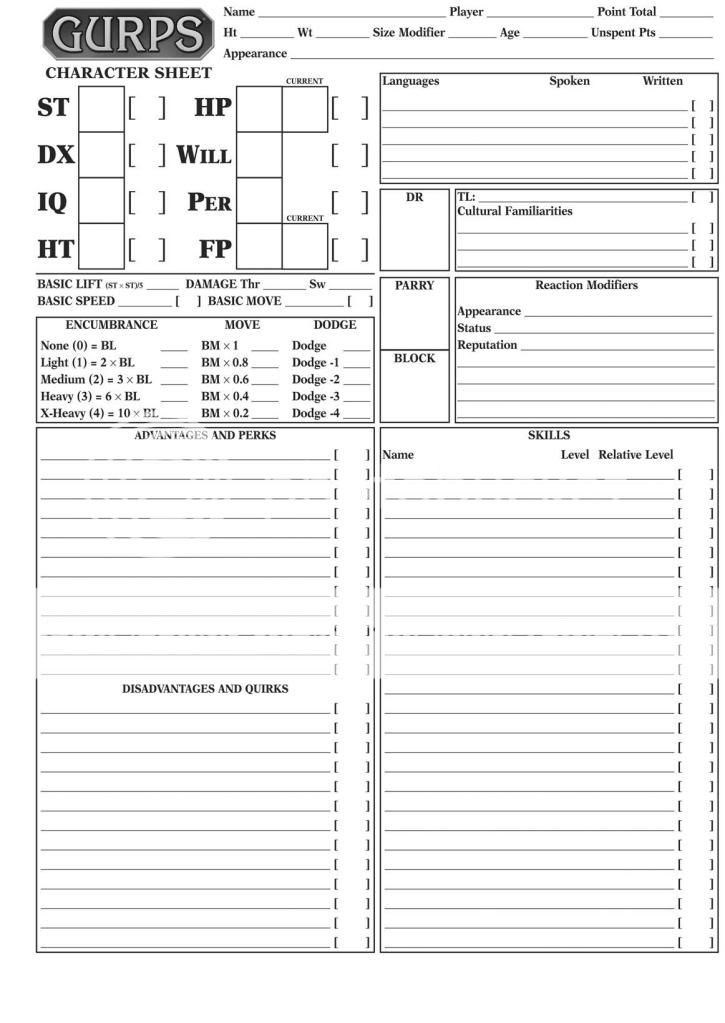
that is the sheet you need to fill out i will help you uh and i will find one you can use on the internet or you can give me info by pming me of what you want some of the details to be ill explain
|
|
|
|
|
|
|
|
|
|
|
|
|
|

Seiko L Rose rolled 2 6-sided dice:
4, 6
Total: 10 (2-12)
|
|
|
Posted: Fri Feb 19, 2010 10:28 pm
thats all the rules im posting the rest i have and you dont need yet ill tell you them when you need them
so we only use six sided dice gaia has this when posting go post action role dice number six sided number of dice usually two unless i say so k
|
|
|
|
|
|
|
|
|
|
|
|
|
|
|
Posted: Fri Feb 19, 2010 10:37 pm
ok heres a site so you can make your character you need either excel or open office open office is a free version of office
|
|
|
|
|
|
|
|
|
|
|
|
|
|
|
|
|
|
|


 Reply
Reply