|
|
| Have you read this? |
| Yes |
|
25% |
[ 1 ] |
| I helped produce it |
|
75% |
[ 3 ] |
|
| Total Votes : 4 |
|
|
|
|
|
|
|
|
 Posted: Tue Feb 23, 2010 1:34 pm Posted: Tue Feb 23, 2010 1:34 pm
March 2010 Newsletter "March is a month of considerable frustration - it is so near spring and yet across a great deal of the country the weather is still so violent and changeable that outdoor activity in our yards seems light years away." - Thalassa Cruso
|
 |
|
|
|
|
|
|
|
|
|
|
|
|
|
Posted: Tue Feb 23, 2010 1:45 pm
Ostara History
The word Ostara is just one of the names applied to the celebration of the spring equinox on March 21. The Venerable Bede said the origin of the word is actually from Eostre, a Germanic goddess of spring. Of course, it's also the same time as the Christian Easter celebration, and in the Jewish faith, Passover takes place as well. For early Pagans in the Germanic countries, this was a time to celebrate planting and the new crop season. Typically, the Celtic peoples did not celebrate Ostara as a holiday, although they were in tune with the changing of the seasons.
A New Day Begins:
A dynasty of Persian kings known as the Achaemenians celebrated the spring equinox with the festival of No Ruz -- which means "new day." It is a celebration of hope and renewal still observed today in many Persian countries, and has its roots in Zoroastrianism. In Iran, a festival called Chahar-Shanbeh Suri takes place right before No Ruz begins, and people purify their homes and leap over fires to welcome the 13-day celebration of No Ruz.
Mad as a March Hare:
Spring equinox is a time for fertility and sowing seeds, and so nature's fertility goes a little crazy. In medieval societies in Europe, the March hare was viewed as a major fertility symbol -- this is a species of rabbit that is nocturnal most of the year, but in March when mating season begins, there are bunnies everywhere all day long. The female of the species is superfecund and can conceive a second litter while still pregnant with a first. As if that wasn't enough, the males tend to get frustrated when rebuffed by their mates, and bounce around erratically when discouraged.
The Legends of Mithras:
The story of the Roman god, Mithras, is similar to the tale of Jesus Christ and his resurrection. Born at the winter solstice and resurrected in the spring, Mithras helped his followers ascend to the realm of light after death. In one legend, Mithras, who was popular amongst members of the Roman military, was ordered by the Sun to sacrifice a white bull. He reluctantly obeyed, but at the moment when his knife entered the creature's body, a miracle took place. The bull turned into the moon, and Mithras' cloak became the night sky. Where the bull's blood fell flowers grew, and stalks of grain sprouted from its tail.
Spring Celebrations Around the World:
In ancient Rome, the followers of Cybele believed that their goddess had a consort who was born via a virgin birth. His name was Attis, and he died and was resurrected each year during the time of the vernal equinox on the Julian Calendar (between March 22 and March 25). Around the same time, the Germanic tribes honored a lunar goddess known as Ostara, who mated with a fertility god around this time of year, and then gave birth nine months later – at Yule.
The indigenous Mayan people in Central American have celebrated a spring equinox festival for ten centuries. As the sun sets on the day of the equinox on the great ceremonial pyramid, El Castillo, Mexico, its "western face...is bathed in the late afternoon sunlight. The lengthening shadows appear to run from the top of the pyramid's northern staircase to the bottom, giving the illusion of a diamond-backed snake in descent." This has been called "The Return of the Sun Serpent" since ancient times.
According to the Venerable Bede, Eostre was the Saxon version of the Germanic goddess Ostara. Her feast day was held on the full moon following the vernal equinox -- almost the identical calculation as for the Christian Easter in the west. There is very little documented evidence to prove this, but one popular legend is that Eostre found a bird, wounded, on the ground late in winter. To save its life, she transformed it into a hare. But "the transformation was not a complete one. The bird took the appearance of a hare but retained the ability to lay eggs...the hare would decorate these eggs and leave them as gifts to Eostre."
Modern Celebrations
This is a good time of year to start your seedlings. If you grow an herb garden, start getting the soil ready for late spring plantings. Celebrate the balance of light and dark as the sun begins to tip the scales, and the return of new growth is near.
Many modern Wiccans and Pagans celebrate Ostara as a time of renewal and rebirth. Take some time to celebrate the new life that surrounds you in nature -- walk in park, lay in the grass, hike through a forest. As you do so, observe all the new things beginning around you -- plants, flowers, insects, birds. Meditate upon the ever-moving Wheel of the Year, and celebrate the change of seasons.
|
|
|
|
|
|
|
|
|
|
|
|
|
|
|
|
|
|
Posted: Tue Feb 23, 2010 1:47 pm
Spring Deities
Spring is a time of great celebration in many cultures. It's the time of year when the planting begins, people begin to once more enjoy the fresh air, and we can reconnect with the earth again after the long, cold winter. A number of different gods and goddesses from different pantheons are connected with the themes of Spring and Ostara.
* Asasa Ya (Ashanti): This earth mother goddess prepares to bring forth new life in the spring, and the Ashanti people honor her at the festival of Durbar, alongside Nyame, the sky god who brings rain to the fields.
* Cybele (Roman): This mother goddess of Rome was at the center of a rather bloody Phrygian cult, in which eunuch priests performed mysterious rites in her honor. Her lover was Attis (he was also her grandson, but that's another story), and her jealousy caused him to castrate and kill himself. His blood was the source of the first violets, and divine intervention allowed Attis to be resurrected by Cybele, with some help from Zeus. In some areas, there is still an annual three-day celebration of Attis' rebirth and Cybele's power.
* Eostre (western Germanic): Little is known about the worship of this Teutonic spring goddess, but she is mentioned by the Venerable Bede, who said that Eostre's following had died out by the time he compiled his writings in the eighth century. Jacob Grimm referred to her by the High German equivalent, Ostara, in his 1835 manuscript, Deutsche Mythologie. Eostre's name is the root of our present day spring celebration of Ostara.
* Flora (Roman): This goddess of spring and flowers had her own festival, Floralia, which was celebrated every year between April 28 to May 3. Romans dressed in bright robes and floral wreaths, and attended theater performances and outdoor shows. Offerings of milk and honey were made to the goddess.
* Freya (Norse): This fertility goddess abandons the earth during the cold months, but returns in the spring to restore nature's beauty. She wears a magnificent necklace called Brisingamen, which represents the fire of the sun.
* Osiris (Egyptian): This lover of Isis dies and is reborn in a resurrection story. The resurrection theme is popular among spring deities, and is also found in the stories of Adonis, Mithras and Attis as well.
* Saraswati (Hindu): This Hindu goddess of the arts, wisdom and learning has her own festival each spring in India, called Saraswati Puja. She is honored with prayers and music, and is usually depicted holding lotus blossoms and the sacred Vedas.
|
|
|
|
|
|
|
|
|
|
|
|
|
|
|
Posted: Tue Feb 23, 2010 1:57 pm
March rolls in like the proverbial lion, and if we're really lucky, it might go out like a lamb. It's the time of the Storm Moon, the month when Spring finally arrives, around the time of the Equinox, and we see new life begin to spring forth. As the Wheel of the Year turns once more, heavy rains and gray skies abound -- the earth is being showered with the life-giving water it needs to have a fertile and healthy growing season. This is also a time of equal parts light and darkness, and so a time of balance.
Correspondences:
Colors: Green, yellow, light purple
Gemstones: Bloodstone, aquamarine
Trees: Dogwood, honeysuckle
Gods: Isis, the Morrighan, Artemis, Cybele
Herbs: High John, pennyroyal, wood betony, apple blossom
Element: Water
Use this month for magical workings related to rebirth and regrowth. New life is blooming during this phase of the moon, as is prosperity and fertility.
Also Known As: Seed Moon, Lenten Moon, Crow Moon
|
|
|
|
|
|
|
|
|
|
|
|
|
|
|
|
wicked_faery Vice Captain
|
Posted: Tue Feb 23, 2010 4:35 pm
Recipes
Snacks
Fairy Berries
Ingredients:
* Large strawberries with stems
* White chocolate (such as Nestle Premier White Morsels or Wilton White Candy Melts; 1 cup of pieces will coat about 12 strawberries)
* Red food coloring
* Decorating sugar (sprinkles also work well)
Instructions:
1.Rinse the berries, then pat them dry with paper towels.
2.Place the white chocolate in a bowl and melt it in the microwave according to the package instructions. Stir in red food coloring until the chocolate is tinted pink (we used 5 drops for 1 cup of chocolate).
3.Pour the sugar onto a plate. Holding each berry by the stem, dunk it into the chocolate, then roll it immediately in the sugar. Place the berries on a sheet of waxed paper and let the coating harden.
Deviled Egg Boats
Ingredients:
* 12 hard-boiled eggs
* 2 teaspoons Dijon mustard
* 2 teaspoons vinegar (white or cider)
* 1/4 to 1/2 cup mayonnaise
* 2 red, orange, yellow, or green bell peppers
* Paprika
Instructions:
1.Peel the eggs, then slice each one in half to make boats. Place the yolks in a medium-sized bowl and mash them with a fork. Add the mustard and the vinegar, then add the mayonnaise, stirring until the consistency is smooth but not soupy.
2.Next, make the sails. To do this, cut each pepper into 1-inch-wide strips, then cut the strips into 1-inch squares and slice each square in half diagonally.
3.Fill the egg-white halves with the yolk mixture. Stick the sail upright into the filling and sprinkle with paprika. Makes two dozen.
Dinners
Grilled Pork Tenderloin & Asparagus with Peanut Dipping Sauce
Ingredients:
* 1/2 cup soy sauce
* 1/2 cup rice wine vinegar
* 2 tablespoons toasted sesame oil
* 2 tablespoons honey
* 1 teaspoon peeled and grated fresh ginger
* 2 cloves garlic, minced
* 1/2 teaspoon lemon pepper
* 1 pound fresh asparagus, rinsed and snapped
* 1 pound pork tenderloin
* 1/2 cup peanut butter (smooth or crunchy)
Instructions:
1.Make the marinade by whisking together the soy sauce, vinegar, sesame oil, honey, ginger, garlic, and lemon pepper in a bowl, and reserve 1/2 cup of the mixture in a separate container.
2.Place the asparagus in a ziplock bag and pour in 1/4 cup of the marinade from the bowl. Work the bag gently with your fingers to distribute the marinade. Do the same with the pork tenderloin, using a second ziplock bag and the remaining marinade from the bowl. Let the meat and vegetables marinate at room temperature for 30 minutes. Meanwhile, prepare a charcoal fire or heat a gas grill to medium-high, and oil the grates.
3.Add the peanut butter to the reserved marinade and whisk the mixture until smooth.
4.Grill the tenderloin for 3 to 4 minutes on each side, rotating it a quarter turn at a time, until the internal temperature registers 145º in the center. Remove the meat from the grill and let it rest for about 5 minutes (the internal temperature will rise to 150º). Meanwhile, grill the asparagus spears for 2 minutes per side.
5.Slice the pork diagonally into 1- to 2-inch slices. It should be juicy and slightly pink inside. Serve the meat and the asparagus with the peanut dipping sauce. Serves 4.
Chicken Yumstick Kebobs
Ingredients:
* 2/3 cup plain low-fat yogurt
* 2 tsp. brown sugar
* 2 tsp. hot sauce, plus extra to eat with the chicken
* 1 tsp. ground cumin
* 2 garlic cloves, minced
* 1/4 tsp. salt
* 8 chicken breast halves
* Lemon wedges (optional)
Instructions:
1.Combine a few tablespoons of the yogurt with the brown sugar in a medium-sized bowl and mix until well blended. Add the remaining yogurt, hot sauce, cumin, garlic and salt.
2.Cut each chicken breast half into 6 to 8 equal pieces.
3.Add to the yogurt mixture and stir until well combined. Thread the chicken onto eight skewers. Place in a doubled gallon-size ziptop bag (to guard against leaks). Chill for 30 minutes to 2 hours. Pack in a cooler to bring to the park.
4.Grill the kebobs over medium heat, rotating sides every few minutes, until cooked through, about 10 to 14 minutes total.
5.If desired, serve with extra hot sauce and lemon wedges. Serves 6 to 8.
Cooking Tip: While you have the grill going, cook up some veggie kebobs to serve alongside the chicken. Simply thread cherry tomatoes, zucchini, onion and other vegetables on skewers, brush with olive oil, and cook until slightly tender.
Desserts
Blueberry Lattice Pie
Ingredients:
* CRUST
* 2-1/4 cups all-purpose flour
* 1 tbsp. sugar
* 1/2 tsp. salt
* 1 tsp. cinnamon
* 6 tbsp. butter
* 1/3 cup shortening
* 6 to 8 tbsp. ice water
* 1 egg white, beaten
* FILLING
* 5 cups blueberries
* 2/3 cup sugar
* 1/4 cup all-purpose flour
* 1 tbsp. lemon juice
* 1 tsp. lemon zest
* Pinch of salt
* 2 tbsp. butter
Instructions:
1.To make the pie crust, place the flour, sugar, salt, cinnamon, cold butter, and shortening into the bowl of an electric mixer or a food processor. Blend until the mixture resembles a coarse meal, adding the ice water one tablespoon at a time. When the dough forms easily into a ball, divide it in two halves and place them on waxed paper. Pat each half into a pancake, wrap, and refrigerate.
2.Meanwhile, mix the washed blueberries with the sugar, flour, lemon juice, lemon zest, and pinch of salt in a large bowl. Let the filling sit for at least half an hour.
3.Preheat the oven to 425 degrees. On a lightly floured surface, roll out half of the pie dough to a 1/8 inch thickness. Fold it into quarters, set it in a 9 inch pie plate, then unfold. Snip the edges evenly, allowing a slight overhang. Add the filling and dot with butter.
4.Roll out the rest of the dough and slice it into 1/2 inch wide strips. Weave the strips over the filing and flute the edges. Brush the crust with the egg white and cover the edges with tinfoil. Bake for 35 minutes, or until the filling bubbles and the crust turns golden brown. (If the crust browns too quickly, cover it entirely with tinfoil.) Makes 6 to 8 servings.
Strawberry Shortcakes
Ingredients:
* SHORTCAKES
* 5 cups flour
* 4 tsp. baking powder
* 1/2 tsp. salt
* 1 tsp. nutmeg
* 1/4 cup sugar
* 1/2 cup margarine or shortening
* 2 cups milk
* STRAWBERRIES
* 2 quarts fresh strawberries, sliced
* 1/2 cup sugar
* WHIPPED CREAM
* 1 pint whipping cream
* 2 tbsp. maple syrup, or 1 tsp. vanilla, or a few tsps. sugar
Instructions:
1. To make the shortcakes: Preheat the oven to 425 degrees. Sift the flour, baking powder, salt, nutmeg and sugar together in a large bowl. Slice the margarine sticks into pats and add to the dry mixture. Using a handheld pastry cutter or your fingertips, cut the pats into the dry ingredients until the mixture resembles a coarse meal. Avoid overmixing. Make a small well in the center of the flour and pour the milk into it. Stir just until the mixture holds together. If the dough appears too sticky, sprinkle in a little more flour.
2. Turn the shortcake dough onto a lightly floured countertop or pastry cloth and pat gently in a 1 inch thick circle, handling it as little as possible. Do not knead the dough; doing so will make the shortcake biscuits heavy.
3. Use a biscuit cutter or inverted cup to cut out the shortcakes and arrange about an inch and a half apart on an ungreased cookie sheet. Bake for 10 to 12 minutes. Let cool before serving.
4. To make the berries: Wash and hull the strawberries and slice them into a glass bowl. Sprinkle with the sugar. Stir a few times, cover, and refrigerate until ready to serve. The strawberries will release some juice and make a light syrup. Stir once again before spooning the berries on top of the shortcakes.
5. To make the whipped cream: Before whipping the cream, place a stainless steel bowl in the freezer for a little while to chill. Pour the whipping cream into the chilled mixing bowl. Add the maple syrup and whip with an electric mixer or a whisk until stiff. Keep refrigerated until you're ready to serve the dessert.
6.To serve the shortcake, split the biscuits into halves. Spoon some of the strawberries and syrup onto the bottom halves. Cover with the remaining shortcake halves and spoon more of the strawberries on top. Top with the whipped cream and garnish with fresh blueberries. Makes 10 to 12 servings.
|
|
|
|
|
|
|
|
|
|
|
|
|
|
|
Posted: Wed Feb 24, 2010 9:01 am
Narcissus (Daffodils) Every flower has a history and every flower symbolizes something. Often the history and symbols are confusing and contradictory but they are still fascinating. If your birthday is in the month of March, your flower is the daffodil or jonquil. Here is the story and language of your flower. Linguistic Roots for the Various Names of the Daffodil The Latin name for the daffodil, narcissus, has roots in Greek mythology. The Greeks called the flower narkisso because of its overpowering narcotic-like scent and they associated it with Hades. The word narkisso also reminds of us of another Greek legend surrounding a god with a similar name. The God Narcissus was known for being so self-absorbed that he wasn’t interested in the love of the nymph Echo (who entered a cave and allowed herself to die because of her obsessive love). Later, Narcissus paused to gaze at his image in a stream. As he leaned closer to view it more clearly, he fell in and drowned. The gods placed flowers (narcissus) on the bank in remembrance of him. The name jonquil was given to the flower by the Spanish whose word jonquillo meant rush. Apparently the leaves of the flower reminded them of rushes. The Language of Daffodils and JonquilsThe story of Narcissus makes it clear why vanity and death are associated with the flower. The Greeks also gave the flower tones of resurrection and rebirth because the narcissus was the flower which Persephone was about to pick when Hades carried her to the underworld to be his wife. The world mourned her death and became barren until Hades relented and agreed that Persephone could walk on the earth from spring through fall. It was not until Persephone’s resurrection or rebirth that the world experienced spring again – probably some of the first blossoms people saw were the sunny bloom of spring’s daffodils. The narcissus was also used as a ritualistic flower of death by the Egyptians. When Pharaohs were buried the skins of daffodil bulbs were placed over the eyes, nose, and mouth of the mummy. Christians often use daffodils to symbolize both Christ’s death and resurrection. During the Victorian era those who sent bouquets that included a daffodil were telling the recipient of their regard. Those who included the jonquil were sending the more personal message saying “I desire a return of affection,” Speaking with DaffodilsIf you send daffodils or jonquils to someone you are sending them a message of regard, perhaps a remembrance of vanity and death, the hope of resurrection and rebirth, and the promise of eternal life, or you are simply letting them know you wish for them to return your favor. HealingIn kampo (traditional Japanese medicine), wounds were treated with narcissus root and wheat flour paste, though it does not appear in the modern kampo herb list. The Roman physician Aulus Cornelius Celsus listed narcissus root in De Medicina among medical herbs, described as emollient, erodent, and "powerful to disperse whatever has collected in any part of the body". In one scientific study, the ethanol extract of the bulbs was found effective in one mouse model of nociception, para-benzoquinone induced abdominal constriction, but not in another, the hot plate test.
|
|
|
|
|
|
wicked_faery Vice Captain
|
|
|
|
|
|
|
|
|
|
wicked_faery Vice Captain
|
Posted: Wed Feb 24, 2010 6:40 pm
Herb
Fenugreek
Fenugreek is a native to India and southern Europe. For centuries it has grown wild in India, the Mediterranean and North Africa. where it is mainly cultivated. A limited crop grows in France. It was used by the ancient Egyptians to combat fever and grown in classical times as cattle fodder. Commercially, it is used in the preparation of mango chutneys and as a base for imitation maple syrup. In India it is used medicinally, and as a yellow dyestuff. It is also an oriental cattle fodder and is planted as a soil renovator. In the West, fenugreek’s therapeutic use is now largely confined to the treatment of animals, though historically. it has been used in human medicine. The name derives from the Latin ‘Greek hay” illustrating its classical use as fodder.
Spice Description:
Fenugreek is the small stony seeds from the pod of a bean-like plant. The seeds are hard, yellowish brown and angular. Some are oblong, some rhombic, other virtually cubic, with a side of about 3mm (1/8”). A deep furrow all but splits them in two. They are available whole and dried , or as a dull yellow powder, ground from the roasted seeds.
Bouquet: Warm and penetrating, becoming more pronounced when the seeds are roasted. Ground, they give off a ‘spicy’ smell, pungent, like an inferior curry powder which would probably contain too much fenugreek.
Flavour: Powerful, aromatic and bittersweet, like burnt sugar. There is a bitter aftertaste, similar to celery or lovage.
Preparation and Storage:
Dried seeds should be lightly roasted before using (don’t overdo it though, or they will become bitter). After roasting, they are easily ground. A small amount will complement many other spices, but too much can be overpowering. If the seeds are required as part of a curry paste they can be soaked overnight to swell and soften, and be easily mixed with the other ingredients.
Culinary Uses:
The major use of fenugreek is in curry powders, figuring in many mixtures, especially vindaloo and the hot curries of Sri Lanka. It is an ingredient of Panch phoron, the Indian five-spice mixture. In home-made powders, the amount used can be controlled, but in cheap bought powders it often overpowers. When fish is curried, particularly strong-tasting fish such as tuna and mackerel, fenugreek is frequently included in the spice mixture. Many chutneys and pickles incorporate it and it gives a tangy aroma to vegetables. The leaves, both fresh and dried, are used in meat curries, dhal and vegetable dishes and chutneys. The seeds are an ingredient of the Middle Eastern confection halva. Flour mixed with ground fenugreek makes a spicy bread. In India the roasted ground seeds are infused for a coffee substitute or adulterant. A tea can be made by infusing teaspoon of seed with two cups of water for five minutes.
Attributed Medicinal Properties:
Fenugreek is a digestive aid. As an emollient it is used in poultices for boils, cysts and other complaints. Reducing the sugar level of the blood, it is used in diabetes in conjunction with insulin. It also lowers blood pressure. Fenugreek relieves congestion, reduces inflammation and fights infection. Fenugreek contains natural expectorant properties ideal for treating sinus and lung congestion, and loosens & removes excess mucus and phlegm. Fenugreek is also an excellent source of selenium, an anti-radiant which helps the body utilize oxygen. Fenugreek is a natural source of iron, silicon, sodium and thiamine. Fenugreek contains mucilagins which are known for soothing and relaxing inflamed tissues. Fenugreek stimulates the production of mucosal fluids helping remove allergens and toxins from the respiratory tract. Acting as an expectorant, Fenugreek alleviates coughing, stimulates perspiration to reduce fevers, and is beneficial for treating allergies, bronchitis and congestion. In the East, beverages are made from the seed to ease stomach trouble. The chemical make-up is curiously similar to cod liver oil, for which a decoction of the seed is sometimes used as a substitute. Many other properties are ascribed to it in India and the East and not surprisingly include aphrodisiac.
Fenugreek seeds contain alkaloids, including trigonelline, gentianine and carpaine compounds. The seeds also contain fiber, 4-hydroxyisoleucine and fenugreekine, a component that may have hypoglycemic activity. The mechanism is thought to delay gastric emptying, slow carbohydrate absorption and inhibit glucose transport.
Fenugreek may also increase the number of insulin receptors in red blood cells and improve glucose utilization in peripheral tissues, thus demonstrating potential anti-diabetes effects both in the pancreas and other sites. The amino acid 4- hydroxyisoleucine, contained in the seeds, may also directly stimulate insulin secretion.
Plant Description and Cultivation:
An erect hairy annual of the bean family, reaching 30-60 cm (1-2 ft.). The long slender stems bear tripartite, toothed, grey-green obovate leaves, 20-25 mm (3/4-1 in) long. The root is a mass of fingery structures. The sissile axillary flowers are white or pale yellow. The thin, sword-shaped pods are 10-15 cm (4-6 in), with a curved beak-like tip, each carrying 10-20 seeds. The plant radiates a spicy odour which persists on the hands after touching. Wild and cultivated varieties exist. Mild Mediterranean climates are most suitable. Plants mature in about four months. The whole plant is uprooted and allowed to dry. The seeds are threshed out and further dried.
Other Names:
Bird’s Foot, Foenugreek, Goat’s Horn
French: fenugrec Sénegré, trigonelle
German: Bockshornklee, Griechisches Heu
Italian: fieno greco
Spanish: alholva, fenogreco
Indian: mayti, methe, methi
Tamil: venthium
Malay: alba
Sinhalese; uluhaal
|
|
|
|
|
|
|
|
|
|
|
|
|
|
|
Posted: Wed Feb 24, 2010 10:09 pm
OSTARA RITUAL
Casting the Circle
(3x clockwise with athame and 1 time with sage)
Light, oh golden light
I feel your coming and know your going.
The time of your great shining is here
And in the fire of my spirit I nurture your flame.
I lie long and rest under the kisses of your rays
And know the fulfilment of
Fertility brought to fruition.
With the Earth I recline in joyful bounty and rejoice
To feel your light on my skin as she does.
Now to the life of all I offer all the life I have,
One to the other given and received
In a constant cycle of the wheel
Whose turning never ceases.
By the fire which burns within,
By my will, which stirs the elements,
Let nothing harmful in,
So mote it be.
Calling Quarters
East
Hail guardians of the watchtower of the East,
Breath of the ancestors,
I call upon thee and the element of Air
To join me in this sacred space.
Be welcome in my rite!
(light yellow candle and offer lavender).
Blessed Be!
South
Hail guardians of the watchtower of the South,
Will of the ancestors,
I call upon thee and the element of Fire.
To join me in this sacred space.
Be welcome in my rite!
(light red candle and offer lavender)
Blessed Be!
West
Hail guardians of the watchtower of the West,
Blood of the ancestors,
I call upon thee and the element of Water.
To join me in this sacred space.
Be welcome in my rite!
(light blue candle and offer lavender)
Blessed Be!
North
Hail guardians of the watchtower of the North,
Bone of the ancestors,
I call upon thee and the element of Earth.
To join me in this sacred space.
Be welcome in my rite!
(light green candle and offer lavender)
Blessed Be!
(Turn towards the altar)
Spirit of my ancestors,
I call thy name into the night!
Come, be welcome in this my rite.
Blessed Be.
(light white candle and offer lavender)
Calling the Goddess and God
Goddess
Great Mother we call on thee tonight
By the flame that burneth bright,
O Great Mother!
I call thy name into the night!
O Great Mother!
Behold your daughter, strong and true
In thy honor, if it is thy will
Be welcome in my rite!
(light silver candle and offer lavender)
Blessed Be
God
Great Father I call on thee tonight,
By the flame that burneth bright,
O Horned One!
We call thy name into the night,
O Horned One!
Behold your daughter, strong and true
In thy honor, if it is thy will
Be welcome in my rite!
(light gold candle and offer lavender)
Blessed Be.
Grant O Spirits, Thy Protection and in Protection, Strength
And in Strength, Understanding and in Understanding Knowledge
And in knowledge, the Knowledge of Justice
And in the Knowledge of Justice, the Love of It
And in the Love of it, the Love of all Existence
And in the Love of All Existences, the Love of Spirit and All Goodness.
(Light vanilla incense)
Sun Spell
Anoint a yellow candle with bergamot oil.
Excess oil may be used to anoint your breastbone with a symbol that has meaning to you.
Bless and charge the candle with golden sun energy. (Visualizing a shining sphere of white light passing into it to drive out any negativity. When all the negativity is gone visualize a shining sphere of yellow sunlight streaming into the candle bringing with it the life-giving rays of sun energy. Fill the candle to the brim with the light of the sun). Say: Behold, I bless and purify this candle, charging it to be an agent of the light that lights life.
I fill this place with the life-giving rays of the Sun. As this candle burns all darkness of spirit is banished The cleansing heat of the sun chases it out and away.
Light the candle.
Visualize the cleansing heat of yellow sunlight filling the whole of your space.
Warmth and creativity are filling the air and the scent of summer flowers wafts through bringing life and the spacious of peace in its wake.
Explore the feelings this evokes in you.
Visualize tying a knot around the candle to bind the spell. Say:
I bind this spell by power of the three, May it harm none and bring good to me.
After the ritual is ended the lit candle should be placed in a central part of your home and allowed to burn down without being extinguished.
Blessing Cake and Ale
(offering cakes and wine)
We bless these cakes in the name of the Great Mother
Who provides sustenance that we may live
(said while one holds plate up in the air)
We bless this wine in the name of the Horned God
In honor of his essence which gave us life.
(said while holding glass in the air)
Farewell to the God and Goddess
Great Mother,
By the flame that burneth bright,
O Great Mother!
Thank your for being with me tonight
O Great Mother!
Behold your daughter, strong and true
May I retain your bounty and comfort.
(extinguish candle, offer the lavender to the earth)
Farewell.
God
Great Father,
By the flame that burneth bright,
O Horned One!
Thank you for being with me tonight,
O Horned One!
Behold your daughter, strong and true
May I retain your strength and bravery
(extinguish candle and offer lavender to the earth)
Farewell
Farewell to the Quarters
North
Farewell guardians of the watchtower of the North
Bone of the ancestors,
I thank thee and the element of earth
For your blessing and protecting my circle.
(extinguish candle and offer lavender to the earth)
Farewell
West
Farewell guardians of the watchtower of the West
Blood of the ancestors,
I thank thee and the element of water
For your blessing and protecting my circle.
(extinguish candle and offer lavender to the earth)
Farewell
South
Farewell guardians of the watchtower of the South,
Will of the ancestors,
I thank thee and the element of fire
For your blessing and protecting my circle.
(extinguish candle and offer lavender to the earth)
Farewell
East
Farewell guardians of the watchtower of the East,
Breath of the ancestors,
I thank thee and the element of air
For your blessing and protecting my circle.
(extinguish candle and offer lavender to the earth)
Farewell
Opening the Circle
3x with athame wider shins
May the circle be open but never broken
May the Goddess and God be ever in our hearts
Merry meet and merry part
And merry meet again.
|
|
|
|
|
|
Underworld Priestess Vice Captain
|
|
|
|
|
|
|
|
|
|
Underworld Priestess Vice Captain
|
Posted: Wed Feb 24, 2010 10:15 pm
NEW MOON DEDICATION RITUAL
1.By the very definition of the word, you can’t initiate yourself, because to initiate requires more than one person. But what you CAN do is dedicate yourself to your path and to the gods you have chosen to follow. For many people, doing this as part of a formal ritual helps to cement their relationship with the Divine. Some people choose to wait until they have studied for a year and a day before having a formal self-dedication rite. It’s entirely up to you.
2.You may want to wait until the time of the new moon to perform this self-dedication, because it is a time of new beginnings. Bear in mind that self-dedication is a commitment you are making; it should not be done at random or without significant thought beforehand.
This goal of this rite is to bring the dedicant closer to the Divine, as well as to declare your connection to your spiritual path.
3.You should perform this ritual skyclad, if at all possible. Find a place that is quiet, private, and free of distractions. Turn off your cell phone and send the kids out to play if you have to. You will need the following items:
•Blessing oil
•Half a teaspoon of salt
•A white candle
Begin by grounding yourself. Find your inner peace, and become good and relaxed. Shut out all the things from your mundane life that distract you -- forget for a while about paying the bills, your son’s baseball practice, and whether or not you fed the cat. Focus only on yourself, and the tranquility you’re entitled to.
4.When you’re ready to proceed, sprinkle the salt on the floor or ground, and stand on it.
Light your white candle, and feel the warmth of the flame. Look into the glow of the fire and think about what goals you have for yourself on your spiritual journey. Think about your motivations for performing this self-dedication.
5.Stand before your altar, and say:
I am a child of the gods, and I ask them to bless me.
Dip your finger into the blessing oil, and with eyes closed, anoint your forehead. Some people do this by tracing a pentagram on the skin with the oil. Say:
May my mind be blessed, so that I can accept the wisdom of the gods.
Anoint the eyelids (be careful here!) and say:
May my eyes be blessed, so I can see my way clearly upon this path.
Anoint the tip of your nose with the oil, and say:
May my nose be blessed, so I can breathe in the essence of all that is Divine.
6.Anoint your lips, and say:
May my lips be blessed, so I may always speak with honor and respect.
Anoint your chest, and say:
May my heart be blessed, so I may love and be loved.
Anoint the tops of your hands, and say:
May my hands be blessed, so that I may use them to heal and help others.
Anoint your genital area, and say:
May my womb be blessed, so that I may honor the creation of life.
Anoint the soles of your feet, and say:
May my feet be blessed, so that I may walk side by side with the Divine.
7.If you have specific deities you follow, pledge your loyalty to them now. Otherwise, you can use simply “God and Goddess”, or “Mother and Father”. Say:
Tonight, I pledge my dedication to the God and Goddess. I will walk with them beside me, and ask them to guide me on this journey. I pledge to honor them, and ask that they allow me to grow closer to them. As I will, so it shall be.
Take some time to meditate. Feel the afterglow of the ritual, and feel the energy of the gods around you. You have brought yourself to the attention of the Divine, so they will be keeping an eye on you. Accept the gift of their wisdom.
What You Need:
•Blessing Oil
•Salt
•A white candle
•A quiet place
|
|
|
|
|
|
|
|
|
|
|
|
|
|
|
Posted: Sat Feb 27, 2010 8:37 am
Animal Totem of the MonthThe Rabbit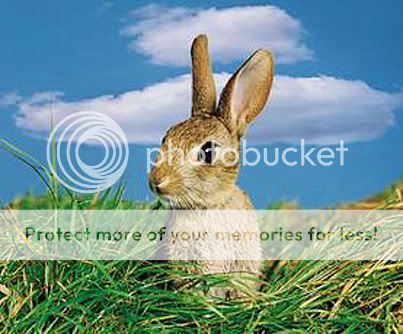 There are two dozen species of Cottontails in the United States, all with similar characteristics. Rabbits are vegetarians eating the inner bark of saplings and shrubs as well as leaves and fruit. They provide a perfect illustration of Nature's balance. Their rapid rate of reproduction is countered by the fact that almost every predatory animal eats them. Cottontail rabbits are quite timid, never venturing too far from the safety of their warrens. Rabbit teaches us through its timidity, to be gentle with ourselves in all situations. The rabbit is often associated with fear because of the nervous energy it expends. They move suddenly and unpredictably. They hop and leap through life asking those with this totem to pay attention to their personal movement. Growth is assured if one is moving in balance with what is in their life. If they are moving to fast or to slow an imbalance occurs and growth is stifled. Rabbits are most visible during dawn and dusk. The sun rising and setting from horizon to horizon holds an air of mystique about it. It is a time when the invisible becomes visible and nature spirits are more pronounced. Because the rabbit and the fairy realms are active during the same time of day it has a strong connection with the magic and mystery of other worlds. To enter this world all that is required is a leap of faith. Sensitive with keen observation skills, the rabbit has strong reflexes that help them dash to safety quickly protecting themselves from danger. They can be seen, disappear and reappear in the twinkling of an eye. Fast, agile and clever they hold the teachings of spontaneous decisive movement. Always knowing which direction to go and when. When rabbit appears it is enabling you to take advantage of opportunities that may only present themselves for brief moments. Rabbits are guides into the shadow world, where all of our personal fears lie. When the rabbit appears it is time to examine those deep reflexive fears that hold you back from growing. Do you keep dashing for the safety of your old patterns every time something new or challenging presents itself? If so the rabbit asks you to face your fears with compassion for yourself. Accept that it is part of human nature to feel fear at times, but also believe that our fears need not paralyze our growth and movement.
|
|
|
|
|
|
|
|
|
|
|
|
|
|
|
|
|
|
Posted: Sun Feb 28, 2010 6:06 am
March's Avatar Contest
Since StarHowl has won twice, she is not allowed to actually be voted on this month. But she can join in on displaying her avatar.
This month theme is St. Patrick's Day. Yes, this will take some creativeness! I wish you all good luck. Please have your avatar up long enough till you get a message stating that its safe to change it. It shouldn't take long, if you notify us that your avatar is ready for judging.
Thank you,
Guardian
|
|
|
|
|
|
|
|
|
|
|
|
|
|
|
Posted: Sun Feb 28, 2010 7:24 am
|
Underworld Priestess Vice Captain
|
|
|
|
|
|
|
|
|
|
|
|
Posted: Sun Feb 28, 2010 11:56 am
Mad as a March Hare
Meaning
Completely mad.
Origin
as mad as a march hareHares have long been thought to behave excitedly in March, which is their mating season. Lewis Carroll is among many who have used that in stories - Alice's Adventures in Wonderland:
"The March Hare ... as this is May, it won't be raving mad - at least not so mad as it was in March."
More recently this behaviour has been questioned and it is now thought that hares behave oddly - boxing, jumping etc. - throughout their breeding season, which extends over several months.
Be that as it may; hares, especially March hares, have that reputation, which will surely stay with them.
The first record of the belief in their madness, or in this case their brainlessness, was circa 1500, in Blowbol's Test reprinted by W. C. Hazlitt in Remains Early Popular Poetry of England, 1864:
"Thanne [th]ey begyn to swere and to stare, And be as braynles as a Marshe hare."
Of course, the phrase 'hare brained' refers to the same behaviour. This is also old and is referenced in Edward Hall's Chronicle, 1548:
"My desire is that none of you be so unadvised or harebrained as to be the occasion that ..."
The first citation that uses the phrase in a form we now know it is in 1529, in Sir Thomas More's The supplycacyon of soulys:
"As mad not as a march hare, but as a madde dogge."
The phrase has been in continuous use in the language since the 16th century. It was well-enough established by 1546 for John Heywood to include it in his collection - A dialogue conteinyng the nomber in effect of all the prouerbes in the Englishe tongue.
|
|
|
|
|
|
|
|
|
|
|
|
|
|
|
Posted: Sun Feb 28, 2010 11:58 am
wow! So much info! I love it!
|
|
|
|
|
|
|
|
|
|
|
|
|
|
|
|
|
|
Posted: Sun Feb 28, 2010 3:27 pm
You guys never cease to amaze with the quality and detail of these newsletters. Sincerest thumbs up here. ;D
|
|
|
|
|
|
|
|
|
|
|
|
|
|
|
|
|
|