|
|
|
|
|
|
|
|
|
 Posted: Mon Mar 15, 2010 1:58 pm Posted: Mon Mar 15, 2010 1:58 pm
Due to a show of interest in my research, I'll be posting a copy of my paper here. Enjoy, and feel free to ask questions!
|
 |
|
|
|
|
|
|
|
|
|
|
|
|
|
Posted: Mon Apr 26, 2010 8:03 pm
|
|
|
|
|
|
|
|
|
|
|
|
|
Posted: Mon Apr 26, 2010 8:05 pm
INTRODUCTION:
You find yourself deep in a dark cavern made completely of ice and snow. Above you, the moon and stars faintly shine through thin patches and cracks in the ice, giving the whole room a shadowy blue illumination. You are up to your waist in soft powdery snow, which broke your fall from the surface ice. Despite this, it feels noticeably warmer than outside. Slowly, you trudge through the snow towards the nearest wall. There you find a ledge of solid ice you can climb up onto. Beyond the ledge is a dark tunnel, out of reach from the starlight above. Upon closer examination, you see that the tunnel was carved out; it is covered in giant claw marks. You have found the entrance to the dragon’s keep.
Not everyone plays role-playing games, but everyone at some point in their life has role-played. Whether it be cops and robbers as a child, trying to fit into a social cliché as a teenager, or going through a training session at work as an adult. No matter the context, the method is still the same: you take on the characteristics of something you’re not, and act on it, pretending to be your new character. It takes a certain amount of imagination and an open mind to role-play, and it’s these skills that I am interested in. The debate goes on about whether or not role-playing games, or RPGs, are poisoning the young minds of our children, giving them false identities and corrupting their moral values. The advocates of these statements say that the games teach the young and impressionable bad habits. What I want to know is not if playing RPGs will turn you into a serial killer, but what can you learn from playing, and are these skills applicable to real life.
First, let’s take a look at how the love for the love for role-playing games develops. At a young age, children tell stories. Not only are these games, but an important social event. “…Children’s interactions with each other contributed to the modification, expansion, increased coherence, and complexity of their anecdotes and stories,” (Cassell 76) skills that they will be using for the rest of their lives. The role-play aspect of these games is reinforced as children take turns telling or interacting with one another’s stories (Cassell). The next step is the child’s continued interest in RPGs. Even though these games are for recreation, there are certain skills that are necessary in order to fully enjoy these games. Communication, planning, and teamwork are crucial, so it is important that these skills are acquired and refined in order for a player to fully participate in the games, and therefore, in the community (Colby). In text-based RPGs, players can do anything. Because of this, special critical thinking skills develop out of the need to make a quick decision while role-playing. The “Game Master,” or whoever is in charge of the game being played, challenges players to solve problems in unconventional ways, so players must use critical thinking skills in order to survive (Fleischer. Miller. Ryan).
As with any skill, critical thinking that is learned from playing RPGs is improved with each play session. Players must visualize maps and images. They are challenged to solve problems in new ways, ones that just aren’t possible in real life. Even though this critical thinking is used for gaming, they are still utilizing important skills. Not only are they improving the ability to think critically, but the ability to tell a story; that’s what role-play is after all! All of these skills can be applied to real life situations. (Jackson. Miller. Ryan).
We know that playing RPGs requires on the spot decision making and critical thinking skills. We know that players are required to solve unusual problems in an unconventional way. However, there is little research on how these skills are used not from a psychological standpoint, but from a composition standpoint. Incoming freshmen enter a whole new world when taking their first year of college composition. Are the ones accustomed to dungeon-delving in fantasy worlds more prepared?
|
|
|
|
|
|
|
|
|
|
|
|
|
|
|
Posted: Mon Apr 26, 2010 8:07 pm
METHODS:
My very first question on the subject was what skills can be learned from playing role-playing games, and whether or not can they be used in a real life situation. Next, could these same skills be gained by playing video games, or does the pre-rendered world given to players negate the need and therefore the honing of playing skills. Finally, I took a look at not just the players of role-play, but the creators. Game masters and dungeon masters have to create campaigns and change events they have planned as the game progresses. Is this any different from writing a story? What effects does storytelling have on critical thinking skills?
My first step in finding answers to these questions was to survey a sample from the population. I wanted my results to fall into one of four categories: role-playing for those who mostly play table-top role-playing games, video gamers, for those who play their games on some sort of virtual console, and a storywriter’s survey, for those who write fiction. I excluded non-fiction writers because I was more interested in the imagination and creative aspect used in building a fictional world. The final category was a survey for anyone who did not fall into those categories, purely as a control group.
In each survey, I began with the same four questions. First is a question about letter grades received in composition class to be used as a reference point to reading and writing ability. Next is a question asking participants to rate their own ability to visualize people, places, and things, along with mental maps. The third standard question is an open-ended question asking participants what strategies they use when they come across a difficult problem, or something they don’t understand. Finally, there is a speculative question about the differences between stories and games. This question served not only as a window into each group’s opinion, but the response can be analyzed as a piece of text from the participant, to look for critical thinking and composition skills.
In addition to the above, the gamer surveys include questions about the imagination difference between video games and table-top games, an open ended question about what participants do when stuck in a game, and a question asking if they have ever solved a real life problem with skills learned from a video game. In the table-top survey, I asked about the imagination involved during play, skills from games used in real life, and problems in real life solved by using problem solving from games. Finally in the storywriter’s survey, I asked how the writer overcomes writer’s block, and asked if they have ever solved a problem in real life using a method they have used in a story they’ve written.
I first distributed these surveys over the internet, through two different “guild” networks; one guild dedicated to text-based games, and the other a video game guild. In both guilds, the surveys were featured in an announcement, which could be viewed by all members of the guild. This ensured that I would be able to target my desired population. I then passed out hard copies of links to the survey on campus. Due to the anonymous nature of the online surveys, I can only guess about the participant’s age range, gender, nationality, occupation, and other identifying traits. Thankfully, they only trait I’m interested in is the hobby of my samples.
To analyze these results, I first sorted each by the categories and the letter grades, as an initial show of critical thinking and composition skills. I then compared the answers to the questions of “how do you solve problems in your hobby” and “how do you solve problems in real life,” seeing if I could make any connections. Finally, I paid close attention to the open-ended responses as a whole to determine how each participant handled each question, analyzing the content, and sentence structure of each.
Through the course of this research, I ran into multiple errors; the first of which was my concern for the honesty of the surveys. According to my research, none of my participants received anything below a C letter grade. I found that highly unlikely; my doubts further increased by the poor grammar and spelling used in some of the surveys. Another problem with the online surveys was some of the participant’s answers had no useful information in them. Sometimes I got a simple yes or no, when I was hoping for an elaboration. Overall, I am happy with the few detailed responses I did receive. Also, I should have done an interview with at least one person, but I have yet to meet a text-based role-player face-to-face. I believe that an in-person interview would yield better results than an online meeting. This type of interview could not only give me more in-depth questions that I could not have prepared before hand, but I could ask them to elaborate on an answer I found could be particularly helpful.
|
|
|
|
|
|
|
|
|
|
|
|
|
|
|
|
|
|
Posted: Mon Apr 26, 2010 8:10 pm
Results and Discussion: The very first thing I noticed was the sheer amount of role-players that were actually writers as well. Nearly everyone, be it player or game master, writes in their spare time. Because role-playing is such an active job, the act of writing a story comes naturally to them. Playing such a games is, after all, just telling an interactive story with multiple authors. Next is the final grade distribution. By far the best grades were achieved by the writers. Not only do they hold the highest percentage of A’s, but they have zero C’s. (Figure 1.3) These amazing grades are followed next by the role-players, who have an equal amount of As and B’s, and a small percentage of C’s. (Figure 1.1) While there are a lot more B’s and C’s compared to the writers, they are still much better scores than you would expect to find if you were to survey an entire class. Finally, the video game players have the lowest grades of the three. More than half have just B’s, while the remaining 47% have either an A or a C, the two being closed to tied. (Figure 1.2) 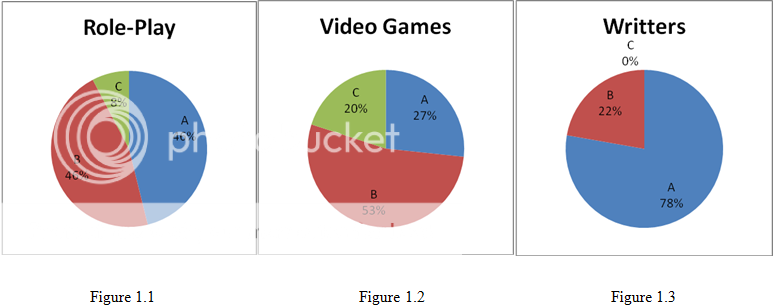 When looking at the responses to the open-ended questions, a curious pattern develops. Aside from the obvious social and mathematical skills prastised when playing a dice game with a tableful of people, learning techniques are developed as well. Some role-player look at a new or difficult concept as a map; with more reserch, they uncover more portions of this map, and gain some understanding. Some claim that the daunting process of following the intricate rules of such games has improved their organizational abilities. Learning could be even as simple as learning a new word. “…knowing different vocabulary from [Dungeons and Dragons] has been known to help in crossword puzzles.” says survey number eight (Appendix A). Another interesting connection is that some of the skills used to solve an in-game problem are similar to what a gamer would do in real life. Survey 9 comments that they “have been known to sketch something out for confused players in game as well as for confused people outside of games” (Appendix A). When they had problems with research or understanding a new concept, the video game players they would ask for help. The interesting connection here is that when they were faced with a problem in a game, they would look up a strategy guide, look up an answer, or ask for someone else’s help. In both situations, the gamer is looking to outward sources for help or answers when faced with something they could not understand. The writers had a more symbolic way of solving problems. I gave them a specific problem to solve (writer’s block), and many of the answers dealt with music, sleeping, reading and sometimes, more writing. When faced with a difficult concept, most bring out the big books, sit down, and do the research. Those who love to write love to read. My final observation of interest is the differences of writing styles of the three groups. My longest responses came from the text-based group. It looked like these responses took the longest time to write. Every detail was explained. The writers left more symbolic responses. Many of the responses sought to explain the answers in a more artistic manner than ‘just saying it.’ Finally, the shortest and most grammatically incorrect responses came from the video gamers. Most of the answers were short, fragmented sentences that barely answered the question, if at all. Not only were the answers short and less-than-sweet, most looked past the point of the question and gave obvious answers. When asked about real life situations solved with skills learned from video games, participants didn’t look past the fighting aspect: “yeah but it usually comes around to fighting...not much else...>_> unless my world gets blown up and i have to kick the s**t outta [the bad guy] just to make my girlfriend happy....but that hasnt happened...yet” remarks Survey 7 (Appendix B). Role-players and writers share many similarities in their hobbies. Both are creating new worlds, and filling them with their own original characters. Both have to think of new situations, and solve problems that arise in their worlds. When playing video games, the world, the characters, and the situation are already planned and pre-determined. Sure, you may run across a new problem, but these occasions in video games are rare, because the technological and programming aspects restrict the world. On the other hand, writing and text-based RPGs are limited only by words, so there are an infinite amount of problems, with an infinite amount of solutions. In order to survive such a game, players must learn to keep on their toes, and to expect the unexpected. The most interesting part of the research, in my opinion, is that no matter the discrepancies and contradictions in some of the answers, every group agreed on just one fact: a game is a pre-made world that only requires exploring, and a story is fashioned from an author’s or dungeon master’s mind. The writer Survey 3 puts it into the best words: “A game is someone else's world, you're just a visitor. In making up a story, the setting, concepts, laws, inhabitants and everything else are yours. The world is you, and you are the world. There's only a fine line between you and your story” (Appendix C).
|
|
|
|
|
|
|
|
|
|
|
|
|
|
|
Posted: Mon Apr 26, 2010 8:19 pm
CONCLUSION:
My research shows that it is not just the love of fantasy or even role-play that improves the critical thinking skills that are necessary for composition classes. It’s the writing and creating aspect that connects the two. Because such unconventional thinking is required for both hobbies, a greater need develops for such skills. Because video games are pre-rendered and don’t require creation on the part of the player, gamers do not develop the same skills that they use in a composition class. Because they always have someone or something to look to or ask for help, they don’t develop the research or problem solving skills that the writers and role-players do.
This is a very shallow step into the ocean of RPGs and writing. More studies need to be done with face-to-face interviews, observations of a player writing, solving problems, and playing their games, and in-depth analysis of their research skills. With more research, we can discover more ways of teaching composition. Encouraging students to write in their spare time may not only improve grades, but improve the skills that students need. Traditional critical thinking and problem solving skills are becoming less and less valuable in a world that is constantly up-grading to the new technology. Students need to learn to adapt to this changing situation. There may be a hidden jewel in the controversial practice of role-playing. After all, adapting and surviving in a new world is what it’s all about.
|
|
|
|
|
|
|
|
|
|
|
|
|
|
|
|
|
|
Posted: Mon Apr 26, 2010 8:22 pm
Works Cited
Cassell, Justine. "Towards a model of technology and literacy development: Story listening ."
Journal of Applied Developmental Psycholog 25.1 (2004): 75-105. Web. 3 Mar 2010.
Colby, Rebekah Shultz, and Richard Colby. "A Pedagogy of Play: Integrating Computer Games
into the Writing Classroom." Computers and Composition 25.3 (200 cool : 300-312. Web. 3 Mar 2010.
Fleischer, S.. “Playing with identity: Literacy, discourse, and identity in role-playing gaming.”
Diss. University of Louisville, 2007. Dissertations & Theses: Full Text, ProQuest. Web. 3 Mar. 2010.
Jackson, Zoevera Ann. “Connecting Video Games and Storytelling to Teach Narratives In First-
Year Composition.” Kairos 7.3 (2002) web. 20 Feb. 2010.
Miller, John. "Role Playing Games as Interactive Fiction." Reconstruction:Studies in
Contemporary Culture 6.1 (2006): n. pag. Web. 3 Mar 2010.
Ryan, Marie-Laure. "From Playfields to Fictional Worlds: A Second Life for Ariosto." New
Literary History: A Journal of Theory and Interpretation 40.1 (2009): 159-176. MLA International Bibliography. EBSCO. Web. 3 Mar. 2010.
|
|
|
|
|
|
|
|
|
|
|
|
|
|
|
Posted: Mon Apr 26, 2010 8:26 pm
APPENDIX A: SURVEY RESULTS FOR TEXT-BASED GAMERS
Sample 1
1. What was your average grade in composition classes? This includes Writing, English, Literature etc.
Letter Grade
Grade: A
2. How good are you at imagining things, or making mental images?
Poor (1) Fair (2) Average (3) Good (4) Awesome (5)
Imagination X
Mental Maps X
Mental Images X
3. What do you do when you come across an idea or concept you don’t understand?
I try to research it as well as I can, and figure out how it works. I'm usually curious about it and want to know more so I can better understand it.
4. What’s the difference between playing a game, and making up a story?
In my case, the only difference is the fact that when I'm playing a game, I am doing it together with other people, and we all put similar effort into the story. When making up a story on my own, I only have myself to rely on, and might not get as much new input. ^^
5. When you play a game, how much imagination is involved?
Depends on the game. If there's a Game Master involved, my imagination may be limited, but more often than not I play free-world rpgs, and that's when I need to use my imagination all the time. Together with the other players, I have to build a believable world, good character interaction, and character development. It demands quite a lot.
6. Do you use any skills you would use to play the game to solve real life problems? How? For example, would you "Map out" a difficult idea like you would make a map of an area?
I actually use a lot of the character interactions I've used in the roleplay, and the ability to put myself in someone else's shoes, attempting to see the situation from the other person's view in arguments and such.
7. Have you encountered a problem in real life that you solved by relating it to a problem you’ve solved in a game?
Yes, multiple times. Mostly arguments.
Sample 2
1. What was your average grade in composition classes? This includes Writing, English, Literature etc.
Letter Grade
Grade: B
2. How good are you at imagining things, or making mental images?
Poor (1) Fair (2) Average (3) Good (4) Awesome (5)
Imagination X
Mental Maps X
Mental Images X
3. What do you do when you come across an idea or concept you don’t understand?
Try to write down the concept and try to shape it
4. What’s the difference between playing a game, and making up a story?
When you make up a story, you have to be willing to improvise
5. When you play a game, how much imagination is involved?
As much I can, but nothing way too simple or complex
6. Do you use any skills you would use to play the game to solve real life problems? How? For example, would you "Map out" a difficult idea like you would make a map of an area?
Draw it out and refine it with my ideas
7. Have you encountered a problem in real life that you solved by relating it to a problem you’ve solved in a game?
A few times but nothing too big that I remember it
Sample 3
1. What was your average grade in composition classes? This includes Writing, English, Literature etc.
Letter Grade
Grade: B
2. How good are you at imagining things, or making mental images?
Poor (1) Fair (2) Average (3) Good (4) Awesome (5)
Imagination X
Mental Maps X
Mental Images X
3. What do you do when you come across an idea or concept you don’t understand?
I tend to stop and examine it for a while to see if I can make sense of it.
4. What’s the difference between playing a game, and making up a story?
When I'm playing a game, I never know what's going to come next. Making up a story, to me, is akin to crafting a fine piece of art; it's very deliberate.
5. When you play a game, how much imagination is involved?
It depends on the game. Granted, any game can become more intricate with judicious application of imagination, but some are more malleable than others.
6. Do you use any skills you would use to play the game to solve real life problems? How? For example, would you "Map out" a difficult idea like you would make a map of an area?
To tell the truth, I don't very often run into the sort of problem that can be solved like that. Most of my problems are interpersonal or introspective.
7. Have you encountered a problem in real life that you solved by relating it to a problem you’ve solved in a game?
I'm sure I have, but I can't recall one at the moment.
Sample 4
1. What was your average grade in composition classes? This includes Writing, English, Literature etc.
Letter Grade
Grade: A
2. How good are you at imagining things, or making mental images?
Poor (1) Fair (2) Average (3) Good (4) Awesome (5)
Imagination X
Mental Maps X
Mental Images X
3. What do you do when you come across an idea or concept you don’t understand?
Research for a different portrayal, or explanation.
4. What’s the difference between playing a game, and making up a story?
With making up a game, you have the story and concept of characters from different people. Sometimes the plot will go in a direction you could never guess. When making a story, you still have an inkling of what's going to happen, but you can never fully predict others.
5. When you play a game, how much imagination is involved?
Quite a bit, as you're acting out your own character and reacting to others as if they exist. As a game master, its your job to create worlds, but there is still a great level of imagination involved in visualizing everything.
6. Do you use any skills you would use to play the game to solve real life problems? How? For example, would you "Map out" a difficult idea like you would make a map of an area?
Many dice games involve a bit of math, as well as vocabulary that you don't usually hear. However, I found that the greatest effect on my real life was learning leadership and management.
7. Have you encountered a problem in real life that you solved by relating it to a problem you’ve solved in a game?
Actually, yes. I met a particularly difficult person to deal with, who wasn't unlike an npc I encountered. Using diplomacy, I managed to take care of this customer's issue. Didn't have to kill anyone this time though...
Sample 5
1. What was your average grade in composition classes? This includes Writing, English, Literature etc.
Letter Grade
Grade: C
2. How good are you at imagining things, or making mental images?
Poor (1) Fair (2) Average (3) Good (4) Awesome (5)
Imagination X
Mental Maps X
Mental Images X
3. What do you do when you come across an idea or concept you don’t understand?
Attempt to understand it.
4. What’s the difference between playing a game, and making up a story?
Creating a story involves complex creation, adaptability, ingenuity and skill. Whereas simply playing a game requires ingenuity, some skill, and luck..
5. When you play a game, how much imagination is involved?
Depends on the game. If its simply hack-and-slash, little, if it involves creativity, role playing, and/or vivid descriptions of whats happening.
6. Do you use any skills you would use to play the game to solve real life problems? How? For example, would you "Map out" a difficult idea like you would make a map of an area?
I honestly haven't run into a situation where I have had to.
7. Have you encountered a problem in real life that you solved by relating it to a problem you’ve solved in a game?
Nope.
Sample 6
1. What was your average grade in composition classes? This includes Writing, English, Literature etc.
Letter Grade
Grade: B
2. How good are you at imagining things, or making mental images?
Poor (1) Fair (2) Average (3) Good (4) Awesome (5)
Imagination X
Mental Maps X
Mental Images X
3. What do you do when you come across an idea or concept you don’t understand?
Look it up, or use context clues
4. What’s the difference between playing a game, and making up a story?
not much.
5. When you play a game, how much imagination is involved?
Quite a bit, as you have to imagine your characters, what they are fighting etc etc.
6. Do you use any skills you would use to play the game to solve real life problems? How? For example, would you "Map out" a difficult idea like you would make a map of an area?
Problem solving skills are useful everywhere.
7. Have you encountered a problem in real life that you solved by relating it to a problem you’ve solved in a game?
Yes
Sample 7
1. What was your average grade in composition classes? This includes Writing, English, Literature etc.
Letter Grade
Grade: A
2. How good are you at imagining things, or making mental images?
Poor (1) Fair (2) Average (3) Good (4) Awesome (5)
Imagination X
Mental Maps X
Mental Images X
3. What do you do when you come across an idea or concept you don’t understand?
I attempt to relate it to something I do understand by coming up with a set of mechanics for it. Failing that, I let it be.
4. What’s the difference between playing a game, and making up a story?
A game has rules to define what you can and can't do, in order to prevent exchanges such as "Ha! I shot you with my super laser beam!" "Nuh-uh! I have a shield that blocks everything!" "Well my laser goes through shields, even shields that block everything!"
5. When you play a game, how much imagination is involved?
As much as I can manage. I put a lot of effort and imagination into creating and playing characters in a realistic and enjoyable manner.
6. Do you use any skills you would use to play the game to solve real life problems? How? For example, would you "Map out" a difficult idea like you would make a map of an area?
Occasionally. Processes such as character creation have helped me to get better at creating and organizing lists.
7. Have you encountered a problem in real life that you solved by relating it to a problem you’ve solved in a game?
None that come to mind
Sample 8
1. What was your average grade in composition classes? This includes Writing, English, Literature etc.
Letter Grade
Grade: A
2. How good are you at imagining things, or making mental images?
Poor (1) Fair (2) Average (3) Good (4) Awesome (5)
Imagination X
Mental Maps X
Mental Images X
3. What do you do when you come across an idea or concept you don’t understand?
I analyze or research it until I do
4. What’s the difference between playing a game, and making up a story?
When you play a game you're only part of the story. When you make up the story you're creating a world for other people to play in.
5. When you play a game, how much imagination is involved?
Some, not as much as when scripting a game.
6. Do you use any skills you would use to play the game to solve real life problems? How? For example, would you "Map out" a difficult idea like you would make a map of an area?
I use diplomacy a lot and have been known to map out areas that I wasn't familiar with. Depending on the situation I also use the same tactical thinking that I use when I am playing in a game. Also, knowing different vocabulary from DnD has been known to help in crossword puzzles.
7. Have you encountered a problem in real life that you solved by relating it to a problem you’ve solved in a game?
Not yet, no.
Sample 9
1. What was your average grade in composition classes? This includes Writing, English, Literature etc.
Letter Grade
Grade: A
2. How good are you at imagining things, or making mental images?
Poor (1) Fair (2) Average (3) Good (4) Awesome (5)
Imagination X
Mental Maps X
Mental Images X
3. What do you do when you come across an idea or concept you don’t understand?
Depends on the origin of the idea/concept. If it is an applied knowledge (such as mathematical equations), then I try to find a worked-out example and go from there, or at least work out the problem in writing. If it is a more visual concept or a design idea, then I try to work it out in my head--but I may resort to drawing a sketch if need be.
4. What’s the difference between playing a game, and making up a story?
Playing a game (either as a video game or a tabletop game) is inherently more passive than creating a story. Although--along with going with the flow--there can be a lot quick-thinking/acting and puzzle-solving. There is also some additional work on the player's part with pen-and-paper games as far as visualizing the scene. Modern video gamers have had little need to truly visualize an image. Some players may even play AS the characters instead of just THROUGH them. This can also be said for Video Games, as my brother and I play many RPGs and sandbox games as different characters with different motivations (not just good to be good or evil to be evil). Coming up with a unique set of character motives/inspirations and sticking to them can lead to a much longer lifetime with either type of game. Preparing a story is an entirely different obstacle. Although there are many similar challenges as playing a game; making a story (or a plot for a game) involves the considering all roles/characters (Player and Non-Player) and not just a single Player Character. Writing for a story has a chance to tax the creator's imagination as they have to think on how each character would react to an event. Compared to writing a game plot, the creator may depend on a little help from the players to help the narrative along.
5. When you play a game, how much imagination is involved?
Personally--being stuck as the Game Master (or GM) most all of the time--I have found the role of GM highly challenging in terms of imagination. No matter how much planning and plotting I make, I could never plan everything my fellow players would come up with. This leads to a lot of thinking on the spot and rewriting the overall narrative in my head while a player does something unexpected. All this time I am also trying to keep the players entertained and buy time by describing everything happening in a scene accordingly. As a Player Character (or PC), I can be viewed as a boon or bane to my fellow PC and the GM. I tend to prefer playing humorous, over-the-top characters (perhaps with another voice than my usual one), and trying to get a few laughs with my antics, speech, and overall survival. This way I get a similar amount of stimulus as if I were running the game; but I do admit it is easier--except GMs can't die, but PCs can.
6. Do you use any skills you would use to play the game to solve real life problems? How? For example, would you "Map out" a difficult idea like you would make a map of an area?
I have been known to sketch something out for confused players in game as well as for confused people outside of games. However, I don't believe this comes up very often--I suppose I'm getting more practice with describing what's going on in my head in words and not relying on drawing things out. Furthermore, I do--like the geek that I am--enjoy to brainstorm current and future campaigns while stuck with nothing to do at work. I also find that my writing of huge epic plots may lead to my excessive verbosity (this helps a lot with college reports).
7. Have you encountered a problem in real life that you solved by relating it to a problem you’ve solved in a game?
Frankly, no. However, I do believe that the processes involved in Tabletop gaming exercise a gamer's ability to think outside the box. I would also add that video games do exercise hand-eye coordination, as well as act as a great stress reliever (if the player knows their own limits).
Sample 10
1. What was your average grade in composition classes? This includes Writing, English, Literature etc.
Letter Grade
Grade: B
2. How good are you at imagining things, or making mental images?
Poor (1) Fair (2) Average (3) Good (4) Awesome (5)
Imagination X
Mental Maps X
Mental Images X
3. What do you do when you come across an idea or concept you don’t understand?
Think about it and attempt to understand it.
4. What’s the difference between playing a game, and making up a story?
Playing a game is less active. The story is already there for you...
5. When you play a game, how much imagination is involved?
The game has alot of imagination, but I don't utilize much of my own.
6. Do you use any skills you would use to play the game to solve real life problems? How? For example, would you "Map out" a difficult idea like you would make a map of an area?
Not really...
7. Have you encountered a problem in real life that you solved by relating it to a problem you’ve solved in a game?
Not really, unless you include strategy guides...
Sample 11
1. What was your average grade in composition classes? This includes Writing, English, Literature etc.
Letter Grade
Grade: B
2. How good are you at imagining things, or making mental images?
Poor (1) Fair (2) Average (3) Good (4) Awesome (5)
Imagination X
Mental Maps X
Mental Images X
3. What do you do when you come across an idea or concept you don’t understand?
I attempt to put that idea or concept within terms that I may comprehend, and then relate it to another. I think communicate in an attempt to grasp the concept with the aid of said person.
4. What’s the difference between playing a game, and making up a story?
Playing a game is different from creating a story because it's like reading a book. You start the game (open the book) and begin to read (play). As the game goes on you learn more and more about the world, the characters, and the environment. It's hopefully a really fun, and exciting experience. Writing the story/making the game is MUCH more difficult, and not as fun sometimes, but does have it's own rewards of excitement and joy. You're creating something which you hope is amazing, and it's your very own. Your desire is to make something wonderful that others can enjoy, and it just makes you feel happy that you can create something that both you and others will love to read/play.
5. When you play a game, how much imagination is involved?
Although realism is a huge thing to me, I realize that fantasy needs to take precedent sometimes. Imagination doesn't always have to involve fantasy however, and so imagination in my opinion is a huge part of games that I play. In fact I believe that imagination is a part of every game, or at least every good game. Without imagination the game itself would not be possible, and so I think that such a trait is a vital aspect of all games.
6. Do you use any skills you would use to play the game to solve real life problems? How? For example, would you "Map out" a difficult idea like you would make a map of an area?
Well, by playing Dungeons and Dragons PbP and DMing some games. I have to use basic math which helps me to increase my mathematical abilities obviously. I also need to create stories for the game, or randomly make things up as best I can. I am a bit indecisive so I tend to use "luck" to my will. I do this by creating tables with which I roll a die and take the result, or by flipping a coin. "Heads or tails". If I had to map out an idea, like say perhaps how to infiltrate an enemy camp. If I had the time and required so would perhaps write out the steps required in order to do so. Step 1 Step 2 Step 3 (Step 4 is variable depending upon the situation which step 3 leads to) Step 4a Step 4b I wouldn't necessarily have to write such a plan out, but could picture it mentally. I have also learned the bulk of my English writing/reading capabilities from playing Role Playing Games that include a ton of text walls. >.>
7. Have you encountered a problem in real life that you solved by relating it to a problem you’ve solved in a game?
I would have to say that I perhaps have, but only with the aspects that I've learned from games. I tend to play Role Playing Games, and am usually always on the good side of things. Seldom is it that I ever play an evil role. Thus I am thrown into moral complications in which a decision must be made. Or that of evil trying to get its nasty little way. Unfortunately I am unable to think of something to relate at the moment. I apologize if my information was not helpful, and I wish you good luck with your work.
Sample 12
1. What was your average grade in composition classes? This includes Writing, English, Literature etc.
Letter Grade
Grade: A
2. How good are you at imagining things, or making mental images?
Poor (1) Fair (2) Average (3) Good (4) Awesome (5)
Imagination X
Mental Maps X
Mental Images X
3. What do you do when you come across an idea or concept you don’t understand?
If it perks my interest, I look into it.
4. What’s the difference between playing a game, and making up a story?
Making up a story involves plotting out what each character will do and how they will react, while playing a game takes most of that out of your hands.
5. When you play a game, how much imagination is involved?
A good amount.
6. Do you use any skills you would use to play the game to solve real life problems? How? For example, would you "Map out" a difficult idea like you would make a map of an area?
Yes, I've solved problems in game in similar ways to how I would solve the same problems if I had them in real life.
7. Have you encountered a problem in real life that you solved by relating it to a problem you’ve solved in a game?
not yet.
Sample 13
1. What was your average grade in composition classes? This includes Writing, English, Literature etc.
Letter Grade
Grade: B
2. How good are you at imagining things, or making mental images?
Poor (1) Fair (2) Average (3) Good (4) Awesome (5)
Imagination X
Mental Maps X
Mental Images X
3. What do you do when you come across an idea or concept you don’t understand?
I usually look it up on the web
4. What’s the difference between playing a game, and making up a story?
Stories require more thought, whereas games require putting yourself inside of someone else's story.
5. When you play a game, how much imagination is involved?
Plenty, staying in character is hard
6. Do you use any skills you would use to play the game to solve real life problems? How? For example, would you "Map out" a difficult idea like you would make a map of an area?
not really
7. Have you encountered a problem in real life that you solved by relating it to a problem you’ve solved in a game?
not at all, considering the joking nature of most of my games.
|
|
|
|
|
|
|
|
|
|
|
|
|
|
|
|
|
|
Posted: Mon Apr 26, 2010 8:30 pm
APPENDIX B: SURVEY RESULTS FOR VIDEO GAMERS
Sample 1
1. What was your average grade in composition classes? This includes Writing, English, Literature etc.
Letter Grade
Grade: B
2. How good are you at imagining things, or making mental images?
Poor (1) Fair (2) Average (3) Good (4) Awesome (5)
Imagination X
Mental Maps X
Mental Images X
3. What do you do when you come across an idea or concept you don’t understand?
i research it .
4. What’s the difference between playing a game, and making up a story?
way different one is made by some one other then you also video games let you interact with it.
5. Does playing video games take just as much imagination as playing a pen-and-paper or table-top game?
yes indeed it does.
6. What do you do when you get stuck in a video game?
level up whats else can you do?
7. Have you encountered a problem in real life that you solved by relating it to a problem you’ve solved in a game?
some times yes.
Sample 2
1. What was your average grade in composition classes? This includes Writing, English, Literature etc.
Letter Grade
Grade: B
2. How good are you at imagining things, or making mental images?
Poor (1) Fair (2) Average (3) Good (4) Awesome (5)
Imagination X
Mental Maps X
Mental Images X
3. What do you do when you come across an idea or concept you don’t understand?
I draw a picture of it, or I simplify it down into a blunt sentence.
4. What’s the difference between playing a game, and making up a story?
A game is a pre-made world. It's someone else's imaginatation, and you as the gameplayer are priveliedged to get a look at this person's (or multiple people's) mind.
5. Does playing video games take just as much imagination as playing a pen-and-paper or table-top game?
In some ways, yes. You need to have a good deal of imagination if you really want to immerse yourself fully into this world you're visiting.
6. What do you do when you get stuck in a video game?
You try every possibility you cn think of. If this doesn't work, you consult someone who got past it.
7. Have you encountered a problem in real life that you solved by relating it to a problem you’ve solved in a game?
I have a very adept sense of polar direction. Dungeons and city streets are not all that different, really! Hahaha!
Sample 3
1. What was your average grade in composition classes? This includes Writing, English, Literature etc.
Letter Grade
Grade: C
2. How good are you at imagining things, or making mental images?
Poor (1) Fair (2) Average (3) Good (4) Awesome (5)
Imagination X
Mental Maps X
Mental Images X
3. What do you do when you come across an idea or concept you don’t understand?
I usually ask for advice or help..something like that razz
4. What’s the difference between playing a game, and making up a story?
Playing a game...I guess you can say you're playing a story that someone has made already, and it could either be good or bad..GOOD like KH > biggrin But making up a story is making a story of your own that you probably got an idea from playing a game or just though about it from the top of your head...I don't know..thats what I think xD
5. Does playing video games take just as much imagination as playing a pen-and-paper or table-top game?
AH! well I don't think it does..I don't really play much pen-and-paper or table-top games cuz they bore me to death D< so thats why I usually play video games..so yeah....It depends I guess you can say though..
6. What do you do when you get stuck in a video game?
Oh dear..this reminds me of when I was trying to defeat Sephiroth in KH2FM+ ON critical mode. D< If you've SEEN Sora's life on critcal you could just IMAGINE how hard Sephiroth was to defeat..I truely was stuck...I managed to defeat him though. biggrin When I was stuck..I equipped sora with more potions and stuff like that and a stronger keyblade and abilities. I even had a glass of water with me and the FF7 Advent Children Sephiroth theme playing while fighting Sephiroth in KH. I even paused a few times to relax cuz I knew I was close to defeating him or any other boss in a game..it took another few times but I was able to defeat him...so This is what I do..Glass of water..Listen to kick a** music that would go well with the boss battle..and pause a few times and relax when you know you're getting close to defeating that boss or w/e..it works for me..idk if it works for others...(btw sorry about the long story xD )
7. Have you encountered a problem in real life that you solved by relating it to a problem you’ve solved in a game?
Hmm..I believe I have..yet I can't really remember what though..I think it had to do something with Star Wars O-O MAY THE FORCE BE WITH YOU D:< (ahah yeah..fail)
Sample 4
1. What was your average grade in composition classes? This includes Writing, English, Literature etc.
Letter Grade
Grade: B
2. How good are you at imagining things, or making mental images?
Poor (1) Fair (2) Average (3) Good (4) Awesome (5)
Imagination X
Mental Maps X
Mental Images X
3. What do you do when you come across an idea or concept you don’t understand?
If I don't understand something I normal try to figure it out myself. But most of the time I just ask for help.
4. What’s the difference between playing a game, and making up a story?
The difference between making up a story is that you're using you imagination to create a fictional story, while as if you were to play a game.. you are only using your brain to think.
5. Does playing video games take just as much imagination as playing a pen-and-paper or table-top game?
I would say so.
6. What do you do when you get stuck in a video game?
I try to find a way around it or I look up the cheats.
7. Have you encountered a problem in real life that you solved by relating it to a problem you’ve solved in a game?
No
Sample 5
1. What was your average grade in composition classes? This includes Writing, English, Literature etc.
Letter Grade
Grade: B
2. How good are you at imagining things, or making mental images?
Poor (1) Fair (2) Average (3) Good (4) Awesome (5)
Imagination X
Mental Maps X
Mental Images X
3. What do you do when you come across an idea or concept you don’t understand?
ponder it for awhile
4. What’s the difference between playing a game, and making up a story?
playing a game is easier/ more fun/ takes more skill
5. Does playing video games take just as much imagination as playing a pen-and-paper or table-top game?
it depends on the game
6. What do you do when you get stuck in a video game?
give up and try again in a month or so
7. Have you encountered a problem in real life that you solved by relating it to a problem you’ve solved in a game?
yes, i have
Sample 6
1. What was your average grade in composition classes? This includes Writing, English, Literature etc.
Letter Grade
Grade: B
2. How good are you at imagining things, or making mental images?
Poor (1) Fair (2) Average (3) Good (4) Awesome (5)
Imagination X
Mental Maps X
Mental Images X
3. What do you do when you come across an idea or concept you don’t understand?
Either think outside the box or get people to help me figure it out.
4. What’s the difference between playing a game, and making up a story?
playing video games allows you to interact virtually, while a story requires you to visualize the action mentally.
5. Does playing video games take just as much imagination as playing a pen-and-paper or table-top game?
At times yes. If it a strategy-based game, it take a lot of it.
6. What do you do when you get stuck in a video game?
i play until i make it through. Sometimes i have to quite because it gets boring redoing the same thing over and over again.
7. Have you encountered a problem in real life that you solved by relating it to a problem you’ve solved in a game?
No, cant say that I have.
Sample 7
1. What was your average grade in composition classes? This includes Writing, English, Literature etc.
Letter Grade
Grade: B
2. How good are you at imagining things, or making mental images?
Poor (1) Fair (2) Average (3) Good (4) Awesome (5)
Imagination X
Mental Maps X
Mental Images X
3. What do you do when you come across an idea or concept you don’t understand?
try to figure it out on my own...usually thinking about the idea and everything it could mean
4. What’s the difference between playing a game, and making up a story?
playing a game is listening to someone else's story and making your own is imagining how you think things would be more interesting
5. Does playing video games take just as much imagination as playing a pen-and-paper or table-top game?
depends on the game
6. What do you do when you get stuck in a video game?
go everywhere i've already been before...talk to everybody...and kill everything
7. Have you encountered a problem in real life that you solved by relating it to a problem you’ve solved in a game?
yeah but it usually comes around to fighting...not much else...>_> unless my world gets blown up and i have to kick the s**t outta Ansem just to make my girlfriend happy....but that hasnt happened...yet
Sample 8
1. What was your average grade in composition classes? This includes Writing, English, Literature etc.
Letter Grade
Grade: B
2. How good are you at imagining things, or making mental images?
Poor (1) Fair (2) Average (3) Good (4) Awesome (5)
Imagination X
Mental Maps X
Mental Images X
3. What do you do when you come across an idea or concept you don’t understand?
I usually like to just try to summarize the idea or concept first
4. What’s the difference between playing a game, and making up a story?
With a game you already have the story and characters and with a story, it's pretty much a blank canvas that needs to be filled.
5. Does playing video games take just as much imagination as playing a pen-and-paper or table-top game?
Hmm...I'd say yes. It still requires strategy and thought.
6. What do you do when you get stuck in a video game?
I retrace my steps, or travel around until I find my way. Or I just hack and slash until I remember what I was doing.
7. Have you encountered a problem in real life that you solved by relating it to a problem you’ve solved in a game?
All the time! Hahaaa. Strategy games aren't just games. They build up your strategy and thinking skills.
Sample 9
1. What was your average grade in composition classes? This includes Writing, English, Literature etc.
Letter Grade
Grade: A
2. How good are you at imagining things, or making mental images?
Poor (1) Fair (2) Average (3) Good (4) Awesome (5)
Imagination X
Mental Maps X
Mental Images X
3. What do you do when you come across an idea or concept you don’t understand?
Research more and ask around to see other people's way of understanding it.
4. What’s the difference between playing a game, and making up a story?
When playing a game the story is already laid out for you but making up a story is just that, you make it up yourself.
5. Does playing video games take just as much imagination as playing a pen-and-paper or table-top game?
No, a lot more goes into playing a table top or pen-and-paper because you make it up yourself.
6. What do you do when you get stuck in a video game?
Look up what to do.
7. Have you encountered a problem in real life that you solved by relating it to a problem you’ve solved in a game?
Hmm... I can't remember if I have.
Sample 10
1. What was your average grade in composition classes? This includes Writing, English, Literature etc.
Letter Grade
Grade: C
2. How good are you at imagining things, or making mental images?
Poor (1) Fair (2) Average (3) Good (4) Awesome (5)
Imagination X
Mental Maps X
Mental Images X
3. What do you do when you come across an idea or concept you don’t understand?
Look it up.
4. What’s the difference between playing a game, and making up a story?
A video game? Having imagination of conforming.
5. Does playing video games take just as much imagination as playing a pen-and-paper or table-top game?
Hell no.
6. What do you do when you get stuck in a video game?
Spend 5 hours trying to figure it out
7. Have you encountered a problem in real life that you solved by relating it to a problem you’ve solved in a game?
Yes
Sample 11
1. What was your average grade in composition classes? This includes Writing, English, Literature etc.
Letter Grade
Grade: A
2. How good are you at imagining things, or making mental images?
Poor (1) Fair (2) Average (3) Good (4) Awesome (5)
Imagination X
Mental Maps X
Mental Images X
3. What do you do when you come across an idea or concept you don’t understand?
I analyze and research it until I do.
4. What’s the difference between playing a game, and making up a story?
When playing a game you're only a part of the story, when you're creating a story, you're building a world.
5. Does playing video games take just as much imagination as playing a pen-and-paper or table-top game?
No, pen and paper takes more. You have to visualize everything, instead of just staring at you're monitor to see what someone else wants you to.
6. What do you do when you get stuck in a video game?
First I pester my husband to see if he's solved it. If he hasn't I'll go look it up on one of the many online forums for games.
7. Have you encountered a problem in real life that you solved by relating it to a problem you’ve solved in a game?
Not yet, no.
Sample 12
1. What was your average grade in composition classes? This includes Writing, English, Literature etc.
Letter Grade
Grade: B
2. How good are you at imagining things, or making mental images?
Poor (1) Fair (2) Average (3) Good (4) Awesome (5)
Imagination X
Mental Maps X
Mental Images X
3. What do you do when you come across an idea or concept you don’t understand?
I attempt to grasp the concept/idea in any way that I am able. If unsuccessful I either attempt to acquire help from a another, or if possible once help is unable to aid me, ignore the concept/idea.
4. What’s the difference between playing a game, and making up a story?
Playing a game is much different than making a story in my opinion. It's much easier, and requires less effort, plus you get to enjoy the game and story, rather than trying to create it which could sometimes be difficult
5. Does playing video games take just as much imagination as playing a pen-and-paper or table-top game?
I would say that simple video games which do not allow much character customization or are very linear, do not require as much imagination. However, games have been evolving it seems, and character customization has become a large part of them. As for story, well those may seemingly be improving as well. So I believe that it really does depend upon the game you're playing in order for imagination to either take a back seat, or the whole table. Over all, I would say that D&D/Pathfinder require more imagination.
6. What do you do when you get stuck in a video game?
I attempt to ask someone for help after I have tried, and have become frustrated. If I am unable to locate help, I shall attempt to look at a guide/walk-through for the part at which I'm stuck. If all those fail, I'll give up for a while, and may or may not return to the game depending on my interests.
7. Have you encountered a problem in real life that you solved by relating it to a problem you’ve solved in a game?
I cannot recall a situation at the moment, but I would like to believe that everything you do changes you. Thus since I've been playing many Role Playing Games where one must make tactical or moral decisions. The aspects that I've acquired have affected my decisions in real life.
Sample 13
1. What was your average grade in composition classes? This includes Writing, English, Literature etc.
Letter Grade
Grade: A
2. How good are you at imagining things, or making mental images?
Poor (1) Fair (2) Average (3) Good (4) Awesome (5)
Imagination X
Mental Maps X
Mental Images X
3. What do you do when you come across an idea or concept you don’t understand?
Think about it for a while or ask other people for their opinions.
4. What’s the difference between playing a game, and making up a story?
When you play a game you're following a story line. When you're writing a story you create your own path and it can change unlike in a video game where everything is pre-determined.
5. Does playing video games take just as much imagination as playing a pen-and-paper or table-top game?
Sure it does, especially if you're playing a strategy game.
6. What do you do when you get stuck in a video game?
Go back and see if I missed anything. Worse case scenario and I can't figure it out for myself, I'll check IGN.com
7. Have you encountered a problem in real life that you solved by relating it to a problem you’ve solved in a game?
Yes
Sample 14
1. What was your average grade in composition classes? This includes Writing, English, Literature etc.
Letter Grade
Grade: A
2. How good are you at imagining things, or making mental images?
Poor (1) Fair (2) Average (3) Good (4) Awesome (5)
Imagination X
Mental Maps X
Mental Images X
3. What do you do when you come across an idea or concept you don’t understand?
Read it again, and try to think about it at a 'different angle'.
4. What’s the difference between playing a game, and making up a story?
When playing a game, it's 'go here, go there, do this'. When making up a story, you're the one deciding where to go and what to do.
5. Does playing video games take just as much imagination as playing a pen-and-paper or table-top game?
Most do. However I don't think point-and-shoot games give much to imagination.
6. What do you do when you get stuck in a video game?
Ask friends if they've gotten past the part. Rearrange parties. Think about weaknesses and strengths of target.
7. Have you encountered a problem in real life that you solved by relating it to a problem you’ve solved in a game?
Not yet.
Sample 15
1. What was your average grade in composition classes? This includes Writing, English, Literature etc.
Letter Grade
Grade: C
2. How good are you at imagining things, or making mental images?
Poor (1) Fair (2) Average (3) Good (4) Awesome (5)
Imagination X
Mental Maps X
Mental Images X
3. What do you do when you come across an idea or concept you don’t understand?
Ask for help or skip it.
4. What’s the difference between playing a game, and making up a story?
Making up a story puts you in control, while playing a game has you under control.
5. Does playing video games take just as much imagination as playing a pen-and-paper or table-top game?
Depends on the type of person. Personally, videogames don't let me use my imagination as much as pen-and-paper and table-top games.
6. What do you do when you get stuck in a video game?
Stategy guide
7. Have you encountered a problem in real life that you solved by relating it to a problem you’ve solved in a game?
not really, games and real life have similar problems, but also have different ways of solving them. Ex. In the game "Bully", kids bully you. What do you do? Beat them up. Would that help in real life? Not so much.
|
|
|
|
|
|
|
|
|
|
|
|
|
|
|
Posted: Mon Apr 26, 2010 8:33 pm
APPENDIX C: SURVEY RESULTS FOR STORYTELLERS
Sample 1
1. What was your average grade in composition classes? This includes Writing, English, Literature etc.
Letter Grade
Grade: A
2. How good are you at imagining things, or making mental images?
Poor (1) Fair (2) Average (3) Good (4) Awesome (5)
Imagination X
Mental Maps X
Mental Images X
3. What do you do when you come across an idea or concept you don’t understand?
I think about it for a while before asking for help if I still don't understand it. If none of that works, then I give up.
4. What’s the difference between playing a game, and making up a story?
Making up a story is something completely of your own making while playing a game is just following someone else's story.
5. How do you deal with writer’s block?
I just don't write.
6. Have you encountered a problem in real life that you solved by relating it to a problem you’ve solved in a story you’ve told or written?
No, I don't think so.
Sample 2
1. What was your average grade in composition classes? This includes Writing, English, Literature etc.
Letter Grade
Grade: A
2. How good are you at imagining things, or making mental images?
Poor (1) Fair (2) Average (3) Good (4) Awesome (5)
Imagination X
Mental Maps X
Mental Images X
3. What do you do when you come across an idea or concept you don’t understand?
I think it over.
4. What’s the difference between playing a game, and making up a story?
Making up a story comes from your own mind. And playing a game is created by people.
5. How do you deal with writer’s block?
I go out to places and try to focus on ideas for my story.
6. Have you encountered a problem in real life that you solved by relating it to a problem you’ve solved in a story you’ve told or written?
No
Sample 3
1. What was your average grade in composition classes? This includes Writing, English, Literature etc.
Letter Grade
Grade: B
2. How good are you at imagining things, or making mental images?
Poor (1) Fair (2) Average (3) Good (4) Awesome (5)
Imagination X
Mental Maps X
Mental Images X
3. What do you do when you come across an idea or concept you don’t understand?
I often simplify it into shorter vernacular, and I draw a picture of the concept (Take the Water Cycle, for example)
4. What’s the difference between playing a game, and making up a story?
A game is someone else's world, you're just a visitor. In making up a story, the setting, concepts, laws, inhabitants and everything else are yours. The world is you, and you are the world. There's only a fine line between you and your story.
5. How do you deal with writer’s block?
I experiment with music, eat comfort food, and make jewelry.
6. Have you encountered a problem in real life that you solved by relating it to a problem you’ve solved in a story you’ve told or written?
Well, life itself is a story. I've solved all my problems doing this.
Sample 4
1. What was your average grade in composition classes? This includes Writing, English, Literature etc.
Letter Grade
Grade: B
2. How good are you at imagining things, or making mental images?
Poor (1) Fair (2) Average (3) Good (4) Awesome (5)
Imagination X
Mental Maps X
Mental Images X
3. What do you do when you come across an idea or concept you don’t understand?
I research whatever it is that I do not understand, and read anything that talks about it. If it is a fictional idea, then I go to community sites that talk about it. Googling it helps me out a lot.
4. What’s the difference between playing a game, and making up a story?
When you are playing a game, for example, a role-playing game, you connect with the characters, and it is like reading a book, because you continue to play in order to find out what's going to happen next, but when you are writing a story, not only are you connecting with your characters, you are also in control of the events, therefore you know what to expect.
5. How do you deal with writer’s block?
If I can't think of anything to write, I usually play music, mostly instrumental. Usually the music will trigger an image, and then I am able to attach words to those thoughts in my head. Another way is that I write fanfictions about my own stories. Putting my characters into a story that does not fit in the main storyline helps me to expand my thinking, because I am freeing myself from the limitations of the main plot.
6. Have you encountered a problem in real life that you solved by relating it to a problem you’ve solved in a story you’ve told or written?
With help from the news on television and books that I have read, I wrote about an event of losing a loved one. When my dog died of kidney disease, I was able to cope with the loss, thanks to my experiences of writing about death, and to the books that spoke of it as well.
Sample 5
1. What was your average grade in composition classes? This includes Writing, English, Literature etc.
Letter Grade
Grade: A
2. How good are you at imagining things, or making mental images?
Poor (1) Fair (2) Average (3) Good (4) Awesome (5)
Imagination X
Mental Maps X
Mental Images X
3. What do you do when you come across an idea or concept you don’t understand?
Ask Questions, figure it out.
4. What’s the difference between playing a game, and making up a story?
A story is a world seen from a small point of view, a game is more of a section of a world. The reader usually must follow the story, whereas the gamer must make their own story.
5. How do you deal with writer’s block?
Listen to music, watch movies, play videogames. Fresh Ideas come from everywhere.
6. Have you encountered a problem in real life that you solved by relating it to a problem you’ve solved in a story you’ve told or written?
Sorta. I'd be a boring character, so instead I usually write about how I SHOULD have done things...
Sample 6
1. What was your average grade in composition classes? This includes Writing, English, Literature etc.
Letter Grade
Grade: A
2. How good are you at imagining things, or making mental images?
Poor (1) Fair (2) Average (3) Good (4) Awesome (5)
Imagination X
Mental Maps X
Mental Images X
3. What do you do when you come across an idea or concept you don’t understand?
I research it until I feel I've grasped the concept. If the writer doesn't understand, you can be sure the reader won't.
4. What’s the difference between playing a game, and making up a story?
Games have the story and character development spelled out for you already. While often times this is great for inspiration, it's nothing like making up your own world for your characters to live in.
5. How do you deal with writer’s block?
I often watch a movie or play a game with a similar subject. Sometimes, I'll read pieces from a book that I really enjoy to grasp the writer's style and reasons for doing things. More often than not, it works.
6. Have you encountered a problem in real life that you solved by relating it to a problem you’ve solved in a story you’ve told or written?
Yes. What makes a piece of writing great is its ability to relate to every day life. Writing just gives you the chance to put it all out on paper to make sense of. So, it's not too hard to believe that one could help solve their problems with a piece of writing.
Sample 7
1. What was your average grade in composition classes? This includes Writing, English, Literature etc.
Letter Grade
Grade: A
2. How good are you at imagining things, or making mental images?
Poor (1) Fair (2) Average (3) Good (4) Awesome (5)
Imagination X
Mental Maps X
Mental Images X
3. What do you do when you come across an idea or concept you don’t understand?
Research it until I do understand.
4. What’s the difference between playing a game, and making up a story?
Well, you have a bit more freedom when making up a story. You control all the characters, and you control what happens to them.
5. How do you deal with writer’s block?
I write something else.
6. Have you encountered a problem in real life that you solved by relating it to a problem you’ve solved in a story you’ve told or written?
All the time. It's amazing that I don't just keep a journal and then publish it.
Sample 8
1. What was your average grade in composition classes? This includes Writing, English, Literature etc.
Letter Grade
Grade: A
2. How good are you at imagining things, or making mental images?
Poor (1) Fair (2) Average (3) Good (4) Awesome (5)
Imagination X
Mental Maps X
Mental Images X
3. What do you do when you come across an idea or concept you don’t understand?
I ponder the thought and if I don't understand it's formal meaning, I re-write it to make it simpilar. That usually never happens though.
4. What’s the difference between playing a game, and making up a story?
A video game can only have so much imaginationa nd effects in it. When you make up a story, anything can happen however you want it.
5. How do you deal with writer’s block?
The band Muse and Chiodos usually get me through my writer's block but if that doesn't work, then Stephen King or Anne Rice will do the trick.
6. Have you encountered a problem in real life that you solved by relating it to a problem you’ve solved in a story you’ve told or written?
I was a anorexic for a period of time and writing out what I did and turning it into a biography helped me. Eventually, I really began to notice what I was writing and realize that I needed to change.
Sample 9
1. What was your average grade in composition classes? This includes Writing, English, Literature etc.
Letter Grade
Grade: A
2. How good are you at imagining things, or making mental images?
Poor (1) Fair (2) Average (3) Good (4) Awesome (5)
Imagination X
Mental Maps X
Mental Images X
3. What do you do when you come across an idea or concept you don’t understand?
Read whatever I can find about it before writing out my thoughts on some scrap paper.
4. What’s the difference between playing a game, and making up a story?
Playing a game is like reading a book. Someone else's story slowly unfolds on the screen and in your imagination. Sometimes they're fairly predictable, but I still love finding out exactly what's going to happen next. I'm fairly organized when writing. I plan out major plot points before hand, so I'm never surprised by what's going to happen next. For me, playing a game is creating a story for me, while writing is creating a story for someone else, and I need to worry about what would be interesting to someone else.
5. How do you deal with writer’s block?
Read! My inspiration comes from other stories, and at worst, I'll reconnect with the characters and enjoy myself even if it doesn't resolve the block.
6. Have you encountered a problem in real life that you solved by relating it to a problem you’ve solved in a story you’ve told or written?
I tend to treat all of life like a story. A problem comes up, I figure out the plot, options, and ramifications before proceeding. I can't say it's always worked, but hey, I tried to predict would would happen so at least I was somewhat prepared.
|
|
|
|
|
|
|
|
|
|
|
|
|
|
|
|
|
|
Posted: Mon Apr 26, 2010 8:35 pm
*phew* after all that hard work, I'm craving a summer roll... mmmm... peanut sauce!
|
|
|
|
|
|
|
|
|
|
|
|
|
|
|
Posted: Mon Apr 26, 2010 9:38 pm
rofl "Peanut sauce," that's rich! (no pun intended) Anyway, back on topic, AND MY MOTHER WONDERS WHY I'D RATHER PLAY GAMES THAN DO HOMEWORK!
I should have her read this at some time or another. It might make her lighten up on me, or it may just make her hate both games, and Gaia a little more than she already does... bout a 50/50 chance either way...
All that aside, that's EXACTLY what the campaign I'm trying to get off the ground in the guild stresses, critical thinking, I'd rather have the players who try to solve problems without immediately going "GRR SMASH" to whatever stands in their way as opposed to those that do.
|
|
|
|
|
|
|
|
|
|
|
|
|
|
|
|
|
|
Posted: Mon Apr 26, 2010 10:21 pm
Vellick rofl "Peanut sauce," that's rich! (no pun intended) Anyway, back on topic, AND MY MOTHER WONDERS WHY I'D RATHER PLAY GAMES THAN DO HOMEWORK! I should have her read this at some time or another. It might make her lighten up on me, or it may just make her hate both games, and Gaia a little more than she already does... bout a 50/50 chance either way... All that aside, that's EXACTLY what the campaign I'm trying to get off the ground in the guild stresses, critical thinking, I'd rather have the players who try to solve problems without immediately going "GRR SMASH" to whatever stands in their way as opposed to those that do. Ah hah hah... I guess my half-orc barbarian with an INT of 4 wouldn't be such a good choice then, huh? sweatdrop I really wonder why nobody's done this before, I mean it seems so obvious! I mean, for my pannel presentation, I'm going to start by passing around my PHB and one of those little booklets that comes inside a video game, and ask them which they think requires more effort. You really think my essay is good enough to show off?! Thank you! 4laugh maybe this one will get published!
|
|
|
|
|
|
|
|
|
|
|
|
|
|
|
Posted: Wed Apr 28, 2010 3:26 pm
mew Aeris Ah hah hah... I guess my half-orc barbarian with an INT of 4 wouldn't be such a good choice then, huh? sweatdrop I really wonder why nobody's done this before, I mean it seems so obvious! I mean, for my pannel presentation, I'm going to start by passing around my PHB and one of those little booklets that comes inside a video game, and ask them which they think requires more effort. You really think my essay is good enough to show off?! Thank you! 4laugh maybe this one will get published!Well he would if you could find a way to justify the thought processes he'd have to go through to arrive at any intellectual resolution to an encounter or such, especially considering he's a barbarian... Just to further illustrate the point that any kind of recreational activity like RPing is better for a person than most any other way of learning, you should probably pass around an AD&D PHB instead of any of the other, more recent versions, and a collage paper, any kind of college paper, you'd be best off with an A grade paper. I'd definitely do it! mrgreen When I said I should show it to my mom, I meant just that, show it to MY MOM, nobody else... it's too long to finish reading, she'd never finish, let alone anybody else in the world. But I think it has a chance at getting published, you just have to know who and where to go to. (I'm kidding about the first part of this bit. SHOW THIS BEAST OFF!)
|
|
|
|
|
|
|
|
|
|
|
|
|
|
|
|
|
|
Posted: Wed Jun 09, 2010 3:01 am
Interesting study. I'll have to read it all the way through sometime. It's 3am here so my brain is too muddled to comprehend big long scy ents see stuff (sci-en-ce get it? I was reading the word "science" in braille and had to sound it out. biggrin )
Anyway, Vellick's response doesn't seem like what he did in my game... maybe his char is too different... I made them swear to no evil chars.
I don't have the MOM problem, both my parents play DND, but my mom mushed her games with chaosium to make a percentile-based game for her students (she teaches english, etc. for emotionally disturbed kids and kids with disabilities [They're a lot cooler than people think. Bad prejudices or something.]. )
I'm babbling again aren't I? I just need to go to bed... sleep, saru...ZZZzzz...
|
|
|
|
|
|
|
|
|
|
|
|
|
|
|
|
|
|


 Reply
Reply