




Ares
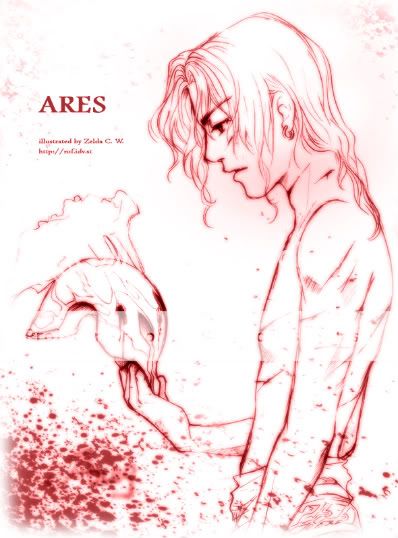
Ares is a violence and war god in Greek mythology. He was not well-liked or trusted by the Greeks and there are few tales in which he plays a major role. Cults of Ares were found mainly in Crete and the Peloponnese. Athena is also a war goddess, but was well-respected, as a polis protector and goddess of strategy instead of Ares' forte, mayhem and destruction.
Ares appears in what one might call bit parts, overshadowed by heroes or other gods, and in many battle scenes in Greek mythology. In the Iliad, Ares is wounded, treated, and returns to the fray.
Thracian-born Ares is usually counted the son of Zeus and Hera, although Ovid has Hera produce him parthenogenically (like Hephaestus). Harmonia (whose necklace turns up in stories of the Cadmus and the founding of Thebes), the goddess of harmony, and the Amazons Penthesilea and Hippolyte were daughters of Ares. Through Cadmus' marriage to Harmonia and the dragon Ares sired that produced the sown men (Spartoi), Ares is the mythological ancestor of the Thebans.
Ares has no unique attributes, but is described as strong, harnessed in bronze, and golden helmeted. He rides a war chariot. The serpent, owls, vultures, and woodpecker are sacred to him. Ares had unsavory companions like Phobos ("Fear") and Deimos ("Terror"), Eris ("Strife") and Enyo ("Horror"). Early depictions show him as a mature, bearded man. Later representations show him as a youth or ephebe
Athena
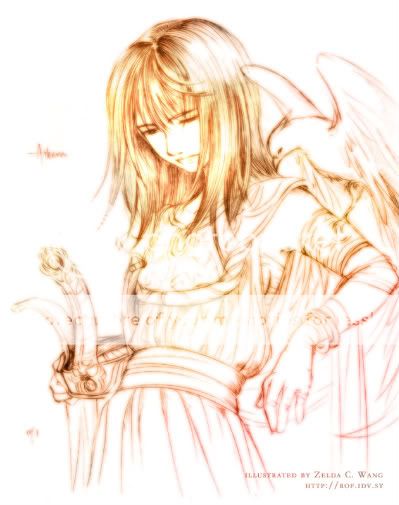
Athena is the name of an important goddess for the Greeks. She is the patron goddess of Athens, the goddess of wisdom, a goddess of arts and crafts (agriculture, navigation, spinning, weaving, and needlework), the favorite daughter of her father Zeus, and, as a war goddess with a focus on strategy more than bloodshed, an active participant in the Trojan War. She gave Athens the gift of the olive tree, providing oil, food, and wood.
The Greek goddess Athena is said to be the offspring of Zeus alone, but that was only after the Oceanid Metis became pregnant and Zeus swallowed her. By swallowing the Oceanid and her unborn child, Zeus became pregnant with Athena. Zeus wasn't built to deliver a baby, so he seems to have gestated the baby in his head. The solution to the lack of an opening in Zeus that would serve for the birth canal: Hephaestus (or Prometheus) struck open Zeus' head with an axe to release the goddess Athena. Athena emerged from her father's head fully armed
Athena is a virgin goddess, but she has a son. Athena is credited with being part-mother of Erichthonius through an attempted rape by Hephaestus, whose seed spilled on her leg. When Athena wiped it off, it fell to earth (Gaia) who became the other part-mother. The offspring of Gaia, Athena, and Hephaestus is Erichthonius. Thus, Erichthonius, a half-snake half-man creature, has two mothers and one father. He is a mythological ancestor of the Athenians.