





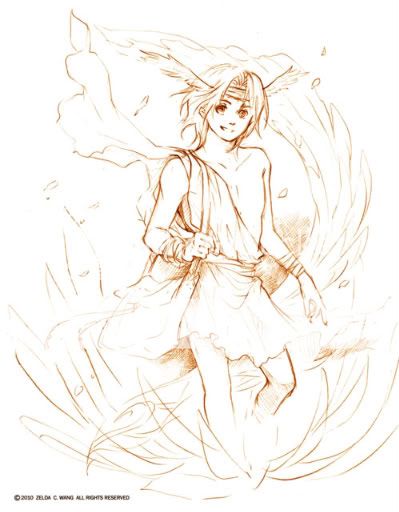

Hermes
Hermes (Mercury to the Romans), the fleet-footed messenger with wings on his heels and cap symbolizes fast floral delivery. However, Hermes was originally neither winged nor a messenger -- that role was reserved for the rainbow goddess Iris*. He was, instead, clever, tricky, a thief, and, with his awakening or sleep-conferring wand (rhabdos), the original sandman whose descendants include a major Greek hero and a noisy, fun-loving god.
Like Hercules, Hermes showed remarkable prowess in infancy. He escaped his cradle, wandered outside, and walked from Mt. Cyllene to Pieria where he found Apollo's cattle. His natural instinct was to steal them. He even had a clever plan. First Hermes padded their feet to muffle the sound, and then he drove 50 of them backwards, in order to confuse pursuit. He stopped at the Alpheios River to make the first sacrifice to the gods. To do so, Hermes had to invent fire, or at least how to kindle it.
Zeus realized he had to keep his clever, cattle-rustling son out of mischief, so he put Hermes to work as god of trade and commerce. He gave him power over birds of omen, dogs, boars, flocks of sheep, and lions. He provided him with golden sandals, and made him messenger (angelos) to Hades. In this role Hermes was sent to try to retrieve Persephone from her husband.
Aphrodite
Aphrodite is the goddess of beauty, love, and sexuality. She is sometimes known as the Cyprian because there was a cult center of Aphrodite on Cyprus [See Map Jc-d]. Aphrodite is the mother of the god of love, Eros (more familiar as Cupid). She is the wife of the ugliest of the gods, Hephaestus. Unlike the powerful virginal goddesses, Athena and Artemis, or the faithful goddess of marriage, Hera, she has love affairs with gods and mortals. Aphrodite's birth story makes her relation to the other gods and goddesses of Mt. Olympus ambiguous.
Hesiod says Aphrodite arose from the foam that gathered around the genitals of Uranus. They just happened to be floating in the sea -- after his son Cronus castrated his father.
The poet known as Homer calls Aphrodite the daughter of Zeus and Dione. She is also described as the daughter of Oceanus and Tethys (both Titans).
If Aphrodite is the cast-offspring of Uranus, she is of the same generation as Zeus' parents. If she is the daughter of the Titans, she is Zeus' cousin.
She is often associated to Mirror, of course -- she is the goddess of beauty. Also, the apple, which has lots of associations with love or beauty (as in Sleeping Beauty) and especially the golden apple. Aphrodite is associated with a magic girdle (belt), the dove, myrrh and myrtle, the dolphin, and more. In the famous Botticelli painting, Aphrodite is seen rising from a clam shell.
Trojan War and Aeneid's Aphrodite / Venus:
The story of the Trojan War begins with the story of the apple of discord, which naturally was made of gold:
Each of 3 goddesses:
1. Hera - marriage goddess and wife of Zeus
2. Athena - Zeus' daughter, wisdom goddess, and one of the powerful virginal goddesses mentioned above, and
3. Aphrodite
thought she deserved the golden apple, by virtue of being kallista 'the most beautiful'. Since the goddesses couldn't decide among themselves and Zeus wasn't willing to suffer the wrath of the females in his family, the goddesses appealed to Paris, son of King Priam of Troy. They asked him to judge which of them was the most beautiful. Paris judged the goddess of beauty to be the loveliest. In return for his verdict, Aphrodite promised Paris the fairest woman. Unfortunately, this fairest mortal was Helen of Sparta, wife of Menelaus. Paris took the prize that had been awarded him by Aphrodite, despite her prior commitments, and so started the most famous war in history, that between the Greeks and Trojans.
Vergil or Virgil's Aeneid tells a Trojan War sequel story about a surviving Trojan prince, Aeneas, transporting his household gods from the burning city of Troy to Italy, where he founds the race of the Romans. In the Aeneid, the Roman version of Aphrodite, Venus, is Aeneas' mother. In the Iliad, she protected her son, even at the cost of suffering a wound inflicted by Diomedes.

 Aphrodite I believe had a role in the ancient Greek love tragedy of the story of 'Peremus and Thisbe'...which later was the premise to the Shakespherean love tragedy 'Romeo and Juliet'. Aphrodite has influenced a lot Greek playwrights in ancient Greece. Many stories of romance were made in her honor. Although Aphrodite was the Goddess of love; she was very deceitful and narcissistic when it came to her looks. Aphrodite got morbidly jealous of beautiful women, and she would usually curse them with foul unthinkable things.