





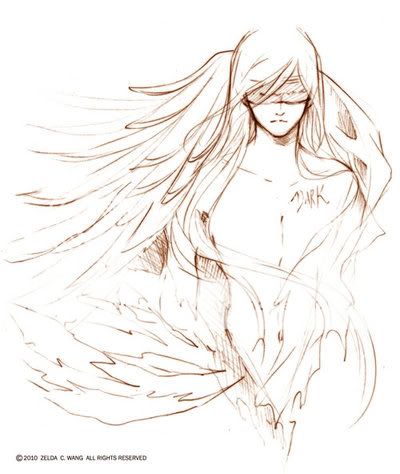

Thanatos
In Greek mythology, Thánatos (in Greek, Θάνατος – "Death") was the daemon personification of Death. He was a minor figure in Greek mythology, often referred to but rarely appearing in person. His name is transliterated in Latin as Thanatus, but his equivalent in Roman mythology is Mors or Letus/Letum, and he is sometimes identified erroneously with Orcus (Orcus himself had a Greek equivalent in the form of Horkos, God of the Oath)
According to Sigmund Freud, humans have a life instinct – which he named 'Eros' – and a death drive, which is commonly called (though not by Freud himself) 'Thanatos'. This postulated death drive allegedly compels humans to engage in risky and self-destructive acts that could lead to their own death. Behaviors such as thrill seeking, aggression, and risk taking are viewed as actions which stem from this Thanatos instinct. However, from a scientific viewpoint, the notion of Thanatos continues to be highly controversial.
Thanatophobia is the fear of things associated with or reminiscent of death and mortality, such as corpses or graveyards. It is also known as Necrophobia, although this term typically refers to a singular fear of dead bodies rather than a fear of death in general.
Thanatology is the academic and scientific study of death among human beings. It investigates the circumstances surrounding a person's death, the grief experienced by the deceased's loved ones, and larger social attitudes towards death such as ritual and memorialization. It is primarily an interdisciplinary study, frequently undertaken by professionals in nursing, psychology, sociology, psychiatry, social work and veterinary science. It also describes bodily changes that accompany death and the after-death period.
Thanatophoric dysplasia, so named because of its lethality at birth, is the most common lethal congenital skeletal dysplasia with an estimated prevalence of one in 6,400 to one in 16,700 births. Its name Thanatophoros, meanis 'death-bearing' in Greek.
Euthanasia, 'Good Death' in Greek, is the act or practice of ending the life of an individual suffering from a terminal illness or an incurable condition, as by lethal injection or the suspension of extraordinary medical treatment. The Thanatron, built by Doctor Jack Kevorkian, was a device used to aid in the suicide of his patients by euthanasia.
Rhea
Rhea (pronounced /ˈriː.ə/; ancient Greek Ῥέα) was the Titaness daughter of Uranus, the sky, and Gaia, the earth, in Greek mythology. She was known as "the mother of gods." In earlier traditions, she was strongly associated with Gaia and Cybele, the Great Goddess, and was later seen by the classical Greeks as the mother of the Olympian gods and goddesses, though never dwelling permanently among them on Mount Olympus.
Cronus, Rhea's Titan brother and husband, castrated their father, Uranus. After this, Cronus re-imprisoned the Hekatonkheires, the Gigantes and the Cyclopes and set the monster Campe to guard them. He and Rhea took the throne as King and Queen of the gods. This time was called the Golden Age.
Cronus sired several children by Rhea: Hestia, Demeter, Hera, Hades, and Poseidon, but swallowed them all as soon as they were born, since he had learned from Gaia and Uranus that he was destined to be overcome by his own child as he had overthrown his own father. When Zeus was about to be born, however, Rhea sought Uranus and Gaia to devise a plan to save him, so that Cronus would get his retribution for his acts against Uranus and his own children. Rhea gave birth to Zeus in Crete, handing Cronus a stone wrapped in swaddling clothes, which he promptly swallowed.
Then she hid Zeus in a cave on Mount Ida in Crete. According to varying versions of the story:
1. He was then raised by Gaia,
2. He was suckled by a goat named Amalthea, while a company of Kouretes, soldiers, or smaller gods, shouted and clashed their swords together to make noise so that Cronus would not hear the baby's cry,
3. He was raised by a nymph named Adamanthea, who fed him goat milk. Since Cronus ruled over the earth, the heavens, and the sea and swallowed all of the children of Rhea, Adamanthea hid him by dangling him on a rope from a tree so he was suspended between earth, sea, and sky and thus, invisible to his father.
Zeus forced Cronus to disgorge the other children in the reverse order in which they had been swallowed, the oldest becoming the last, and youngest: first the stone, which was set down at Pytho under the glens of Parnassus to be a sign to mortal men, then the rest. In some versions, Metis gave Cronus an emetic to force him to disgorge the babies, or Zeus cut Cronus' stomach open. Then Zeus released the brothers of Cronus, the Gigantes, the Hecatonkheires and the Cyclops, who gave him thunder and lightning, which had previously been hidden by Gaia. Zeus and his siblings, together with the Gigantes, Hecatonkheires, and Cyclopes, overthrew Cronus and the other Titans. Similarly, in later myths, Zeus would swallow Metis to prevent the birth of her child, Athena, but she was born unharmed, out of a wound made in his head by one of the other gods.