|
|
|
|
|
|
|
|
|
 Posted: Tue May 24, 2011 8:23 am Posted: Tue May 24, 2011 8:23 am
One for Sorrow HEY FOLKS it's Snifit's Magpie Quest version 2.0, now with TWICE THE BEEF. Just when you thought I wasn't long-winded enough. Anyway, let’s get rolling. Handy Dandy notebook Table of Contents1. The City
2. The Son
3. The Fledgling
3. The Scandal
4. The One-Eyed Magpie
5. Profiles
6. St Cobb
7. About Magpies
8. WINTER EVENT 2011
9. WINTER EVENT 2011 - Surrender
10. WINTER EVENT 2011 - Flee
11. Et Cetera
Thank you Hedjrebl for proofreading these things and catching errors I missed after proofing them myself two times. How does that even. I don't. So manu typos. Anyway, thanks. <3
I'd also like to thank Katachii and Saint Cinq for their very helpful critiques! You guys are awesome!
And I'd like to thank PRETTY MUCH EVERYONE at PD for being so nice and welcoming and putting up with my RAMPANT GOOFERY and just generally being the greatest group of folks on the planet. YOU GUYS... YOU GUYS... UGUU @w@
|
 |
|
|
|
|
|
|
|
|
|
|
|
|
|
Posted: Tue May 24, 2011 10:03 am
The City There is a city on the eastern edge of the continent of Panymium which has never been properly named. Legend has it that the first settlers were actually sailors blown off course, forced to stay because of the damage to their ship. To be sure, it is hard to imagine anyone choosing such an inhospitable spit of land on purpose, because the area surrounding this nameless (or, depending on your perspective, many-named) city was then, and remains still, unforgivably swampy. They decided to name it Port Esme, after their doomed ship. Still others claim that its original name was Arrowford, based on an unusually-shaped geographic feature that dominates the city center. Most folks acknowledge that this story might be true, but find it too unimaginative to use on a daily basis. To further complicate matters, residents of the city know it by many colloquial names. Some call it La Ville de la Mort, a rather morbid name that stems from its many aboveground mausoleums and grandiose, sprawling graveyards, some of which have been reclaimed by the surrounding swamp, turning them into dreamlike kingdoms of the dead. Some call it the Teeth of the Marsh, or Swamptooth, which is a name that relates to the view of the city from a boat. From a distance, the buildings jut haphazardly out of the tangle of ancient, gnarled trees, looking like nothing so much as a snarling maw waiting to eagerly partake of what the ship-merchants have to offer. Ironically, the most common name for the city is simply St. Cobb, named after its famous cobblestone streets. An outsider, inquiring about the name, will invariably be told dozens of different accounts of who or what St. Cobb was, most of these stories ending in the saint's noble, grisly death. Over the years, different names have appeared on different maps, lending the city an almost mythical quality to those not intimately familiar with the region. “Oh, you came here looking for Arrowford? I’m sorry, ma belle, but it doesn’t exist any more.” Interestingly, some antiquarians even use the name listed for this city by the sea to date maps. Despite its bustling port, an air of relaxation has long since been a part of the city, just as old and tangible as the cobblestones for which it is named. The influx of trade has brought many cultures together, primarily from the continent of Ecara. Under normal circumstances, such a clash of viewpoints would normally spark tension and even prejudice. Not so in St. Cobb. The residents have often been remarked upon by outsiders as simultaneously too curious and too lazy to get up in arms about those sorts of things. It is another well-known joke that the citizens embrace the cultural diversity of its myriad residents simply because it gives them that many more reasons to celebrate and, more importantly, to drink. The dialect of St. Cobb has been influenced by these many cultures, dotted with phrases from various languages, the most popular additions to Panymese being, naturally, expletives. Because it was built on such swampy ground, and subject to frequent heavy rainfall, flooding is a regular problem at St. Cobb, but the residents endure it with their trademark nonchalance. Unfortunately, poor city planning combined with poor sanitation have led to outbreaks of many diseases in recent years, most notably cholera and the dreaded Black Death. What was once regarded as a decadent, but oddly endearing addition to Imisus’s coast is now slowly crumbling into a true city of the dead. The businesses established have been the primary force driving the city since the most virulent of cholera outbreaks over a decade ago, and more and more, economic standing is replacing political standing. Despite its flaws and recent catastrophes, most people still regard the pseudo-mythical St. Cobb as a colorful, interesting city, well worth a visit for anyone with the financial wherewithal to make such a trip through the unforgiving marshes. It is odd without a doubt, but it is endlessly fascinating and irrefutably charming, and its residents are doubly so. This is why most people don’t believe it when Reynard Irving tells them this is the city of his birth.
|
|
|
|
|
|
|
|
|
|
|
|
|
|
|
|
|
|
Posted: Wed May 25, 2011 7:58 am
The Son Reynard Irving was born in 1387, the child of a laborer (his father) and an Vossanian sailor (his mother). Reynard only has fleeting memories of his mother, as she was away for most of his childhood, but he remembers her as a warm, if weary, presence, elevated to mythical levels of perfection by his father’s countless tales of her adventures. Bedtime stories were a tradition in his home, and rather than tales of ancient heroes (which he regarded as doubtful in their veracity) and sweeping prophecies (which he deemed too silly to warrant attention), Reynard wanted tales of his mother’s very real exploits, never once imagining the amount of embellishments his father heaped on them. His father was a man bubbling with endless energy, cheerful, hopelessly romantic, and inclined to overexcitement. Reynard was solemn, even as a young child, and often found himself exasperated with his father’s antics. His neighbors at the time would regularly find amusement in the sight of a seven-year-old Reynard sternly telling his father off for wasting what little money they had on frivolities and knickknacks. Father and son barely understood one another, were almost constantly at odds, and loved each other with a fierce, unwavering devotion. When Reynard turned ten, word reached the town that his mother’s ship, the Prospera, had been lost at sea. The loss of his mother was a difficult time for him, but the blow hit his father especially hard, and Reynard found himself comforting and encouraging his father more than mourning. It wasn’t until years later that his loss finally hit him, and that he finally grieved for the mother he had barely known, but loved, all the same. The ship was never found. From thereon in, it was the two Irvings against the world. His father didn’t have any manner of stable job, but would rather jump from place to place, working where he was needed. He was a strong fellow, broad of shoulder and decidedly tall, with sun-tanned skin and a mop of unruly brown hair that he often simply forgot to cut. His family had lived in St. Cobb for generations. Reynard took more after his mother than his father. He was slender as a youth, with his mother’s red-gold hair and light-colored eyes. Neighbors often joked that the two of them scarcely looked related. There was really only one time Reynard ever resembled his father, and that was when he smiled. It was an extremely rare occurrence, but when he did, the expression was all-encompassing and wealthy with mirth and joy. He looked his age when he smiled. One fall night, in 1399, Reynard’s father came home early from work. He’d been spending most of his days (and a few nights) in another quarter of the city, a place he’d found good construction work. Greeted by a look of mute concern on his son’s face, he gave his customary bright grin and said he had a bit of a stomachache. There was pain in his eyes, though, and in the shortness of his breath. Reynard could see he was in much more pain than he let on. Within hours his father was vomiting and, worse, violently evacuating his bowels. He spent the night in their bath tub while cholera ravaged his body from the inside out, and within eight hours, his father died, trembling and delirious in his own filth. Reynard was twelve at the time. This was when the pattern of his life first established itself. Reynard was to be struck at least one more time by terrible luck, followed by a stroke of good fortune. He didn’t sleep that night, and stayed by his father’s body until dawn, where, standing, he drained the tub, washed his father as best as he was able, and then left, returning with a sheet with which to cover him. Then he went to contact the landlady of the tenement they were renting, and in his quiet, flat voice, told her that his father was dead. At first she had not understood--surely he did not mean his father was dead she had just seen Mr. Irving earlier that day--but when she reached for the young boy and he did not flinch away allowing her fingertips to come into contact with his cheek, clammy with shock, she knew something was terribly wrong. The unlucky part, of course, was the death of his parent. The prospect for an orphan in an industrialized city was poor, and Reynard, under different circumstances, might have ended up in a factory somewhere, to die an early, violent death, much like many Panymese children. However, he and his father had made an impression on the tenants of the building in which they lived, and the landlady, accompanied by her patrons, decided to more or less communally adopt him. The tenants were typical Cobbian fare: a variety of people, all of them uniquely diverse but essentially Cobbian by their very otherness. He was shuffled from room to room. One week he’d be staying with the eccentric lady who owned a variety of exotic birds she bred for a living, and the next he was living with a mute priest who ascribed to some religion Reynard could not place, but who played a variety of musical instruments and made the most beautiful music the boy had ever heard. He lived with a kindly old lady who worked as a professional exterminator. He stayed with a wild game hunter who guided travelers through the swamps surrounding St. Cobb. One would think that such exposure to so many eccentric viewpoints would have broadened his horizons as a child, but not so with Reynard. Instead he simply developed an awareness of other cultures. He realized that, in the wide, wild world, people were often just as foolish as they were in his hometown, and if there was any uniting factor to the people around them, it was their propensity for frivolity. His caretakers never saw him cry for his father. The boy seemed to have been stunned into shock, a state of numbness that only deepened into a sort of brutal practicality as he grew into his teenage years, followed by a sternness as he reached adulthood. He had, over the years, developed an intense dislike for silliness of any kind, preferring to find shelter in a world that made sense. The tenants were able to cobble together enough resources to give him a surprisingly decent education, a pursuit into which Reynard threw himself with gusto. He developed into an intensely intelligent, but highly unimaginative young man, and at the age of seventeen, he landed a bookkeeping position at a local bank. Economic politics, then positively embryonic, began to slowly develop over the course of Reynard’s career. By and large he ignored it. He was happy to exist in his own world, where careful penmanship provided the key to ultimate happiness, and everything was carefully categorized and alphabetized. Numbers made sense. The crazy world outside did not, so he disdained it. His work ethic saw him garner a major promotion at the age of twenty-one as head clerk. Three more years later, months before the present time, he became the personal assistant to the head of the office, an older, rich man known to his employees as Mr. Linchuk. He was keen-minded and congenial, definitely getting on in his years, but still healthily energetic. His son, Marcus Linchuk, was set to take over his position when he died. Reynard was so focused on his clerical duties, so focused on ignoring the world around him, that he didn’t notice the looks Marcus was beginning to give him. He didn’t notice the seed of enmity growing in the young man’s breast, the suspicion. Reynard was never an actual threat to Marcus’s position, but he was a perceived one, and that was enough for Marcus to take action. Elucidation of this will bring us to his present circumstances…
|
|
|
|
|
|
|
|
|
|
|
|
|
|
|
Posted: Wed May 25, 2011 7:59 am
The Fledgling …but not to hers.She began her life as all magpies do, cramped in an egg. Of the six eggs laid by her mother, four hatched, and three nestlings made it to adulthood, which actually isn’t that bad for a magpie family. They were part of a colony situated along a stream that wound through the rolling, somewhat wind-blasted hills surrounding St. Cobb’s swamplands. There was little to fear as a young bird. She went from a wobbly pink lump of flesh to an energetic and ungainly fledgling over the period of a month or so, and remained in her family’s territory, learning the ropes from both her parents as well as her siblings. At about the age of three months, it was time to strike out, and she did, exploring the surrounding countryside, as young magpies are wont to do. For the most part her story was typical. She was an excellent scavenger and opportunist, even scoring a few scraps from traveling caravans who were charmed by her dapper appearance and bold behavior. She was as adventurous and curious as a bird could be, and easily distracted by anything glittery she came across. Eventually her travels brought her to the edge of the swamp. If she had decided to fly away, to return to her family’s breeding ground, or perhaps to veer north towards the hills, things might have turned out differently. Instead, she stuck around, exploring the fringes and making a healthy living off the fat snails found in the muck. When a traveling caravan stopped by, she thought it was business as usual. Once they’d made camp, she deigned to join them, hopping into the ring of firelight with an expectant air, as if she were saying, I’m here now. Where’s the food? Before she even had time to study the humans, a flash of grey bowled her over. She didn’t know what a cat was, or why one was lurking around this caravan. All she knew was that this great striped thing had pounced at her and was hurting her, and the only response to that was to screech and flap wildly. Her violent struggle saved her life, as the cat only got a few swipes in, unable to bite down, before the magpie was off rocketing through the night. Its claws had torn out some of her glossy black-and-white feathers and cost her her left eye. The magpie retreated into the swamp, huddling in the confusing tangle of a tall bush, making soft, distressed sounds to herself, until dawn. The blow had done more than just damage her body. She became timid, loathe to venture out of the thick undergrowth, and only snatched at what food she could safely reach. She grew weak and unhealthy. Every now and again she took a snail, or perhaps pecked dejectedly at a dead fish, but for the most part she just sat, her remaining eye closed, sheltering from the world around her. Her feathers lost their sheen, and some began to fall out. She was a ragged, sad little creature, all youthful vitality and razor-edged curiosity gone. When the hunger became too much, she finally left her shelter. She stuck to the open areas where she could keep an eye on danger, and as she fluttered shakily from tree to tree, along a swamp path, she spotted an unusual sight. There was a roofed cart, a small one, standing in the road. It had lost its mule, and one of its wheels had been removed. Timidity bade she stay away, but a spark of curiosity, perhaps her body’s last-ditch effort to save itself, propelled her forward. She alighted on the cart, observing the bright glint of what was left of the mule’s rigging with her eye. Nice! She hopped gingerly around the stirred mud, searching for scraps of food. Nothing. Huh. As she made her way to the back of the caravan, the familiar stench of decay hit her. She fluttered up to the cart’s roof and peered inside. There was a dead human inside. There was something wrong with the color of its skin, and its flesh had already been worried by small scavengers--probably rats--but other than that it looked as if it had just been sleeping. It positively reeked, and though to a human such a smell would have been absolutely repellent, to a born carrion-eater it was like the aroma of a perfectly-seasoned steak. She hopped inside. There was food here, a lot of food, and no sign of unpleasant grey things. It would be a good place to scavenge for a few days. She remained there nearly a week, feeding and growing stronger. The moment she partook of the tainted flesh, strength returned to her little body. As the days passed, the feathers grew thick and healthy, regaining their oily sheen. Her empty eye socket healed properly. The rate at which she recovered was unnatural, but by the end of the week, so was she. She felt herself filled with a new electric vitality, a budding something that began to seep into her brain. The little bird had been close to death, but instead of succumbing, had experienced a curious rebirth. Eventually the body was too far gone for even her to eat, and, a healthy young magpie once more, she set off down the path, which turned out to be worth further scavenging. Eventually it led her to the city of St. Cobb, which was a confusing sight at first, but as soon as she discovered the heaps of trash piled in the back alleys, she took to the city. The first time she encountered a cat, it was lounging in the sun, and she cheerfully dive-bombed it from above. Since then, cat-bombing has been one of her favorite pastimes. Well-fed, healthy, and presented with a wealth of new curiosities, she reached one year of age. The city was a good place for a bird like her. One day, she landed on a street sign at the corner of Hanover and Central Avenue. It was a brisk morning, and she was young and full of strange new life, eager to find fresh things to puzzle over. She tilted her head, turning her eye down to the street, and there, she spotted a human leaving a house. The sunlight glinted from his spectacles. Interesting. Riik-rik-rik-rik.
|
|
|
|
|
|
|
|
|
|
|
|
|
|
|
|
|
|
Posted: Sat May 28, 2011 11:21 am
The Scandal The morning of the second-worst day of Reynard Irving’s live began like any other. He walked down the steps to the dining-room of the tenement house, greeted each of the tenants in turn, and partook of the communal breakfast prepared by the landlady. He thanked her afterward, as he always did, and she insisted that no thanks were necessary, as she always did. Then he bid a polite good-bye and made his way to work. He stepped outside and inhaled deeply. It was a fine morning. Brisk! Though the air carried the promise of later rain, he figured he should be home well before it arrived. Riik-rik-rik-rik. He looked up. There was a bird sitting on the street sign for Hanover and Central. There were many superstitions associated with magpies, and even a nursery rhyme to go along with them: One for sorrow, two for mirth
Three for a funeral, four for a birth
Five for silver, six for gold
Seven for a secret never to be told
Eight for Heaven, nine for Hell,
Ten for the devil, his own self. A lone magpie was supposed to be powerfully unlucky. Naturally, Reynard thought such a notion was very silly, and disregarded it. He returned his attention to the path in front of him and walked on, utterly unconcerned. The magpie watched him go. --- Marcus Linchuk woke up, readied himself for his work day, and after arriving at the bank, immediately became frustrated. He’d intended to arrive at the bank early to get some daily preparations done before his father arrived, but had realized that he’d left his coat at a friend’s house the night before, and inside of it, his keys. It was not a normal thing for him to do, but he didn’t want it to reflect badly on his character. He’d been trying more and more these days to display his usefulness as far as matters concerning the bank went. He had, from an early age, determined that he would not be an incompetent heir, and instead would closely observe his father and adhere to his studies in preparation for the day he would take over management of the bank. It was not only the prosperity of the bank that hinged upon his skills as a proprietor, but his own. If something happened to the bank, aside from being out of a job, he would have to deal with King Fang’s displeasure. He doubted the King would look kindly upon such mishandling of his money, as the bank also dealt with the taxes of St. Cobb’s citizens. There was a heavy weight on the boy’s shoulders, and it was understandable that the thought of some stranger waltzing in and potentially making a mess of everything only made it worse. That clerk. Irving. He was certain his father had taken a shine to him. Marcus and Reynard were actually close to the same age, with Marcus being a few years his senior, but the two had never gotten along. Very simply put, Reynard had no reason to socialize with anyone. He preferred to be left alone and take care of his job. When all one had was his clerical duties, he performed them especially well. His cold, matter-of-fact nature combined with his work ethic made it seem--to Marcus, at last--as if he had disliked Marcus from the start, and aimed to show the proprietor’s son up. Marcus had been relating this to his friend, one Floyd Scott, the night before, and he was still grateful of Floyd’s willingness to let him vent. Floyd was a man considered his equal in station, and likeable in a rakish sort of way. Marcus had been standing before the doors for approximately two minutes, rubbing the bridge of his nose and waiting for his father to arrive, when he heard a familiar voice pipe up, “There you are. Thought you’d be needin’ this.” Upon turning, he beheld the familiar face of his friend, grinning and offering his coat. “Floyd,” Marcus sighed, “you are absolutely invaluable. Thank you.” “ Pas de probléme. I figured after that speech last night, the last thing you needed was to forget your keys.” Marcus nodded, and, after a brief exchange of pleasantries, the two men parted company. Marcus was a bit stressed out, so he failed to notice the positively mischievous smirk on his friend’s face as the man turned and trotted off into the streets. --- Reynard arrived on schedule, falling easily into his morning rhythm. He removed his coat and made his way to his office. There were already three forms for him to fill out, so, un-slinging his satchel and unpacking his writing materials, he got to work. The first thirty minutes held no surprises for him. He fell into the usual comforting, monotonous cadence, feeling the minutes drain away into the careful sweep of his quill’s tip. At the half-hour mark, though, there was a knock on his door. Reynard raised his eyes and removed his pen from the paper, but otherwise did not move. “Come in.” “Irving? It’s me.” Another of the clerks ducked in, scuttling up to his desk. She blinked myopically and offered a brief smile, “I’m sorry to ask, but something seems to have happened to all of my quills. Do you have one I can borrow?” Reynard nodded and she drew up by his desk, close enough to be congenial, but not close enough to violate his personal space, which he appreciated. He opened his drawer to pull out one of the quills he kept there, carefully wrapped in rice paper to keep it from splitting and there was a small dark vial rolling around in his desk. Reynard blinked. The female clerk gasped sharply, but said nothing. Reynard hesitated a moment longer, his eyes pinned to the little vial rolling back and forth, before he reached out, gathered a quill, and handed it to her, still-wrapped. Never once did he take his eyes from the bottle. “Th-thank you, Irving. I, ah, I’ll just… thanks.” She hurried out of the room, and slowly, with an air of disbelief, Reynard plucked the tiny vial from his desk, holding it between his gloved fingers. A blackened potion. In his desk? How had it gotten here? The sudden and violent interruption of his blissfully predictable morning upset him so much that he hadn’t even considered the consequences of owning such an item. The Emperor had decreed that anyone found in possession of such a thing would be immediately put to death. When they finally did arise in his consciousness, he felt a coldness sweep through him. Oh no. Oh no.It was in his desk. It was in his desk. Once again he had to ask himself how had it gotten there. Surely there was some manner of reasonable explanation for this. Nobody could get into his office who didn't have the keys to the bank. He was certain neither the head of the bank, nor his son would do something of the sort. He was needed here. He had responsibilities. He tried to think of a time when he had left his desk unattended, but there were so many possibilities, so many variables. Anxiety began to buzz on the edges of his subconscious. Someone had come into his office. Someone here wanted to hurt him. Maybe even someone he knew. The mundane confines of the room around him seemed to deny him even as he stood. You know this place, Reynard. This place is familiar. It is safe. He felt himself calming slightly at the notion. Then he looked down to the tiny vial and the anxiety rose again, stronger than before. He couldn't think here. He had to get some fresh air. He had to go somewhere and figure this out. He swallowed heavily and stood. His mind exploded in a confusion of thoughts, every mental thread racing in all directions as he tried to figure out what he should do next. Anxiety hummed ever stronger in his veins as he gathered his satchel. He snagged his coat from where it was hanging, and stepped out of his office, into the large room the rest of the clerks used. He noticed that the female clerk that had taken his quill was not at her desk. The anxiety deepened into an emotion he hadn’t felt in a long, long time. It was deep, visceral fear. He walked through the office. A few clerks glanced up, but apparently the quill-taker had been discreet, because they went back to work, obviously assuming that Reynard wouldn’t be walking among them without a reason. He met no resistance as he moved to the front of the office, his feet carrying him forward in a thoughtless, dreamlike trance. Nobody gave him a second glance as he made his way out the front door. When he stepped outside, it all came crashing down. He didn’t know what was going on. He didn’t know what to do. He was going to be arrested, and then they were going to kill him. The fear rose in his throat and choked him. He turned and, with brisk, businesslike strides, made his way down Hanover street. He did not look back. --- Later in that evening, after the news had rampaged through the office, after Reynard’s flight had been discovered, after the local law enforcement had been brought in, Marcus Linchuk went to his friend’s house, just as stunned by the turn of events as everyone else. “I don’t… I guess I never really knew him. I thought he was just some spiteful, quiet clerk. I never thought he was a criminal! To think he’d be involved in the black market! Bon sang!” Floyd was grinning. He kept on grinning, even as Marcus rambled his disbelief, until he blinked, slowed to a verbal halt, and stared at him. “What’s so funny?” “You were right about your friend. He isn’t some criminal.” The grin widened. Floyd was clearly immensely pleased with himself. “When you left your coat here last night, I figured I’d do you a favor. I snuck in there and planted that in his desk. It ain’t real. The guards’ll figure that out soon enough, so it isn't as if he’s going to be killed or anything. But he’s going to be knocked clean out of the running for the bank, that’s for sure.” Marcus stared at his friend in horror. “What? You did what?” He stood. “You--he’s on the run now! You ruined that man’s life! I didn’t--that’s not what I wanted!” He felt the color drain from his face, and he repeated numbly, the fire taken out of his voice, “That’s not what I wanted…” Floyd just stared, taken aback by his friend’s reaction. “I was just trying to help! I didn’t think there’d be any harm in it, not for you, anyway!” “This is a disaster!” Marcus cradled his face in his hands and gave an inarticulate groan of misery. “Bad. This is bad. We’ve got to tell the truth. We can’t let him take the blame for this…” Floyd frowned. “Look, I’m sorry it got out of hand, but we can’t throw away everything we’ve got for some no-name clerk. You don’t even like the guy.” “Shut up.” Marcus drew his hands away and glared at his friend. “I don’t know what makes you think that you can just play around with peoples’ lives, but…" He struggled for words, the right words, but all he came up with was, "Well, you can’t! I just… I can’t believe you… corbleu. He ran, you know. He ran away. That’s going to make it look worse! We’ve got to find him before something happens, and we have his blood on our hands!” “Relax, he can’t have gotten far.” Floyd frowned. “I mean, after all, where would he go? The swamp?”
|
|
|
|
|
|
|
|
|
|
|
|
|
|
|
Posted: Sun May 29, 2011 7:28 pm
The One-Eyed Magpie Reynard spent the first evening in the swamp. His shock had carried him forward through the city. First he stopped on the edges of one of the city older graveyards, placing his gloved hands on the wrought-iron fence and trying to clear his mind. When a watchman walked by, his felt the anxiety returning, spearing through his thoughts and tearing their coherence asunder. He couldn't stay there. He had to keep walking. The day passed, largely unnoticed by the man, who weaved his way through familiar back-streets and down thoroughfares he’d walked across all his life. Nobody gave him a second glance. After all, why should they? He was a reasonably well-dressed fellow, and very neatly groomed, with a bookish air that lent a sense of respectability to him. Several times during the day he stopped himself, irritated with his own reaction, and tried to force himself to go back to the bank, but the memory of the blackened potion in his office, that safe place that he knew, that had been his sanctuary against a wild, cruel world... no, he couldn't. He couldn't face that. He just needed to think, that was all. He just needed to be out here, in the city, and to think. He walked until he reached the edge of the city, when someone shouted. The loud sound startled him and he ran then, the coiling terror in his gut snapping loose and propelling him forward, satchel bouncing at his side. The shouter had been trying to shoo a mongrel away from the trash heaped under her window, and had thus not noticed the odd reaction her voice had produced. Reynard continued to run as fast as he could, sprinting through the dirt paths meandering through the swamp, occasionally blundering over an exposed root or splashing through an unexpected puddle of water. He didn’t stop until a particularly harsh stumble had nearly sent him sprawling, the jerk knocking his glasses from his face. His momentum carried him forward. Crunch. Reynard stopped, panting, and looked down at his twisted spectacles. They were thick and sturdily built, but the left side of the frame was slightly crooked, and he’d splintered the lens. Great. Now he was lost, on the run, and half-blind. He placed his glasses back in place and, drawing a deep breath, struggled to get a hold of himself. He looked down to see what he’d tripped on, and was quite shocked to discover it was the crumbled remains of a tombstone. He turned, and an unearthly panorama spread before him. It was an old graveyard, the headstones grandiose obelisks that had long since gone out of fashion. Moss clung hungrily to their contours, and most of the names had receded into their stone faces. The remains of a wrought-iron fence wove erratically through the underbrush beyond, and a squat mausoleum presided over the entire grim scene. Old, twisted trees half-blocked out the wan light of the late-evening sun, and wisps of hanging moss swayed like veils in the light breeze moving through the area. He frowned and stepped forward. The marshy ground was quite uneven here, with notable sinkholes near some of the gravestones. He skirted those gingerly, making his way to the steps of the mausoleum. There he sheltered in the portico with the intention of gathering his thoughts. Instead, he fell asleep. He was awoken by a crack of thunder sometime deep in the night. The rainstorm he’d sensed that morning had let loose sometime while he was sleeping. Reynard huddled closer to the mausoleum door in an attempt to keep warm and dry and slept again. He had walked and run most of the day. He was unused to such exertion. When he woke up the following morning to a vaguely misty, dripping swamp, he panicked. Why had he done that? Why had he run? That decision had only made all of this worse! What had he been thinking? The answer was that he very simply hadn’t. He’d been afraid, and he’d let his fear get the better of him, even if he hadn’t actually done anything wrong. Now that he had fled, if he was caught, he’d be lucky to escape whatever judgment awaited him with his life. Stupid, stupid, stupid! This was what happened when he let his emotions rule his actions, rather than logic and common sense. Now he’d made a wreck of things, and he was unsure if he could fix it. He shifted his position on the steps, bringing his legs out on front of him so that he could rest his elbows on them, and sighed slowly through his nose. Frankly put, he had no idea what to do next. There was a flutter and a flash of black-and-white. A magpie landed before him. Technically the correct term was “crashed into the ground.” It either could not land properly because of its impaired vision, or simply didn’t care about trivial things like landing at a reasonable velocity. It rearranged its limbs and feathers and then began to strut before him with an air of great self-importance. Reynard stared at it. Magpies were not common in that region, and even if they had been, the one on the ground before him was unmistakably the same creature he’d seen sitting on the sign on Hanover street. It was missing an eye, for one thing, and there was an unusual blackness to its feathers; they seemed to suck in light rather than reflect it. “You,” he said, and then instantly felt foolish for talking to a bird. He stood, and the bird fluttered to a nearby tree, watching him carefully from the branches. Right. No more mucking about. He had to figure this out, and he would do it the proper way. Should he go back and try to explain himself? St. Cobb was all he’d ever known. It was familiar to him. It was safe. Except… it wasn’t as safe as he’d thought it was, if someone was running around sticking blackened potions in other peoples’ drawers, was it? And if he went back now, he would undoubtedly be taken into legal custody. He would be very suspicious in their eyes. He could be killed. An involuntary shudder ran through him. No. He couldn’t go back. He’d ruined whatever chance he had at redeeming himself when he ran like an idiot. Besides, someone in St. Cobb had in in for him. It was… unthinkable, ludicrous, but he simply couldn’t go back. So he had to go forward. With only the previous day’s packed lunch as provisions. Through a swamp treacherous for its terrain, down to a road treacherous for those who stalked it. As a potentially-wanted criminal. Might as well get started. Maybe once he’d found a safe place to bed down and collect his thoughts, he could make sense of all of this. With that thought in mind--the thought that he would simply return to civilization, work this out, and go back to his home and his familiar ways--he took a resolute step forward. A dry rustling prompted him to look up over his shoulder. The magpie was following him, hopping from tree to tree. As he walked, the bird eventually apparently lost interest in him and flew on ahead, vanishing between the trees. Reynard continued to resolutely follow the path. It never struck him that sticking to the path could have been a sure-fire way to get himself caught. Nor did the fact that nobody was actively looking for him register as strange. He just kept walking, trying to remember what, if any, nearby townships rested in the plains beyond the swamp. As the sun reached its zenith, he became aware of how desperately thirsty he was. He hadn’t had hardly anything to drink the day before. Still, there was nothing for it, so he journeyed on. As the thirst began to worsen, he started to wonder if it wouldn’t be better to return to the city after all. He might be held in custody, but at least he’d (likely) be fed and watered. And possibly dead, he reminded himself, so no. Movement in the corner of his eye distracted him from his thoughts. He glanced towards it. Was it that ridiculous bird again? Something else flickered through the trees--a glimmer. The glimmer of water. He frowned, hesitated, and then carefully began to make his way through the underbrush towards it. Being in a swamp, there was no real shortage of water, of course, but clear, drinkable water was hard to find. He came upon the edge of a clear brook. It seemed to originate between two irregularly-shaped hunks of limestone, and it dribbled down through a pebbled stream bed made of tiny chunks of the same rock before disappearing into the swamp. There was no way of knowing whether the water was safe to drink, but it looked clean. The magpie was drinking from it, dipping its head down and tossing it back in little gulps. When Reynard approached, it swung its eye towards him and flapped to the safety of a nearby tree. Reynard paused. The water was apparently safe enough for the bird to drink. And it looked clean. And delicious. He really shouldn’t, but it was this water or no water, and it might be days before he reached a settlement. He carefully approached the boulder and cupped his hand under the stream, bringing it carefully to his lips. It was cold, crisp, and the most delicious thing he’d ever tasted. Before he could stop himself, he’d already downed four handfuls of the stuff, and once he’d slaked his thirst, he was surprised to find he was also ravenously hungry. Reynard was not used to hardship. He didn’t live the life of an aristocrat, but he could count on the basics to be there: food, water, and a place to sleep. As he sat down, unwrapping the hunk of cheese and removing the soft potato roll from inside his satchel, it struck him how little food he had, and how long he was going to have to make it last. He nibbled at it, deciding to save the hunk of salted pork for later, reflecting at how often he’d taken the luxury of a full belly for granted. Riiik. He jerked. The magpie had abandoned its arboreal post and was standing across the stream, watching him intently. The promise of food apparently did wonders for its bravery. He hesitated. That moment was perhaps the most important of Reynard Irving’s life. It wasn’t because it was the kindest thing he would ever do, or because it was the most heroic, or death-defying. It was because his actions at that moment would determine the course of the rest of his life, and the decision he made regarding them, though deceptively simple, would change him forever. He shrugged, broke off a small piece of bread, and tossed it to the bird. He owed it that much for finding him water. The magpie eagerly snapped it up and without hesitation fluttered over, perching on the opposite bank near him and fixing him with a single eye. It seemed to say, I’m sticking with you. Reynard shrugged. What could it hurt? The magpie followed him the rest of the day. Reynard was once again forced to spend the night in the swamp. The second morning he went on with his journey just as resolutely, though with considerably less gusto than before. He really, really wasn’t cut out for this sort of thing. Hopefully he’d find someplace civilized along this route soon. The magpie kept steady pace with him, occasionally deigning to simply follow him on the ground, pecking at twigs, the back of his shoes, or anything else of suitable interest in range. In contrast to Reynard’s flagging strength, the bird was positively full of vim, and chattered noisily to itself as they traveled. It seemed to have an uncanny knack of finding sources of clear water, which it did regularly. Reynard assumed this was due to two factors: one, the glint of sunlight on water was shiny, and attractive to such a creature, and two, the last time it had done so, it was rewarded. Every time it found him a place to drink, he was sure to repeat the rewarding process, pleased with himself at having come upon such a lucky companion. On the third day, disheveled, smelly, and more than a little weak from his journey, Reynard and the magpie came to the plains. For a moment the vastness of the sky, unbroken by trees or buildings, frightened Reynard. He felt like he was going to be sucked up into it, and he took a reflexive step back towards the welcoming dank familiarity of the swamp. Then he realized he was being stupid. “This is silly,” he declared to no-one in particular, or possibly to the magpie. It watched him from the ground. He looked down at it. “This road has to lead somewhere.” He was aware of how foolish he was being, talking to the bird, but it helped him get his thoughts in order. That was useful enough to justify the practice. “So let’s hope it leads us to a town.” He stepped out of the shadows of the trees and made his way down the road, his once-fine clothing dirtied and disheveled, one spectacle-lens cracked in an unusual mimic of his avian friend’s missing eye, with an air of dignity that did not suit someone looking so ruffled. The magpie took to the sky joyously. It felt good to be in the open air again.
|
|
|
|
|
|
|
|
|
|
|
|
|
|
|
|
|
|
Posted: Sun May 29, 2011 8:33 pm
Profiles 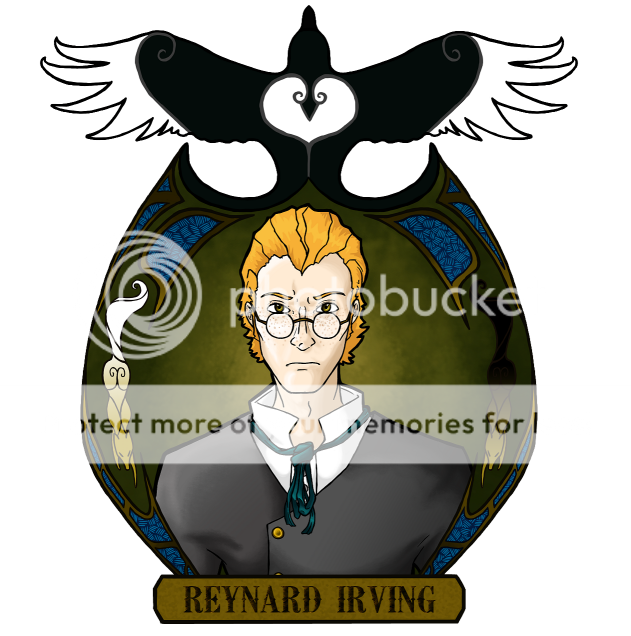 Character Name: Character Name: Reynard Esmund Irving Age: 24 Region: Born in a city known as St. Cobb along the eastern coast of Imisus. Panymese by birth, in short. Appearance: Reynard is quite tall at 6’1”, but decidedly rangy and raw-boned. He is a clerk. He doesn't usually exert himself physically. He’s unnaturally, unhealthily pale, and unfortunately, exposure to the sun will not give his skin a healthy tanned glow, but will instead manifest hordes of freckles all over exposed parts of his body. His fingers are long and bony, as well as quite deft. His face can be best described as pointy. His features are striking rather than attractive, with a peculiar angularity that brings a fox into mind. A spray of stubbornly permanent freckles can be seen across his upper cheeks and the bridge of his nose. His hair is reddish-gold with a strangely wiry texture, and his eyes are hazel. He usually keeps his hair shortish and brushed back against his skull. If left to its own devices, his hair will curl slightly, which is another trait he inherited from his mother. Reynard tries to keep it under control. He has a prominent, pointed nose, atop which a pair of spectacles can always be seen. His expression is most commonly one of blankness or vague distaste, as if he has just swallowed something that has disagreed with him. He almost never, ever smiles. Such a sight is a true rarity. Most people expect such a lanky figure to have a thin voice, but Reynard’s is unexpectedly deep. He would make a pleasant, if unremarkable, singer if he ever put effort to it. Naturally, he dismisses singing as unnecessary. Language(s) Spoken: Panymese, Cobbian Icaran Personality: In a word? Efficient! Reynard prefers to do things without any sort of fuss or hullabaloo, and dislikes frivolity and silliness wherever they occur. He is somewhat flat in the way he deals with people, and doesn’t seem to make emotional ties easily. He has an intense dislike of disorder, and will often attempt to impose sense upon things that were never made to make sense, like the weather, or the tax system. At his worst, he is unforgiving and harsh; at his best, he is loyal, if not especially warm. He is not easily moved to displays of intense emotion. He will, and often does, get irritated with people, but the feeling is shallow and he will gladly disregard past transgressions as long as they are not serious. It takes work to get Reynard to have a grudge against you, but once he does, he clings to the feeling. His ire, when roused, is intense and unforgiving. The same could be said for emotions of the opposite spectrum, but provoking powerful positive emotion in Reynard is even harder to do. Except in circumstances of dire consequence, Reynard is not prone to fear. If an irrational fear crops up, he will beat it down with logic. If he cannot handle the fear with logic, unfortunately, he will often overreact, as if he is compensating for his usual level-headedness in some bizarre fashion. He has not developed any irrational phobias he couldn’t handle. If he is nervous, he prefers to have something to do with his hands. Small, methodical acts comfort him and give him the illusion of imposing order. He has an intense dislike of physical contact, and always wears a pair of gloves. Light touches and everyday physical interactions are something he’s had to learn to deal with, and he will unconsciously lean away from other people if they start to reach out for him. The movements, by now, are so fluid and practiced that they can even go unnoticed by strangers. His reaction to being grabbed is much more violent; he will actively attempt to get away from whatever is grabbing him, and skin-to-skin contact just plain freaks him out. If you want to hear Reynard yell at you, touch his face and see what happens. The reason for this is not exactly known, and not something he discusses. Those around him think it might have something to do with the circumstances surrounding his father's death. He has many personal idiosyncrasies. For instance, he is quite accustomed to drinking liquor, and has a tolerance one might not expect from such a frail-looking fellow. He also has an iron stomach. The cuisine of St. Cobb is varied and residents typically delight in finding new and exciting things to gobble down. He is not easily put off a meal, and not squeamish about what that meal might be. He'll eat anything from exotic runny cheese to crawfish to snails. He suffers occasional migraines. He doesn't know why, and neither, to date, do any doctors who have examined him. Luckily, these are quite rare, with perhaps one every two years or so. He is otherwise healthy, with no known allergies. He also possesses a multitude of small personal habits that are too numerous to name here, stemming from a constant bubble of fussiness. They will crop up in-RP. The residents if St. Cobb have a charming way of speaking, a lazy drawl dotted with phrases and colloquialisms in both Panymese and Cobbian Vossanian. It is also not uncommon for them to weave back and forth between the two languages with ease. Reynard has worked very hard as he has grown older to eradicate every trace of the easy rolling Cobbian accent from his vocal cadence, and most of the time speaks in flat, clipped tones. However, if he is under extreme emotional duress, either positive or negative, he will revert. He does occasionally lapse into Cobbian Vossanian, but with much less frequency than his fellow townsfolk. Cons:-Reynard is aloof, a little abrasive in his mannerisms, and harsh against anything he deems unnecessarily frivolous. On the outside, he is not terribly attractive, and on the inside, he's also not particularly pleasant. He can come across as cold and rude to other people without really trying. All in all he's... er, through-and-through kind of irritating. -He is quite naïve to the workings of the world outside of his office, and is constantly trying to force the outside world to fit into his mental paradigm of the way things should be, rather than accept them for the way they are. -Physically, he is not imposing, and really doesn’t know much about defending himself. He's not much use in a fight! -He’s fastidious and meticulous to the point where it can be a bit annoying, and will often organize other people’s things for them if he has access to them and he feels they are not doing a good enough job. He will also see no reason why they get upset with him when he does this. Pros:-He is fair. He is not likely to be turned against a person because they look a certain way, or because of their social station. For so long, people, to him, were just numbers on a page, and he tends to see them all with a sort of flat equality and let their actions elevate their status in his mind. -He is quite intelligent. He is also very neat, and possesses both excellent penmanship and rather a knack for sketching objects from life. He has never had to apply his mind to more than his job, but when faced with new intellectual challenges, he would devour them eagerly. -He’s adaptable! His quick-thinking and cunning offset his naiveté a bit. -Once someone does find themselves into Reynard’s good graces, they will be defended zealously. He is intensely loyal to those who manage to earn such affection, and will not hesitate to face down any adversary to ensure their safety. History:The long version of his history is under “The Son” above. Rather than repost, I will relate it here in scholarly shorthand. One day this boy, Reynard, was born, and his folks were like, “Aww yeah we got us a babby.” Then his mom was LOST AT SEA. Then his daddy died. Reynard was sad, but all the folks in the building, they were all, “We take you in boy” so he had THE BIGGEST FAMILY IN PANYMIUM. And THEN… he was a clerk at a bank. Then he was BOSS CLERK. And then a bunch of crazy stuff happened and he ended up running through the swamp with a bird. Now he and the bird are off to have grate great adventures. Aww yee. If the judges decide they would rather have his above history copy/pasted or simply condensed, I will be happy to do so at their instruction. Faction Inclinations I thought it'd be interesting to weigh the possible decisions that would await Reynard if he should be accepted. I guess this is more of a diversion to entertain myself. OH WELL I'M DOING IT ANYWAY. Council of Sciences: This is perhaps the faction that Reynard would lean most naturally towards. Their mission would resonate deeply with him, growing up as he has in a city so closely acquainted with disease and death. Association with the Council of Sciences would expose him to a wealth of new information, to which Reynard's intellect would be quickly and efficiently applied. All in all, it'd be a good fit for him. He is not likely to lean towards developing actual cures, but, with proper guidance from other scientists and access to the appropriate literature, his natural talent for mathematics would probably steer him towards an interest in architecture. He could work wonders for architectural sanitation, and by association, disease prevention. The Imperial Guard: Heh. Heheheh. HEHEHEHEH. AHAHAHAHAHAHA. Sorry. I was just picturing Reynard dressed in knight's armor. Hoohoo. Reynard would only be useful to the Imperial Guard as an investigator. His eye for detail and logical thought process would make him downright uncanny when it came to small-scale mysteries. However, he would be strictly non-combatant, and the fine tradition of the Imperial Guard would not likely admit such a strange member to their ranks. Anything is possible, though... The Fellowship of Mages: Reynard has no natural magical talent. It would be a bit odd for him to seek the Fellowship out, but he could easily be seen as being sympathetic with their goals. The only use he would be to them would be as some sort of clerk. His organizational skills would be useful for a variety of mundane, but important tasks. The House of Obscuvos: This is the faction Reynard is least inclined to join. He thinks the Obscuvan religion is silly, and would say this to a cultist's face (and then get stabbed). The only possible way he would ever join willingly is if he was convinced that going along with their goals would be the right and logical thing to do in his situation. Even then, they would have to tolerate a non-believer in their midst, which is highly unlikely. There is only one more option, and that would be their having to straight-up just kidnap him and hold him at the headquarters. Both of these options call for an amount of effort that Reynard simply isn't worth. He has nothing special to offer the House of Obscuvos. So, unless they have some sort of peculiar reason of their own for wanting to recruit him, it's highly unlikely he will end up there. The Plague Name: Hanover Item History: Detailed above in "the fledgling," however, I will recount those events down here in scholarly shorthand. Once upon a time, "I AM A BURD RAK RAK RAAAK" Then, she flew around and ate all the food. All of it. Suddenly, a cat! And she was a sad bird. But! She got better! And met Reynard while he was having a bad day, and now he is her human. Personality: In a word? Silly.Hanover is absolutely full of energy, all of which she directs into exploring the world around her. She is highly curious, and unfortunately for Reynard, this is not the "Let me ruminate on what I have learned today" sort of curiosity, but rather the "Hey what's that I'm going to go stick my face in it" sort. Needless to say, this makes it easy for her to get into trouble, but she is not readily daunted. The entire world is one big novelty to her. Her enthusiasm and sense of wonder often lead people to think she's stupid, which is not the case. She retains information fairly well, but has something of a short attention span, preferring to investigate many new things in favor of investigating one thing thoroughly. She is quite friendly and prefers company to being alone. She is not stingy with her affection, either. As long as an individual does not upset her, she is glad to consider them a friend, and worthy of her attention and help. A true sign of whether or not Hanover trusts you is not how cheerful and pleasant she is around you, but whether or not she lets you see her being noticeably afraid or sad. Despite her seemingly happy-go-lucky air, she is very hesitant to share any sort of weakness with anyone. In a situation involving many people, she will often attempt to take charge, not out of a desire to assert her authority, but out of a subconscious need to be doing something. If she's called out for being bossy, she will often relent, and has no problem following the direction of someone who is better suited to the task of leading than she is. When she is acting as leader for any group, she noticeably mellows out. She is less inclined to do something daringly stupid when she has other people to consider. Overall, she is capable of taking charge, but she is not bossy. She is not so much brave as she is simply enthusiastic--there is no room in her for fear. Hanover is not easily cowed, and she fears things happening to other people more than them happening to her. In many ways, she is the exact opposite of Reynard, but in others, they are quite similar. She, like Reynard, is slow to truly anger and not inclined to hold grudges over inconsequential offenses. However, once someone does manage to tick her off, he or she can count on a long, difficult road back to forgiveness. In general, she is good-natured and inclined to give strangers the benefit of the doubt, but harsh and cruelly vindictive with those that betray her trust. In her darker moments, Hanover's main objective is to get whatever she doesn't like away from her. She is more concerned with chasing something off than actively pursuing it. When she is displeased with someone, she will rather bluntly let them know that she doesn't like them, and that they should go away. If they fail to leave, she will attempt to force their departure in any way necessary. Obviously this won't be very easy for her in her smaller forms, but as she grows, she will likely attempt to bodily remove offenders from her presence. This behavior is somewhat analogous to how magpies deal with foes, particularly ones that poke around their nests during certain times of the year. Hanover is not inclined to deadly violence. She is more about noise and bluster than she is about debilitating her foes, and once again, this has origins in her roots. Still, the noise and bluster can be very convincing, especially when she is frogmarching someone to the nearest doorway. The quickest way to tick Hanover off is to mess with Reynard, or anyone else she considers to be her "flock," i.e. her friends. This takes a bit of explaining! Magpies, as self-aware communal creatures, associate with other magpies and recognize other magpies. As an Excito, Hanover is likely to seek out other Excitos, filling a psychological need to associate with others of her kind. As an Anhelo, she will continue to do this (she will still carry over the association of magpies and Excitos as "her kind" in this form, as well). Once you've been accepted into the flock, then you are basically family. She is rather self-assured and convinced of her own invincibility, but anything she perceives as harm to her flock will be met with ire. Small grievances are easily forgiven, but repeated or severe offenses will deem the offender a troublemaker. Verbal abuse doesn't really matter to her. She will tell someone if they are being rude, and note that such a thing isn't called for, but noise is noise; it isn't dangerous. She is a bit more sensitive about rudeness directed towards Reynard, who is, after all, a big clumsy human who can't always be expected to take care of himself (in her eyes, anyway) and who doesn't need any more reminding of the fact. Her vindictive nature kicks in when someone has done something serious. This state is usually reserved for those whose actions have immediately physically harmed her or a member of her flock, or an action that has caused psychological damage to her or a member of her flock. In these cases, she will strike back by whatever means she deems most effective. If physical violence will do the most damage, she will hurt the offender. If there is some means of harming a valuable reputation, she will find it. Time is not a concern. She is often very cold and calculating when she reaches this state, but it takes a lot to push her into such a wrathful mood. The only person who can reign her in in this state is Reynard. Hanover also has a multitude of small behaviors that help make her her. She runs into things. Reynard is never sure if this is because her depth perception has been thrown off by her single eye, or if she simply can't be bothered to stop. He suspects the latter. Either way it doesn't seem to bother her. As a magpie, she will often seek out shiny things, scoop them up in her beak, and carry them around with her until she either needs to use her beak or loses interest. This tendency will follow her as she grows, only, of course, she will be using her hands. She will eat just about anything, and insists on eating even in her Excitos stage. As an Anhelo, she really won't care about what she eats, and will simply have a go at whatever looks interesting, which can be potentially embarrassing if she and Reynard get invited to any fancy dinners. Neither of them are holding their breath, proverbial or otherwise, on that, though. Pros: Hanover is cheerful, open, and energetic. She is quite curious about anything and everything. She is willing and eager to make new friends, especially ones that are shaped like her. It is not terribly difficult to make her an ally, and once she is on your side, she is a very loyal and stalwart companion. She is a reasonably intelligent creature and overall very easy to get along with. She is also not very easily intimidated. Cons: She is inclined to be a bit gullible and trusting. She is a very straightforward individual, and unused to manipulative behavior, so it would not be very difficult to trick her. She can be painfully blunt and come across as rude without meaning to. In addition, when someone seriously upsets her, she will not rest until she has vengeance. Concept Ideas: Hanover is based off the European Magpie (pictured above). So, in her Putesco form, that is what she looks like! The only concrete aspects of her design I request are: - Missing left eye. How that translates into higher forms is up to the artist! - As she grows, I would prefer for her not to wear a dress. I have no problem with dresses! But I'd prefer she wear something more dashing. Dresses are pretty, but, I don't know, they don't strike me as dashing. But if you can make a dress dashing, then, you know what, go for it! Magpies are very dashing. That's my reasoning here. The rest is up to the artist!
|
|
|
|
|
|
|
|
|
|
|
|
|
|
|
Posted: Mon May 30, 2011 12:52 pm
St. Cobb
Architecture The city of St. Cobb was constructed in a “build-as-you-go” style, with very little foresight going into the city in a broader sense. This means that St. Cobb is dominated by a handful of broad streets, off which countless smaller side-streets branch out in all directions. The neighborhoods are irregular, and oftentimes the numerous roads are winding and somewhat confusing to navigate to those who don’t know their way around. The main thoroughfares are famous for their fine construction and sturdy cobblestones, but many of the alleyways and side-streets are either shoddily cobbled or just plain bare. The buildings are, for the most part, an untidy mishmash of various cultural influences. There are also numerous buildings that are taller than average; since the city seems to have expanded as deep as it can into the swamp, there is no place for St. Cobb to go except up. The city has never been considered strategically important enough to warrant towering city walls and sturdy fortresses. It is not the biggest or the busiest port on the Imisese coast, and any invading force entering from St. Cobb would have to move through the inhospitable swamplands. In a word, St. Cobb is baroque. Most of the stonework is dark, either by virtue of the original rock, or from some form of pollution or other. Earlier buildings are more varied in design, but as of about fifty years ago, most construction seemed to take on a uniform sturdy, severe appearance that belies the cheerful nature of the people of the city. The city is littered with ancient graveyards. It has been a long-standing tradition of Cobbians to live their lives alongside the dead. In the distant past, this was done out of a necessity, but now one can find very macabre motifs that represent themselves in the stonework of official buildings, cathedrals, and even some of the grander homes. St. Cobb, it seems, has embraced the darker aspects of life and death. Most of this is the work of an unusual man called Timothy Harvey. 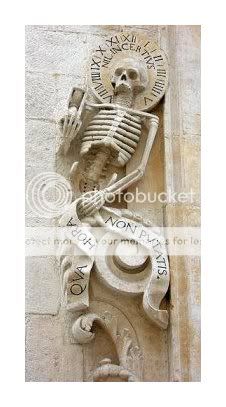 Timothy Harvey was born to an affluent family and arranged from age five to marry a young girl from another, even wealthier family. This sort of arrangement might have rubbed some souls raw, but Timothy was quite besotted with his betrothed, one Marguerite Sullivan, from an early age. She was just as close to him. Tragically, at the age of fifteen, she succumbed to yellow fever and died. Timothy never quite recovered from her loss. He vowed he would never take a wife, despite his parents’ wishes, and instead devoted himself to the craft that, until then, he had been studying more as a hobby: architecture. Timothy Harvey went on to become a famous architect, helping to shape the face of St. Cobb’s newer districts. He turned out to be especially skilled in melding form with function, delighting his clients with the finery he could coax from stone. However, he seemed to prefer one particular design motif above all others. Skeletons. He made an intensive study of the human arrangement of bones and incorporated them into nearly all of the buildings he was commissioned for. This sort of thing seemed to resonate with the people who dwelt in La Ville de la Mort, and even after he passed the trend continued, and is still practiced. Skulls and bones are familiar sights even in the most cheerful of settings in St. Cobb. Lately, animal skeleton designs have also become popular as ornamentation. It’s something of a point of pride with the residents and often a nasty shock to outsiders. There is a statue in memoriam to Timothy Harvey, who died of old age, having kept his promise never to wed. It is a sculpture of a winged skeleton with its bony hands resting gingerly on its sternum and its wings cupped forward. There is a small stone ribbon carved to loop around its fingers, and any curious viewer must step forward, into the shelter of the wings, to read what it carved there: Vise en espoir. It means, “Look forward in hope.” It's a very grand and a bit over-the-top memorial, but the residents are fond of it, and enjoy the look of shock on visitors' faces when they see such a macabre monument dominating the otherwise-peaceful courtyard it is situated in. Cobbian Vossanian Cobbians primarily speak Panymese, but a secondary language has taken hold and is taught to all children growing up in St. Cobb: a unique regional dialect of Vossanian. To most native Vossanian speakers, Cobbian Vossanian sounds archaic and odd, but it is not impossible to understand. Because Cobbians have been separated from Vossan for a very long time, certain trends have risen and fallen that didn’t make their way into Cobbian Vossanian, and likewise influences from Panymium and other cultures in St. Cobb have resulted in many borrowed terms and words in Cobbian Vossanian. Holidays St. Cobb’s residents celebrate most of the traditional holidays in Panymium. However, there are some holidays celebrated enthusiastically in the city that are not as widely-known, and some well-known holidays get special treatment. The denizens of the city are by and large a friendly people, and something about living on the edge of death has made them a curiously welcoming of new thoughts, traditions, and cultures. Here are a few of the holidays celebrated in the city, as well as details on their origins. Feast of the Court’s PrideThis festival has its origins in colorful local folklore. Legend has it that one of the first ships to land at St. Cobb actually did so by accident; the ship was carrying a royal offering of the finest wines and brews from one monarch to another. Different versions of the tale state different royal families as both the giver and the receiver. The ship was caught in a gale and forced to make an emergency landing on the site where St. Cobb is currently built. Unfortunately, the ship was damaged beyond the sailors’ means to repair. Word would eventually reach their king of their failure to deliver his gift, so they held onto hope that a search party would be sent. In the meantime, they ate what food they could, but before long they were left with nothing but the intended gifts. Which they drank. The festival starts with the first low tide of spring and lasts for about a week. In that time, Cobbians honor their ancestors by drinking as much as they possibly can. Some Cobbians use this as an opportunity simply to drink frivolously and some genuinely do so in the spirit of honoring the pioneers that came before them, making this inhospitable spit of land the place they now call home. Different versions of the festival tell of the sailors meeting with different fates. The name of the festival comes, of course, from the name of the wrecked ship. In recent years, this festival has been somewhat subdued by the wave of plague-related deaths in the city. War of the Crab-applesThere is a particularly large grove of crab-apples on a rise of land in the northern part of one of St. Cobb’s older districts. These rest on the spacious grounds of an old cathedral. Legend has it that, one day, two clergymen of rival churches were having a particularly spirited argument. One of the men, growing too angry to speak, grabbed a crab-apple from the ground and simply threw it at the other. At least, that’s the excuse Cobbians use to have an enormous and outrageous city-wide food fight. It occurs after the spring. There is no set date for the War of the Crab-apples, as it depends on the harvests of the trees themselves, but it usually takes place sometime in the summer. Crab-apple groves have sprung up all over the city over the years as a result of escalated celebrations of this bizarre holiday. Most guild headquarters have a small grove on their private grounds, and in years past it was considered prestigious if a business could afford to have one planted nearby. Oftentimes they would draw or carve a stylized crab-apple tree somewhere on their sign or building, and this has since come to mean that such a sign represents an establishment with a long and distinguished history of quality service. Crab-apples are given away or picked on a free-for-all basis, and then allowed to soften with rot. As soon as they are suitably squishy, the leader of the festivities (different every year, as chosen by those participating in the festival) announces the beginning of the war. This is celebrated primarily in residential districts, with citizens allying themselves with one of the two rival churches. The resulting pulpy mash left after the fight is usually picked off by local birds or gathered by enterprising merchants as feed for pigs and goats. In recent years, the festival has suffered a blow, and the famine currently wracking Panymium has led to the discussion of canceling the upcoming year's festival altogether. All Hallows' EveCobbians celebrate this holiday perhaps more enthusiastically than most of the rest of the continent. Most Cobbians genuinely believe that on All Hallows' Eve and, more importantly, the following day, the veil between the world of the living and the world of the dead is at its thinnest. Parades are held all throughout the month, privately organized by local guilds as a celebration of the thinning of the veil (and as a chance to showcase their wares). A final parade is held by the city itself on the morning of All Hallows' Eve, and celebrations rage well into the afternoon. It is a tradition, however, for citizens to go to bed early, so as to be prepared to rise for the next day, on which falls another holiday… Day of the DeadMore widely celebrated off Panymium, this holiday has gained an unusually fervent following in the city of St. Cobb, which is a city that has seen many disease-related tragedies. Residents of the city are surrounded by death every day, and as such take the opportunity to honor those passed quite seriously. The festival was brought over by Ecaran settlers during the early development of the city. The new residents brought their traditions with them, and the poignancy of the celebration struck a chord with their fellow townsfolk, who adopted the tradition and passed it down through the generations that came after them. The living celebrate the life they still have to honor their fallen loved ones; graveyards are brightly decorated and individual graves are cleaned and lined with personal offerings in an effort to tempt the souls back to the land of the living. An elaborate ritual dinner is usually prepared in the evening, in which families and friends gather to exchange fond memories of loves lost, and the night is finished off by the consumption of a particularly strong alcoholic beverage known simply as Suivez de l’ange (Follow the angel). Common folklore dictates that this drink is so potent that the gathered souls of the dead can feel its effects. Many people are quick to dismiss this festival as frivolous and borderline disrespectful, but there is nothing but genuine love behind the motivation for the Day of the Dead in St. Cobb, a love that is tempered with the deep sadness of a people whose lives have been historically scarred by tragedy after tragedy. This holiday finishes off the month-long celebration of the two worlds, the living and the dead. Whereas recent events in Panymium have had a dampening effect on most of the other festivals, the Day of the Dead has been celebrated with more fervor than usual in recent years. Winter HolidaysJust as All Hallows' Eve is a night where the veil between one world and the other thins, so does Midwinter Day represent the touch of the supernatural on everyday life. However, it is not the dead that Cobbians expect during this time of year; it is all things abnormal and fey. These holidays and festivals are not truly religious, and are more often than not celebrated simply for the sake of celebration. Mythological figures are recognized throughout the months leading to midwinter. Bonfires, costumed parades, and special dishes are all methods of honoring each specific spirit. The type of spirit honored usually depends on one’s familial descent, but most Cobbians recognize this as a time for the otherworldly in general to walk the earth. Offerings are left for faeries in certain households; still others gather for a vigil should they chance to see a Wild Hunt racing across the sky. Midwinter night itself is said to be the time when fey creatures creep into the company of the living. Festivals during this time are often cheerful in nature. Traditionally, a horse’s skull is mounted on a pole and decorated with swathes of fine cloth and thin veils. This is said to represent “Mam Mari,” or “Mother Mare,” a fearsome creature that, in folklore, carries the chill of winter on its bare bones. Parties sporting a Mam Mari travel throughout the city, exchanging ritual insults and singing traditional songs, often accompanied by groups of masked and costumed wassailers. It is said that sometimes the fey themselves join these activities, and by indulging them their playfulness, participants ensure good luck in the year to come. These varied festivals have gained a wider following in recent years. The residents of St. Cobb feel they need all the luck they can get. These festivals are mostly civic in nature, and hold no real religious sway with the exception of All Hallows' Eve and the Day of the Dead. Not every citizen of St. Cobb shows up for the every event--some don’t celebrate any of them. There are numerous other festivals and holidays celebrated privately and publicly; these are merely the ones that are done so in a manner so outlandish as to often draw attention from other parts of Panymium. St. Cobb and Disease Flooding is a perpetual problem in some of the older parts of St. Cobb. In addition to being closer to the waterfront, many sections of the city are built below sea level. These waterfront neighborhoods are often the place where most of the city’s myriad laborers do their work, so the filth that gathers there is easily and widely spread. These are some of the illnesses that have ravaged the city of the years, in ascending order of their death toll. DysenteryDysentery is an inflammation of the intestine. Victims suffer from frequent vomiting and bloody diarrhea. It is dangerous in that it robs the body of hydration, which can result in death if no medical attention is given. It is a common problem among the workers laboring on the docks and in dock-side factories in St. Cobb. Yellow FeverYellow fever is a viral disease that once decimated the population of St. Cobb. There is no cure for yellow fever, and the technology has not yet been created to prevent it in Panymium. Victims of yellow fever may suffer one of two phases: the first phase, in which the victim will experience nausea, weakness, lack of appetite, fever, and vomiting. Some sufferers face a second phase, the toxic phase, in which hemorrhaging occurs throughout the body, jaundice occurs from damage to the liver, and multiple organ failure leads to death. Yellow fever is no longer quite so common in St. Cobb, and most cases are only single-phase. With rest and nutrition, most victims recover. The Black PlaguePerhaps the most dreaded disease of all, everyone on Panymium is now familiar with the plague. This is without a doubt the most deadly of all the diseases to have harried the city, but it has only recently begun to gain a foothold in St. Cobb. Nothing substantial is know about this dreaded disease or the bizarre effects its taint is capable of producing on anything it comes into contact with. Its mysterious nature makes it all that much more feared. CholeraThis disease has been an unwelcome constant companion to St. Cobb since its founding. Cholera is spread by the bacteria Vibrio cholerae, and it infects the small intestines, manifesting in symptoms roughly five days after ingestion. It is less the virulent nature of the bacteria that has to do with the high death toll it claims over St. Cobb, and more to do with the way it is spread. Contaminated water and food can spread the disease. There is no real sanitation in St. Cobb, with human waste instead being dumped into the river. In addition, the bacteria can be transmitted through shellfish living in contaminated water. This ensures the continued spread of the disease in St. Cobb. Cholera, like dysentery, induces vomiting and severe diarrhea in the victim, rapidly dehydrating them. Rehydration is the only hope for a victim, and even then they might not be able to hold down any water. Untreated cholera has a mortality rate of about 50-60% but in some very severe cases, infected have been known to die as early as two hours after their first symptoms. Ironically, there is one defense that Cobbians have been utilizing over the years against their arch-foe, and that is their propensity to drink liquor, which is much safer to drink than the polluted water. However, the only way to defeat cholera for good is by sanitation and a dramatic reconstruction of St. Cobb’s virtually nonexistent sewer system.
|
|
|
|
|
|
|
|
|
|
|
|
|
|
|
|
|
|
Posted: Thu Sep 01, 2011 6:25 pm
About Magpies 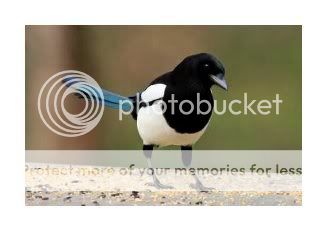 Magpies in Science Magpies in ScienceMagpies are birds of the corvid family. They are perching, or passerine birds, which, as adults, range from 17-18 inches in length that can live up to twenty years. There are many species of magpie, but here in the science section we will focus on the one on which Hanover is based, the European Magpie. Magpies begin their lives in medium-sized clutches raised by two parent birds. At about three months of age, young magpies often strike out on their own. Sometimes groups of the birds form loose-knit colonies, and sometimes only a single pair will hold sway over a territory. They guard their territory fiercely, dive-bombing anything they perceive as threatening, from cats to foxes to human beings. Magpies mate for life, remaining with the same partner unless one of the pair dies. Magpies, like most corvids, eat most anything they can get. Carrion, insects, baby songbirds--even sometimes adult songbirds--all are on the menu. They will also eat grains and some plant matter. Their tendency to rob nests has earned them something of an unfairly bad reputation. They are not typically shy of humans unless they have been treated badly, which they will remember. They can also learn to speak and imitate other noises. Magpies exhibit a number of unusual behaviors, and all of these are tied to one thing: the bird’s uncommon intelligence. There are many intelligent birds. Most people associate bird intelligence with parrots. However, to date, the European Magpie is the only bird to exhibit behaviors indicative of self-awareness. The test is simple. For those unable to watch the video, the test is as follows: A colored dot is placed on a part of the bird that it cannot see without the aid of a mirror. When the magpie looks into the mirror, is recognizes itself and sees the foreign object stuck to it, and attempts to remove it. As a control experiment, a dot is placed on the bird that matches the color of its plumage. Since the magpie cannot tell that the dot is there, it does not try to take it off. This proves that it isn’t just feeling the dot in place, rather than seeing it. This seems like no big deal, but to date only nine species of animal have ever passed this test (eight if you don’t count humans), and one of them was the humble magpie. In addition, it has been noted that the ratio of a magpie’s neostratum to its brain (commonly used as an indicator of intelligence) is similar to that of a primate or cetacean’s, and only slightly lower than a human’s. A concept of “self” changes everything in animal behavior. If a magpie knows that it is a magpie, and knows what it is supposed to look like, then it must recognizes other magpies as separate individuals of its kind, as well. Magpies also have been recorded behaving in a way that suggests grief. Magpies will often congregate around a corpse, sometimes quietly pecking once or twice in an attempt to rouse the dead before flying off, and sometimes gathering in great force, making raucous distress-calls. On the lighter side, magpies are known thieves with an eye for anything bright and shiny. Their tendency to make off with glittering things has been referenced in works of classic literature multiple times. They also have a playful side: magpies of several species have been observed playing with objects or with other magpies, often rolling over onto their backs to kick out or manipulate objects with their feet. Magpies are unusual creatures whose mysterious behaviors have not only made them curious scientifically, but have resulted in a colorful folklore following. Magpies in FolkloreThere is one constant in all folklore representations of magpies: they are used as fortune-tellers. In fact, a group of magpies is known a “tiding” of magpies for this very reason. In Western cultures there are several nursery rhymes used to predict one’s future based on the number of magpies one sees, with a single magpie being particularly unlucky. If one encounters a lone magpie, there are several things that can be done to reverse the bad fortune. - Doff your hat politely and say, “Good Morning, Mr. Magpie; how is your wife?” - Repeat the phrase, “I defy thee” seven times. - Salute the bird. It is also said that magpies have a drop of the devil’s blood under their tongue, which gives them their uncanny ability of speech. They are often viewed as symbols of witchcraft or impending death. Overall, it’s a bad lot for them in the West. Their fortunes are reversed in Eastern cultures. Magpies are symbols of good luck in Korea and China. The call of a magpie is supposed to foretell the arrival of company in Korea, and magpies play a part in the highly romantic Night of Sevens festival in China. What does this mean for the plagued item?Three main things: One, Hanover will be intelligent and self-aware even as a putesco. When she later grows to the Excitos stage, she will have very vivid memories of her life as a bird, and still think of herself as a magpie, even if she has changed in shape; coming to terms with the fact that her life and her very being have been irredeemably altered is probably going to be distressing for her. Two, Reynard will somewhat stick out when it's seen that a tame, lone magpie follows him around. Superstitious people are likely to give him a wide berth, even if they don’t realize that his magpie companion is Plagued. Three, Hanover will nick everything shiny that she comes across. Forever.
|
|
|
|
|
|
|
|
|
|
|
|
|
|
|
Posted: Thu Sep 01, 2011 6:56 pm
WINTER EVENT 2011
--- When winter came roaring down from the north, all bluster and icy-edged winds, Reynard Irving hadn’t had the slightest idea as to what he should do. He had no home to go back to, no place to seek shelter, and no means to defend himself against the descending chill. When he had expressed these concerns, in his dry way, to Hanover, the tiny caedos had simply blinked her single glowing eye and said, “Then you must go south. That is what you do when it is too cold! Don’t you know that?”
“Is that what magpies do?” Reynard had lost his voice during the most recent weather change. When he spoke, it was almost as hoarsely as his Plague did.
“Well, no, other birds do, and it is wise to know when you can find other birds, and where, after all. But… that’s just…” She paused, tipping her head to one side contemplatively. Rather than offer any further information, she said, simply, “I thought everyone knew that.”
Regardless of Reynard‘s standing knowledge (or lack thereof) on the subject, they needed to move. Reynard made his way south, taking whatever route was available to him, fleeing winter’s chill. Sometimes he managed to hitch a ride on a caravan. Sometimes he was able to pay his way on the back of a farmer’s cart. Sometimes he simply walked. Hanover enjoyed the third method of travel the most, because then she didn’t have to hide.
After they had crossed the Arcana River, they jointly decided that they needed to proceed with a specific destination in mind. The busier the town, the more likely the bedraggled former clerk was to find something in the way of a job. If they had employment, that was one step closer to acquiring a roof over their heads, even a temporary one. Reynard had acquired a map early in his exile, and had since grown quite adept at reading it and orienting himself. He didn’t need a compass. He had Hanover, who always knew which way was north.
He’d asked her to explain it to him once, and she had shrugged under her tiny feathered cloak. “It is simply a feeling.” She reached to tap at her face, but paused, “Oh, my beak is gone. I had forgotten. Well. A magpie knows,” she finished, “Any bird would know.”
Now she strutted over the map with a vaguely imperial air, as if she were genuinely some sort of giant crushing entire cities and forests underfoot. “This one looks important.” She knelt and tapped at the word “Foxbrook,” a town whose name was written in broad, fanciful letters. It was located in central Auvinus.
Reynard narrowed his eyes slightly and leaned over the map. “I have heard of Foxbrook. It is quite important as far as farming goes. Possibly,” he went on, pausing to rub at the bridge of his nose, “one of the more important towns for such in Auvinus.”
Hanover was staring up at him. “Are you all right, Reynard?”
He opened his eyes and blinked at her. “Pardon?”
“You look sick.”
“I am sick, ma fille.” Hanover only seemed more distressed by his frank admission, and Reynard shook his head. “It is hardly serious, I assure you.” He knew that he wasn’t telling the strict truth. The weather was taking a toll on him, as was the constant strain of travel. Some people flourished under hardship, emerging from the other end of their trials more robust than they had been before. Reynard seemed to be gradually withering. The fact that Hanover had noticed only made Reynard wonder what he must look like to those he met on his travels.
“Then maybe we should stop somewhere closer,” Hanover cautioned.
“No. I do not have many skills that I can offer in exchange for goods. If we are to find work in the south, it will be in Foxbrook.” He placed his finger on the dot indicating the location of the town. “So that is where we will go.”
---
The road to Foxbrook led them through a seemingly-endless sea of shifting golden grasses. Every now and again they would spot signs of a settlement. Sometimes there would be smoke, lights, signs of life, but more often than not the buildings they passed were cold and dead, the fields untended and overrun with native grasses. There was almost no food to be had, and Reynard, not for the first time since he set out from his hometown, simply went hungry.
One night they came across a small town. In the afternoon light, it had appeared on the rise of a particularly steep hill, and the sight of it was a beacon of hope to the travelers. They drew nearer as night did, and by the time they had reached the town’s outskirts, it was apparent that the entire place was deserted.
With ruthless efficiency, Reynard went through the more in-tact looking buildings, searching for food or anything else of use. He located some dusty preserves and some wine in a cellar. He broke up a bit of the remaining furniture, stoked the squat iron furnace in the corner of the cellar, and removed his gloves so that he could eat his dinner with his hands. Hanover huddled near him, absently nibbling at a pickled leek that was nearly as big as she was. “What do you suppose happened here, Reynard?”
He swallowed a draught directly from a bottle and replied, simply, “The plague.”
Hanover frowned and tilted her head. She had a habit of looking at Reynard sideways out of the corner of her single eye. It was a habit she had carried over from her days as a bird. “You think the plague killed everyone here? Why are most of their things gone?”
Reynard took a deep breath and went silent for a moment, lowering his head and letting the dull warmth of the furnace wash over him. “Perhaps not all,” he rasped. “I imagine many of the inhabitants fled. What they could take with them, they did. What they could not, perhaps family or travelers like ourselves took with them.”
“Hmm.” Hanover went back to nibbling her leek. Reynard wasn’t sure if she technically needed to eat, as a Plague, but she insisted. Reynard slept in the cellar that night, relatively warm and fed. The following morning, they intended to stay longer, scouring the town for any trace of overlooked valuables. In the light of the rising sun, however, the utterly still town looked somehow more sinister than it had by night. They hastened along with a jar of jam, a bottle of wine, and two silver spoons for their troubles.
---
Reynard saw the lake before he saw the city of Foxbrook itself. It stretched away, a sudden glittering distraction in the middle of the endless Auvinian fields. It sparkled and heaved like a miniature sea. Reynard felt an unexpected pang of homesickness hit him, staring at it so. Stop that, he chided himself. There was no use in getting worked up over what could not be changed.
“Oh,” Hanover stood straight from where she was perched on his shoulder. “That’s lovely.”
The town itself was situated closely enough for fisherman to haul in their daily freshwater catches, but far enough to obscure the sound of the lake from all but the outermost of dwellings. Hanover relocated herself to Reynard’s much-abused satchel, peering out every now and then from under the main flap. “Settle down,” Reynard hissed as they approached the outskirts. “These people are not likely to take kindly to Plagues, given the circumstances.”
Hanover made no reply, but either understood or simply decided to obey, because she ducked out of sight and did not resurface.
The town of Foxbrook was very open and spread-out. It was quite a change of pace compared to what Reynard was used to: the looming closeness of St. Cobb. The broad, flat plains seemed to welcome the wide avenues, which had been designed with freight in mind. The buildings were low, providing no hindrance to the view of the skyline. Reynard tried not to focus too hard on the openness. The plains made him feel strangely exposed and a little dizzy, as if he were on the verge of falling off of something. He could handle the uncomfortable sensation in the face of necessity, but he’d been hoping this settlement would feel safer, somehow.
Still, now was not the time to let feelings get in the way of what must be done. His first course of action was to cast about for anywhere he could find employment. Foxbrook was responsible for the sending and receiving of quite a bit of perishable goods. It was up to the offices to send as many different loads of harvest, from grains, to vegetables, to cured meat, all throughout the region. This was accomplished primarily through mule-driven carts. Needless to say, such a monumental task required organization.
Reynard plied his luck at the local freight hubs. He was met, each time, with dubious stares, owing to his scruffy appearance, but those that gave him a chance found him to be particularly handy with numbers. Reynard had already given thought to what sort of work he could possibly put himself to, and decided to focus on helping the busy warehouses organize and balance their inventories.
For all his skill, though, he met mostly with refusal. He was an unknown quantity, a stranger. It was luck that landed him a job more than anything else. “Tell you what,” one of the warehouse proprietors finally sighed, “if you need a job that badly, the inn down the road needs someone to ‘elp ‘em out in the kitchen. Their scullery maid’s taken ill. I don’t know if they’d consider you, but…” She shrugged.
Reynard immediately left for the inn. The proprietor seemed just as reluctant as the others, but after a moment of listening to Reynard, he blinked and asked, “You from St. Cobb, son?”
Reynard blinked back. “Yes.” He hadn’t noticed his accent peeking through the threadbare limits of his self-control, but apparently this man had.
“Oh.” The man eyed Reynard again, appraisingly, this time. Reynard shifted a little uncomfortably, unsure if his city of origin would be considered a strike for him or against him. “Been there once. Had the time of my life,” the man finally concluded. “Look, I can’t promise you that I can keep you for long. As soon as Suzette’s better, you’re on your own. I can’t give you much in the way of payment ‘sides a roof over yer head and some food in yer belly, but if you want work, I can give it to you.”
Reynard sagged with relief. He was shown to a small room with a straw bed that would be his while he worked there. He was to enter and exit the building through the back door, and he would defer to the cook for specific instructions. He was primarily to be entrusted with cleaning tasks. As he shrugged off his coat and carefully set his satchel down, Hanover hopped out and crowed, “Reynard, you are a scullery maid!”
Reynard sighed.
---
It wasn’t challenging work. Not, at least, in the manner in which Reynard usually gauged challenges. It wasn’t mentally demanding, nor did it require him to concentrate. It was physically hard work, though, and quite tiring. He didn’t necessarily mind being isolated from the rest of the inn, and nobody seemed particularly curious about him. He spent his first full day in Foxbrook attacking his task with grim determination, and attacking the meals he was given with even more vigor. He was exhausted, and he didn’t stop shaking until evening set in, but he got the job done.
Hanover had, amazingly, remained in the room, and had not snuck out to investigate her surroundings. Reynard was used to not having this sort of control over his Plague; indeed, she had been even more mobile and independent as a bird. She had been under the bed, and peeked out as he opened the creaking wooden door, scuttling across the floor and giving a prodigious leap to land neatly on top of the mattress, her tiny feathered cloak billowing out in reminiscence of the wings she once had. She stood still for a moment. “You look tired,” Hanover observed.
“You’re standing on my bed,” her Grimm rasped.
Reynard collapsed as soon as Hanover vacated his bed. When he woke again, the night had progressed so far that it was perched on its axis. He blinked and fumbled for his glasses (which he hadn’t remembered removing) only to have them thrust into his seeking fingers by his Plague. He replaced them, blinking blearily at Hanover. She grinned her strange skeletal grin. With a mumbled “Thank you,” Reynard sat up and started to pull his coat on.
“Where are we going?” Hanover visibly perked up at the prospect of leaving the tiny room. Reynard regarded his Plague as he shrugged back into warmer clothes, mildly suspicious of her good behavior.
“There were some trading caravans on the edge of town,” he replied softly, patting his satchel, “I think it would be best if we bartered off the spoons there.” He didn’t want to cultivate a shady reputation here. His position was already quite tenuous--any nudge in the wrong direction, no matter how infinitesimal, could be damaging. Hanover nodded sagely, and Reynard cocked a brow. “You have been unusually quiet, Hanover. Unusually quiet and complacent.”
Hanover drew herself up to her full unimpressive height. “Are you suggesting that I have been up to something, Reynard?”
Reynard’s eyebrow just climbed higher.
“Well, I haven’t,” the caedos protested. She crossed her arms under her cloak. When she spoke again, her voice was soft. “I am… simply worried. You look very tired, and very thin. I don’t want to scare anyone. I don’t want them to chase you off.” She regarded him askance. “So I have been sitting still. For you.”
Anyone who thought that “sitting still” was not a tall order to fill for a loved one obviously didn’t know Hanover. Reynard just stared back at her, startled at such unusual insightfulness. He did not smile, but Hanover had learned to recognize a certain sense of relaxation in his facial muscles when he was content, or pleased. “Well.” He seemed at an unusual loss for words. “Thank you.”
“You are quite welcome, Reynard,” Hanover said with feigned indifference, preening a bit. “I am certain you would do the same for me.”
“But I am going to the caravans alone.”
“What?”
---
Convincing her had taken some effort, but Reynard had finally managed to get away from his Plague after a bit of negotiation (which comprised itself mainly of promises to take her about the town for some proper sightseeing as soon as he was able). He stepped out into the night. It was chilly, but nowhere near as cold as what he was accustomed to. It occurred to him, for the first time, that he and his Plague might make it through the winter after all.
He set down the main avenue, taking in the sights around him. Ever if he couldn’t risk taking her with him right then, Hanover would probably appreciate his descriptions of what he saw, and he intended to recount a bit of it when he got back. He passed by darkened storefronts and still-lit pubs. He moved through the outskirts, where the stables were located, pausing to observe the sturdy, stocky plains horses most commonly used in this region, and lankier mules standing beside them.
He turned a corner, and caught sight of an enormous building on a rise overlooking the lake. A church, perhaps? It was definitely one of the taller buildings. The trading caravans took him in the opposite direction of the church, however, and he turned his back on it without a second thought.
Reynard decided to try and barter the spoons off for supplies rather than actual money. That would likely raise less suspicion if any of his belongings should become public knowledge if he didn‘t have an inexplicably large amount of money on him. He was pleased to find that some of the caravans were wandering traders of a sect he was somewhat familiar with; he had relied on their tender mercies when he first left his hometown.
They were an insular lot, but reasonable and fair in their dealings. He was able to barter off his spoons for a handful of shillings as well as a small bundle of cured meats. Reynard lingered, chatting with the leader of the caravan, exchanging information. It was something of a custom with this sect to exchange news for news, and though the leader was a little surprised to discover Reynard knew of this practice, he seemed quite happy to oblige him. When it was time to walk away, Reynard was distinctly satisfied. He had made a good impression on these people. It didn’t matter to him whether or not the riders themselves lingered in the town. It was still a step in the right direction, still a small step towards security. He turned back towards the town.
There was a woman standing in the path, smiling at him. Reynard paused, regarding her with his customary blank-faced expression, which, while not the usual reaction of a young man finding himself on the receiving end of a lady’s friendly smile, was not particularly off-putting in of itself. She didn’t move, and he could only assume she wanted to speak, so he nodded to her. “Good evening,” he rasped.
“It is a good evening.” Her voice as lovely to listen to, ringing out in the night like a bell. “You just arrived.” It wasn’t a question, so Reynard merely nodded. He had no desire to socialize with this woman. He was very tired, despite his nap, and wanted to get back to his bed, back to Hanover. He began to walk forward again, giving her a respectful berth.
She did not stop smiling, but the expression never seemed to reach her eyes. “We see our fair share of travelers in Foxbrook.” Reynard passed her, and she turned on her heel, following him. Once again, Reynard had nothing to say. “But it is rare that someone passes through that keeps such company as your lady friend.”
Reynard froze.
She kept on speaking to his back, stopping a few feet from him. “You know, I couldn’t help but notice that you came here to do some trading. I’d be very careful of this lot; they’re a bit shifty.” Reynard half-turned to her, his face set and blank as she went on. “And what was it you were bartering off? Spoons?”
Reynard did not answer.
She tilted her head. She was still smiling. “You look a little worse for the wear.”
“What do you want?” Reynard’s hoarse voice cracked under the strain of his irritation.
“I am merely welcoming you, and giving you a healthy bit of advice. Dear me.” For the first time her smile faltered, and she blinked wide eyes. “You did not do anything tonight that you will later regret, did you? I can’t help but wonder why you would want to come so far out of town just to sell a bit of silver…”
“I don’t have any money,” Reynard rasped. “Not enough to make this worth it.”
“I am not worried about your money, sir. I am worried about your soul.”
In that instant Reynard knew. His eyes widened behind his spectacles.
“We are very welcoming at the church.” She gestured vaguely in the direction of the enormous, stately building on the rise, the one that had caught Reynard’s initial attention. “If you feel the need to pray for forgiveness, then of course you may. It would be wise of you to ease your conscience. Obscuvos’s charity finds those who are pure.” She put her hand over her chest. “And the charity of the townsfolk will follow thusly.”
Reynard said nothing. He held himself tensely, as if he were expecting an attack. There was nobody else here, though, and nothing but this woman’s clear voice and her smile, which returned to her face. Once again it did not quite reach her eyes.
“There is a service tomorrow morning, shortly after sunrise. Please consider joining us. I know,” she added, holding up a hand, as if Reynard had made some sort of move to interrupt her, “that you probably don’t have much aside from the clothes on your back and the company you keep. That is fine. We are more than happy to provide for you.” She looked about her, as if taking in the sight of the town’s outskirts for the first time. “Foxbrook is a very nice town. It would be wonderful if you could stay. You look as if you have seen much hardship on your travels. You wouldn’t want to get started off on the wrong foot, of course.”
Reynard shook his head slowly.
Her smile widened into a grin. “Very good, then! I shall see you tomorrow.” She stepped forward and reached to touch his shoulder, the gesture gentle and friendly, but Reynard instinctively and fluidly leaned away from the contact. She paused. Her eyes flashed. “Of course…?”
Reynard held her stare. “Of course,” he replied quietly.
---
Hanover was waiting for him when he returned, sitting cross-legged on his pillow. “You certainly took your time,” she scolded. “I am not letting you go off on your own like that again. What if you were waylaid?” Under normal circumstances, Reynard would likely have replied with dry surprise at Hanover’s indignation--after all, she often wandered off herself, leaving him to wonder of her whereabouts. Instead, he walked to his mattress and sat slowly, his expression wooden. Hanover tilted her head. “What’s wrong?”
“The cult.” His words had a clear effect on his Plague; Hanover stood up immediately. “They sent someone to… to warn me, perhaps. To invite me.” He paused thoughtfully. “To threaten me.”
Hanover made a low warbling noise. “I do not like them.”
“She was trying to blackmail me.” He only now turned to face Hanover. “I think that perhaps the cult’s presence in this town is… is strong.”
Hanover’s eye widened. “We only just got here. Are they trying to chase us out already?”
Reynard shook his head. “The opposite, I think.” His Plague lowered her gaze and slowly sat back down. Neither of them spoke for a moment.
“Reynard,” Hanover finally asked, softly, “what are we going to do?”
It was no easy decision. Reynard doubted that he would last long in Foxbrook if he resisted the cult’s advances. Nor did he put much stock in their “charity.” He believed that, should he prove inconvenient to them, they would use force to get what they wanted. He knew it had nothing to do with him. They were interested in his Plague.
He couldn’t stay here unless he submitted to their wishes. In doing so, though, what sort of consequences would follow? What would happen to him? To Hanover? When the summer came and it was time to go, would he even be allowed to do such?
What other option did they have? Flee? Were they to leave this town, where, for the first time in over a month, Reynard had a roof over his head that didn’t look as if it were to be left behind in the morning? Where they had food and water? And if so, where would they go? How were they going to survive the approaching thunder and frost of winter?
Hanover stared up at him. “Reynard?” she asked again.
Reynard took a deep breath.
|
|
|
|
|
|
|
|
|
|
|
|
|
|
|
|
|
|
Posted: Thu Dec 22, 2011 2:57 pm
What he did know is that he had no other choice but to come here. If the cultists knew he was here, if they knew that he had gone to the outskirts of town, then they had been watching him. What were the odds that he would be able to slip their net of surveillance and escape? They certainly weren’t high.
Even if he did manage to escape, what awaited him out there? Likely starvation and death. They had barely made it to Foxbrook. He couldn’t throw away his best chance at survival. He did not know what would happen to Hanover if he died. He knew that, in some way, her vitality was tied to his. If he died, she might be hurt somehow.
But oddly more distressing was the knowledge that, if he died, she would be alone.
The door opened, and he was greeted by a tall man, a farmer if Reynard ever saw one, broad and well-muscled. He beckoned Reynard in, warmly welcoming him to the church. Reynard numbly listened to the polite greeting, and as he was brought out to be introduced, he nodded silently to other members of the congregation, who were gathering to prepare for worship.
“We have your robes and mask back here, of course,” the farmer said, leading Reynard to a separate room. Most of the congregation preferred to wear their robes over their clothes, but some chose otherwise. Reynard shrugged off his coat, but otherwise did not disrobe. He preferred to keep a barrier (metaphorical or otherwise) between himself and everything to do with this damn cult.
He did not believe in this god of theirs, this Obscuvos, but he would show them what they wanted to see if it meant he would be allowed to stay here. Reynard paused as he stared down at the pale bird’s mask in his hands, so dark against his black gloves. It stared impassively back at him.
He took a deep breath and slid the mask on, pulling the hood of his robes over it. He was just like them now--faceless, devoid of al identity… equals before Obscuvos.
This was how he would survive the winter.
By doing what he had to.
|
|
|
|
|
|
|
|
|
|
|
|
|
|
|
Posted: Tue Dec 27, 2011 10:52 am
 “We cannot stay,” he said simply. “We have to go before they find some means to keep us here indefinitely.”
Hanover looked down at the bed, and then back up at Reynard. “Where will we go?”
Reynard shrugged. He met his Plague’s gaze. “Further south, perhaps. I don’t think it would be wise to retrace our steps. They might know where we came from. She certainly had no problem finding me.” He tilted his head thoughtfully. “We can follow the river to the sea.” Perhaps it was out of practicality--there was nearly always work to be found at a port--or perhaps it was out of a desperate need for comfort, but the sound of once again working his way to the ocean comforted Reynard.
He was drawn to it, connected to it somehow. It was in his blood. “Yes,” he said with a nod. “We will go to the sea.”
“Very well. When shall we leave?” Hanover asked, stepping back as Reynard stood.
“We must go now. She is expecting me at the church in the morning.” Reynard felt the dull buzz of adrenaline pulse through him, filling the empty, tired hollows behind his eyes. “We will go as far as we can tonight, and when day comes, we will sleep.” He began to gather his few belongings while Hanover darted about the bed--she was doing nothing to aid the preparations to leave, but rather just possessed by restless energy.
“Reynard, are you sure this is what we should do? Perhaps we can just pretend to worship when they do.” Reynard ignored her, still bustling about. When she spoke again, it was louder, with the desperate scrape of a caw on the edges of her voice. “Reynard, I do not want to see you starve.”
He paused then, and once more turned to his Plague. She was staring back at him, the shape of her eye giving the impression of a brow knit in worry. By Panyma, it looked as if she were about to cry. Reynard’s expression softened and he knelt by the bed so that he was more or less eye level with her. She didn’t move.
“Hanover,” he reached up, gently slipping off one of his ever-present black gloves. He reached towards the Plague with his spidery, pale fingers, and she huddled against them. “I know you are thinking about what is best for me. But I also need to think about what’s best for you. And it is not…” He shook his head. “Whatever they have planned for you.”
She silently wrapped her arms around his thumb, leaning against his palm. For a moment she was still, and then, very slowly, she nodded.
Reynard had to wonder if he was making the right decision. The last time he had let his emotions rule his actions, he had fled from his only home. That had brought him here, so many miles from the familiar cobblestones of La Ville de la Mort, half-starved and exhausted.
It had also, however, brought him Hanover.
No matter what happened, he wouldn’t regret it. He left, and left quickly, taking only what he owned; stealing could only further complicate his delicate situation. He received directions to a little-known fur trapper’s path that followed the course of the river from the caravan-leader that he’d sold the spoons to, and, guided by the light of the cold stars, Reynard and Hanover fled.
This was how he would survive the winter.
By the skin of his teeth.
|
|
|
|
|
|
|
|
|
|
|
|
|
|
|
|
|
|
Posted: Tue Dec 27, 2011 10:53 am
Et Cetera OKAY SO VERSION 2.0 IS DONE. Some old and new things in this section. Why the long-winded and unnecessarily convoluted backstory, bro? Well, it's all because of Reynard. I wanted to play a character who would not be happy in his current environment, and who would have to undergo a lot of personal growth and change as his story progressed. In order to get him started, I had to put him in a situation where he would do things that he normally wouldn't. Also, I recall reading that developing settings was sort of encouraged, so I did. And made up St. Cobb. It's obviously based a little on real-life New Orleans. I tried to capture the flavor without mimicking every aspect of the city itself. Since this is not Earth, I figure I have a little creative freedom with what I wanted to make there. I also look forward to possibly role-playing in it, or, if other people are interested, even hearing of their adventures there! I might be getting a bit ahead of myself, but. Uh. Yeah. Also, I want Reynard to eventually return to St. Cobb, but that won't be until much later. Why a magpie? They're so dapper. Also, they are extremely intelligent and lively birds. They can even learn to speak! They're very interesting characters, and I thought that, well, one would make a very interesting character. Why one-eyed? I dunno. It was just an idea, so I went with it! Names! Explain names! Reynard, of course, comes from the French folk-hero, who was a fox. Irving means "fresh water." Water is sort of a theme here. His mother was a sailor, his father died of a disease spread by contaminated water, and he cemented his friendship with Hanover over water. Hanover is just a cool name. It's a region of Germany, but it was also the name of a famous racehorse. Reynard named her it because it was the name of the street sign she was sitting on when he first saw her. Reynard is not creative. --- WINTER 2011 NOTES
Uh, hmm. Not much to say, it's pretty straightforward. I decided to go with the "choose your own ending" deal because I could not decide whether I wanted to interpret the prompt literally or figuratively. Obviously, the "surrender" ending is the literal interpretation, and the "flee" ending is the figurative interpretation!
Uhh... I... uh. DERP? I guess if I get questions on any critiques I can put them here! >8O
Oh, also, since I had to write Hanover as an Excitos, I had to decide what I thought was a likely growth for her. Since the caedos is the most common Plague, as well as the essence of chaos, I figured it'd fit. --- That's all for now, but I'll probably add miscellaneous stuff to this end post as I think of it. THIS HAS BEEN…. Snifit’s entry. Thank you for your cooperation, reader. Your agreed-upon twenty bucks are in the mail. Comments, constructive criticism, tips, free sandwiches, additional guidance, and all other feedback is greatly appreciated! Thank you for your time.
|
|
|
|
|
|
|
|
|
|
|
|
|
|
|
|
|
|