|
|
|
|
|
|
|
|
|
 Posted: Sat Nov 05, 2011 5:17 pm Posted: Sat Nov 05, 2011 5:17 pm
When writing a story, whether it be a manga or a novel, the most important thing to have is plot. Without a proper plot, no matter how amazing your characters, or exciting your action, readers will not want to read for very long. In this little lesson on how to write a story, I will be explaining the essence of plot, and how to create it.
Here is a very average diagram of the concepts I will soon be talking about:
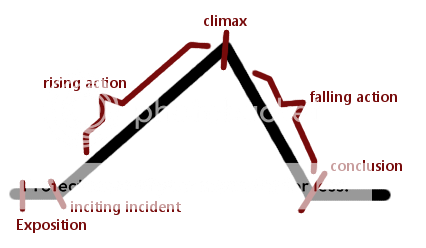 The first part of the story is the exposition. This is the events taking place before the exciting action. In the exposition, characters are introduced to the reader and a little context and background is given. For example, in the play Hamlet by William Shakespeare, the exposition includes the introduction of Horatio (Hamlet’s best friend), Hamlet, Claudius (current king), Gertrude (Hamlet’s mother, queen), Ophelia, her brother Laertes, and their father Polonius. The exposition also includes explanations of where the play takes place (Denmark), and any important history (Hamlet Sr. just died, his brother took the throne and married the queen), we also get the introduction of Hamlet and a brief insight into his character from multiple viewpoints. Without a proper exposition, the reader has no idea what is going on, where and when the story takes place, and does not understand who the characters are and what their place in the story is. The first part of the story is the exposition. This is the events taking place before the exciting action. In the exposition, characters are introduced to the reader and a little context and background is given. For example, in the play Hamlet by William Shakespeare, the exposition includes the introduction of Horatio (Hamlet’s best friend), Hamlet, Claudius (current king), Gertrude (Hamlet’s mother, queen), Ophelia, her brother Laertes, and their father Polonius. The exposition also includes explanations of where the play takes place (Denmark), and any important history (Hamlet Sr. just died, his brother took the throne and married the queen), we also get the introduction of Hamlet and a brief insight into his character from multiple viewpoints. Without a proper exposition, the reader has no idea what is going on, where and when the story takes place, and does not understand who the characters are and what their place in the story is.
|
 |
|
|
|
|
|
|
|
|
|
|
|
|
|
Posted: Sat Nov 05, 2011 5:18 pm
The next part of the plot is the inciting incident. This is the single event that begins the action throughout the story. In Hamlet, the inciting incident is when Hamlet is told by his father to avenge his untimely death and kill Claudius, the current king. The rest of the play happens because of Hamlet’s desire for revenge. The inciting incident can be a number of things; an amazing discovery, an introduction of an important character, a death, finding of an important item etc. As long as the event drives the character to take a step out of his regular life and begin doing something that can last the rest of the story, it can work.
Some examples of plot based on the exciting incident:
-Man against Man: where the main character is fighting against another person.
-Man against Self: the main character is fighting against himself, usually trying to overcome something wrong within his character (that angel on one shoulder, devil on the other kind of thing)
-Man against Nature: a good example is Jurassic Park. Enough said.
-Man against society: when the character is fighting against the government, a way of life, or a community
|
|
|
|
|
|
|
|
|
|
|
|
|
|
|
|
|
|
Posted: Sat Nov 05, 2011 5:18 pm
After the inciting incident, is the rising action. This is the main body of the story and is the longest section in the plot. The rising action is driven by the main character’s plot as well as the other subplots intermingled throughout. In Hamlet, the rising action includes Hamlet’s various plots, Laertes heading off to France, Polonius sending a henchman to cause trouble, and Fortinbras’ army moving through Denmark. Besides the hook at the very beginning, the rising action is the most important part of the story. Losing your hold on the plot here will lose your readers.
At the very peak of the plot is the Climax. This is where all the plots in the rising action meet and the main character either receives what they were searching for in the conflict or loses it forever. In Hamlet, this is where Hamlet succeeds in killing Claudius (along with the rest of the characters except for Horatio). This can be one of the most exciting parts of the story, and can either make readers like the story even more, or get them angry for completing it in a way they don’t like. The climax should reveal to the characters all the subplots and any surprising twists you have been hinting to in the rest of the story.
|
|
|
|
|
|
|
|
|
|
|
|
|
|
|
Posted: Sat Nov 05, 2011 5:19 pm
The falling action is basically a wrap up of any smaller plot points or facts that are revealed after the climax, and is followed by the conclusion (very end of story). This section is relatively short, and can either be really interesting or boring. Try not to bore the readers in the falling action. In Hamlet, the falling action consists of Hamlet finally extending real friendship towards Horatio, and the actions of Fortinbras after entering into Denmark with his army to discover that the whole royal court is dead. Be sure to wrap up all of your plot points before ending your story. Leave no plot holes.
--This is part one in a short series of posts I will make on creating a story. In some of the later ones, I will be going into more depth with some of these sections. If there is anything else you would like me to write more about, feel free to post it here.
|
|
|
|
|
|
|
|
|
|
|
|
|
|
|
|
|
|
|