





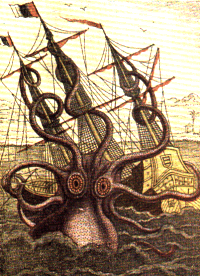
 The kraken may well be dead, poisoned by marine pollution. Those who have studied its history claim that it lives yet, but in a state of hybernation, sleeping, in the words of Tennyson, 'far, far beneath the abysmal sea'.
The kraken was described by the renowned naturalist Erik Pontoppidan, Bishop of Bergen, as 'the largest and most surprising of all the animal creation'. This was no exaggeration, for this immense beast was, or is, the largest animal of all time. Whether there is more than one kraken, what is its gender, how long it lives and many other important questions remain unanswered, for the creature has not been sighted for more than a century.
Giant of the Deep
Descriptions are sketchy, perhaps because the creature is too vast to make a proper observation (except from the air), or because sailors who encounter it are badly traumatised. Although some accounts describe it as an enormous whale- or turtle-like creature, the general consensus is that the kraken is a tentacled, slimy monster up to 1 mile (1.6 km) in circumference. On the rare occasions that the kraken surfaces from the ocean depths, it is easily mistaken for an island. Sailors of old would weigh anchor, 'go ashore' and light fires, waking the slumbering titan which would promptly submerge, creating an enormous whirlpool which sucked ship and crew down with it. Occasionally the kraken would drag down entire ships with its tentacles.
Trench Town
On the whole the kraken restricts its range to northern waters, its favourite haunt being those off Scandinavia. It probably lurks in the Norwegian Deep, the trench that cuts into the continental shelf off the coast of Norway, but it has occasionally been sighted further afield. Sailors in the waters off Scandinavia are used to monsters. They regularly see sea serpents, but the kraken is the most fantastic, and the most feared.
Numerous ships lost without a trace have been credited to its predations, although much less so in recent times. The North Sea is one of the most heavily polluted stretches of water in the world, and it is possible that radioactive and toxic waste have driven the kraken deep into open ocean or even killed it. If it is still alive, it may simply be dormant - a state of affairs that will not last forever. Some fear that continued oil and gas extraction in the North Sea might attract the kraken's wrath, and that retribution will follow.
Literary Monster
In myth and folklore the kraken has been linked with the biblical Leviathan, and the Norse 'world-serpent' Jormungandr.; but it is perhaps best remembered in the English-speaking world by Tennyson's epic poem The Kraken and John Wyndham's science-fiction novel The Kraken Wakes.
-by Joel Levy