Places of Middle-EarthIf you want to look at a map please go to this site. due to the fact that it would be hard to see the maps in full.
http://ring-lord.tripod.com/maps.html For any more information about a place please ask first but if you cant resist try a website like
http://www.wikipedia.org/Arnor:Arnor, or the Northern Kingdom, was a kingdom of the Dúnedain in the land of Eriador in Middle-earth. The name probably means "Land of the King", from Sindarin Ara- (high, kingly) + (n)dor (land).
At its greatest, Arnor encompassed almost the whole region of Eriador between Bruinen, Gwathló and Lhûn, and the region which would later be known as the Shire. Arnor's population was composed by Dúnedain in western-central regions and mixed or indigenous (and reluctant as citizens) peoples. Its capital was Annúminas near the lake Nenuial.
HistoryArnor was founded at the end of the Second Age by Elendil, whose sons founded Gondor at the same time. The history of the two kingdoms is intertwined; both kingdoms are known as the Realms of the Dúnedain in Exile.
Before the foundation of Arnor there was already a sizable Númenórean population living there, a result of the slow emigration of Númenóreans which had started under Tar-Meneldur and Tar-Aldarion. Before the arrival of the Dúnedain Arnor was home to Middle Men of Edain stock, and the early colonists soon interbred with the indigenous population. Arnor was originally favoured over the more southern regions (Gondor) because the Elves under Gil-galad lived near it across the river Lhûn. However, in later days after the Númenóreans fell under Sauron's shadow they settled more to the south. This led to a situation where Elendil arrived in an area populated by people who, unlike his own Númenóreans, were mainly still friends with the Elves, and unlike Gondor to the south in Arnor much knowledge of the Elder Days was preserved.
Arnor's second king Isildur (also King of Gondor) was killed in by Orcs in the disastrous Battle of the Gladden Fields. His three eldest sons were killed with him, but the fourth and youngest, Valandil, survived and became king of Arnor ().
Because Valandil and his heirs did not claim the throne of Gondor the realms were split, but Arnor's ruler kept the title High King, whereas in the south the ruler was 'just' King.
DeclineWith the victory of the War of the Last Alliance, Arnor's power reached its zenith. The King of Arnor held the overlordship of all the land between the Ered Luin and the River Poros on the southern borders of Ithilien, east to the eastern borders of Mordor. After the Disaster of the Gladden Fields, Arnor began its slow decline. In many ways, Arnor never truly recovered from this disastrous blow to its manpower: While the dawn of the Third Age heralded a new era of opportunity and expansion for Gondor, Arnor began it in a futile attempt to simply recover lost strength.
Civil war and successor states.
After the death of its tenth king, Eärendur, in , Arnor was shaken by civil war between the three sons of Eärendur. The eldest son, Amlaith, claimed Kingship over all Arnor but was reduced to only ruling the region of Arthedain as his kingdom, while the other sons founded the kingdoms of Cardolan and Rhudaur. The former capital, Annúminas, became depopulated and fell into ruin.
This marked the start of the decline of the Northern Dúnedain. The three kingdoms had frequent border skirmishes over boundary disputes, but the relationship of Arthedain and Cardolan remained relatively peaceful. However, Rhudaur was unfriendly towards the two other successor states, and took part in a bitter conflict with Cardolan over the tower of Amon Sûl and the palantír associated with the tower.
Then, in around , an evil power, the Witch-king, arose in the mountains of the North East, where he founded Angmar. It was later revealed he was the leader of the Nazgûl, who were dispersed after the first overthrow of Sauron in at the hands of the Last Alliance of Elves and Men, but survived nonetheless.
FallThe last Kings of Rhudaur were not of Númenórean blood, but were descended of Men in service of Angmar. Under their rule the land became a vassal of Angmar, and thus enemies of Cardolan and Arthedain. Angmar annexed and terminated the kingdom in . By this time the Dúnedain were gone from the region, as well as most of the other inhabitants
Armies swept out of Angmar, and were met on the Barrow Downs by the Cardolani army. In the fateful battle that followed, the Cardolani army was utterly destroyed, the majority of the Cardolani Royal Family were killed and many of the nobles of the leading Cardolani houses were slaughtered along with their knights. Many tens of thousands lay dead, the Arthedain capital, Fornost, had barely held out against the invaders, and Cardolan had been shattered. While Arthedain recovered something of her power, Cardolan did not.
In theory Arthedain became Arnor with the end of Cardolan and Rhudaur, but the Kingdom was a poor reflection of the large and powerful realm of Arnor before 861. The Great Plague destroyed the remainder of the People of Cardolan in 1636 and Arthedain was destroyed in 1974, culminating in the pyrrhic victory of the Battle of Fornost. The population of Arnor were mostly wiped out by the wars, but the Hobbits survived in the Shire, men survived in Bree and probably other villages, and the Dúnedain of Arnor created new homes in the Angle south of Rivendell, where some of them became known as the Rangers of the North.
Reunited Kingdom
Aragorn II as King Elessar refounded the Kingdom of Arnor as part of the Reunited Kingdom, and again made Annúminas his capital city. After the fall of Sauron, Arnor was safe again for human population, and although it remained less populated than Gondor to the south in time Arnor became a more densely populated area again, even if it had dwindled in size due to the independence of the Shire.
Annuminas:Annúminas (Sindarin: "West Tower" or "Sunset Tower") is a city of Middle-earth.
The city was once the capital of Arnor, on the shores of Lake Evendim in the north of Eriador. The city was founded by Elendil near where the lake gives rise to the Baranduin (Brandywine) River. It survived for nearly a thousand years. In the early days of Arnor, it was one of the glories of Middle-earth. Soon after its founding, though, the numbers of the Dúnedain of the North began to dwindle. The population of Annúminas seems to have fallen throughout its history, until it was deserted and the kings removed to Fornost to the east.
At the time of the War of the Ring at the end of the Third Age, Annúminas had lain in ruins for more than 2,000 years. There are hints in Tolkien's writings, however, that King Elessar, formerly known as Aragorn, refounded the city and may even have made it his northern capital early in the Fourth Age.
Angmar:Angmar (Sindarin: 'Iron-home') Angmar was founded in T.A. 1300 in the far north of the Misty Mountains by the evil Lord of the Ringwraiths, who became known as the "Witch-king of Angmar". Since the Witch-king was a servant of the Dark Lord Sauron, it is presumed that Angmar's wars against the successor kingdoms of Arnor were done at Sauron's bidding.
The capital of Angmar was Carn Dûm where a race of evil men lived.
Soon after Angmar was founded it waged war against the divided Dúnedain realms of Arthedain, Cardolan and Rhudaur. The Witch-king conquered Rhudaur, the weakest of Arnor's successor kingdoms, and replaced its Dúnedain king with one of the native Hillmen, a wild tribe of men possibly descended from the "accursed" kin of Ulfang.
Now under the Witch-king's control, Rhudaur in 1356 T.A. invaded Arthedain and in the attack, Arthedain King Argeleb I was slain. However, with the aid of the armies of Cardolan, Arthedain managed to maintain a line of defence along the Weather Hills.
In 1409 T.A. Angmar attacked Cardolan, destroying the kingdom. At this time, the Rhudaur disappeared, leaving Arthedain as the last remaining Dúnedain kingdom in Arnor. Arthedain, bereft of allies, struggled on for another 500 years.
In 1974 T.A. Angmar amassed its forces and launched a final assault on Arthedain. Angmar took the Arthedain capital Fornost, thereby destroying the last kingdom of the Dúnedain.
A year later, Prince Eärnur of Gondor arrived to aid Arthedain, but he was too late. His army, along with the remaining Dúnedain, the Elves of Lindon, and elven forces set out from Rivendell led by Glorfindel utterly defeated the forces of Angmar in the Battle of Fornost, but the Witch-king was not slain. He escaped and fled to Mordor, and his kingdom of Angmar dissipated. It was after this battle that Glorfindel made the famous prophecy that the Witch-king would be killed by no man.
Following the victory, Angmar's forces west of the Misty Mountains were completely shattered and it ceased to exist. Meanwhile, the parts of it extending on the east of the Misty Mountains were wiped out by the ancestors of the Rohirrim.
Angband:Melkor's stronghold, built after he destroyed the two lamps it was built under the Ered Engryn. Though it was partially destroyed when the Valar captured Melkor, it was not completely cleaned out and Balrogs and others still hid there during his captivity. After he escaped from Valinor, Melkor rebuilt it and it was never again taken until the Great Battle that ended the First Age of the Sun. Angband was, of course, destroyed when the most part of Beleriand sank beneath the ocean.
Aman:Aman ("blessed realm") is a continent that lies to the west of Middle-earth (although it lay in another dimension during the time of The Lord of the Rings), across the great ocean Belegaer. It is the home of the Valar, and three kindreds of Elves: the Vanyar, some of the Noldor, and some of the Teleri. The (probably large) island of Tol Eressëa lies just off the eastern shore.
Upon the destruction of Almaren in very ancient times, the Valar fled to Aman, and there established the realm of Valinor. Seeking to isolate themselves, they raised a great mountain fence, called the Pelóri, on the eastern coast, and set the Enchanted Isles in the ocean to prevent travelers by sea from reaching Aman.
For reasons unknown, the Valar left two lands outside the wall of the Pelóri: Araman to the northeast and Avathar to the southeast. Ungoliant, an ancient being in the form of a great spider, had managed to escape notice in Avathar. When Melkor was released from his captivity, he fled to Avathar, scaled the mountains with Ungoliant's help, and wrought destruction of great consequence in Aman.
The first navigator to succeed in passing the Isles of Enchantment was Eärendil, who came to Valinor to seek the aid of the Valar against Melkor, now called Morgoth. His quest was successful, the Valar went to war again, and also decided to remove the Isles.
Soon after this, the great island of Númenor was raised out of Belegaer, close to the shores of Aman, and the Three Houses of the Edain were brought to live there. Henceforth, they were called the Dúnedain, or Men of the West, and were blessed with many gifts by the Valar and the Elves of Tol Eressëa. The Valar feared—rightly—that the Númenóreans would seek to enter Aman to gain immortality (even though a mortal in Aman remains mortal, due to it not being their final destination), so they forbade them from sailing west of sight of the westernmost promontory of Númenor. In time, and not without some corrupting help from Sauron, the Númenóreans violated the Ban of the Valar, and sailed to Aman with a great army under the command of Ar-Pharazôn the Golden. Eru collapsed a part of the Pelóri on this army, trapping it but not killing it. It is said that the army still lives underneath the pile of rock.
In light of this new development, Eru removed Aman from the spheres of the world. The earth, at this time, was flat. They clove it in two, and made the half containing Middle-earth round, so that a mariner sailing west along Eärendil's route would simply emerge in the far east. For the Elves, however, they crafted a Straight Road that peels away from the curvature of the earth and passes to the now-alien land of Aman. A very few non-Elves are known to have passed along this road, including Frodo Baggins, Bilbo Baggins, Samwise Gamgee, and Gimli. Aman had many names of which the most common were, The Blessed Realm and the Undying Lands.
Arda:Arda was part of Eä, the universe of all which exists. Arda was created, together with the rest of Eä, through the Music of the Ainur for the Children of Ilúvatar (that is, Elves and Men).
Because the Sun, Moon, stars, and other objects orbited the planet in the cosmology of Middle-earth they were considered part of Arda, leading to Arda sometimes being called the 'Solar System' of Middle-earth. The term for the Earth itself, excluding these celestial bodies, was Ambar or Imbar.
Originally the Earth (Arda) was flat, the continents were surrounded by a mighty ocean (or perhaps by space), Ekkaia or Vaiya, the Encircling Sea, and separated by Belegaer, called the Great Sea and the Sundering Seas. In the First Age, the area in the northwest of Middle-earth was occupied by the country of Beleriand, but this was destroyed during the War of Wrath.
There was also a separate continent south and east of Middle-earth called the Dark Land. Another separate continent to the east of Middle-earth was the relatively small Land of the Sun, so called because when the world was flat the Gates of the Sun were near there, and it would be scorched.
Information regarding both was vague. To the south were the Hither Lands including Harad, though "Harad" means "South" and while properly used for the region immediately south of Gondor and Mordor was often loosely used to refer to every land to the south. There were many stretches of sun-scorched desert in Near Harad, but there was supposedly a jungle beyond it which few had ever ventured to, from which the great Oliphaunts were found. Men of Far Harad are also described as being black skinned. The vast lands East were collectively referred to as Rhûn, though this may have only referred to those immediately east of the Sea of Rhûn and River Running. The Easterlings, like the Haradrim, were a diverse collection of many races. There was even less knowledge of the extreme eastern end of Middle-earth, where the land was supposed to stop at another sea. It is known that in ancient times the great chain of the Red Mountains ran north to south near here, and was roughly analogous to the Blue Mountains of the west (the world was once symmetrical at the dawn of time). The race of Elves first originated near here, though their original home of Cuiviénen no longer existed by the Third Age. It is not known if the Red Mountains survived into the Third Age, either intact or in some reduced form (like the Blue Mountains). It is said that the Blue Wizards went far into the east of Rhûn and beyond to stir up rebellions against Sauron in the lands he held sway over, though the tales of these struggles never reached the west in detail. It is also said that the Blue Wizards may have failed in their mission; this is interpreted several ways, either that like Saruman they set themselves up as lords of men, or that like Radagast they started to care more for the local people they were charged with protecting than Middle-earth as a whole and then refused to return.
In the Second Age, Númenor was raised in the Great Sea for the Edain. This island existed through most of the Second Age, but was destroyed as a result of the pride of the Númenórean people in defying the Ban of the Valar and sailing to Aman in the west.
After the destruction of Númenor, Arda was made round. Aman (The Undying Lands) was taken out of the world, and could only be reached by the Elves, following the straight road that was granted to them. As Aman was taken away from Arda, new lands and continents were created east and west of Middle-earth.
The word "Arda" was apparently conceived as a cognate of English "Earth" and its equivalents in the other Germanic languages (such as Dutch aard, German Erde), although it ostensibly has no relation, being a Quenya word.
Amon Anwar (The Hill of Awe):Amon Anwar (Sindarin Hill of Awe), originally Eilenaer, later Halifirien (Rohirric The Holy Mountain), is the location of several great events in the history of Gondor, and was originally considered the centre of the Realm. Amon Anwar stood up out of a great wood around its feet. The hill was long and sloping and the wood went almost to the summit.
While it was considered the centre of Gondor, it would be better described as the spiritual centre of Gondor, as it was the high place nearest to the centre of a line from the inflow of the Limlight down to the southern cape of Tol Falas and the distance to it was equal from the Fords of Isen and Minas Tirith
HistoryThe Tomb of Elendil
After the War of the Last Alliance, Isildur defined the bounds of Gondor and, upon discovering that this was the centre of Gondor, he entombed his father Elendil the Faithful here and it was at this time that the hill's name became Amon Anwar, as Isildur had called the protection of the Valar upon that hilltop, and they had granted it. Isildur swore all those present to secrecy and forbid anyone save a Heir of Elendil from disturbing it. The tomb then stayed untouched by any save the Kings of Gondor and later, their Stewards.
The Oath of Eorl
In the time of the twelfth Ruling Steward, Cirion, Gondor was faced with a massive invasion of a land they could not protect, Calenardhon which had been depopulated in the Great Plague of 1636, though it had not been greatly populated to begin with. Cirion called upon the aid of the Éothéod and in return for their aid, he surrendered Calenardhon to them, Until the Great King should return. Although by this time the lives of eleven Stewards had passed before him, no one in Gondor ever expected that the King would return.
Cirion took Eorl, Lord of the Éothéod to the hallowed site of Amon Anwar and there before the Tomb of Elendil they swore what would be in later days known as the Oath of Eorl, giving Calenardhon to the Éothéod, and promising eternal friendship between the two Kingdoms. As Amon Anwar was no longer the centre of Gondor, rather its border, Cirion removed the casket that Isildur had set upon the hill two thousand years earlier to Rath Dínen, the Silent Street, where all other Kings of Gondor were entombed.
The Warning Beacon
Also, a chain of warning beacons was established along the line of the Ered Nimrais to warn South Gondor of danger in Calenardhon, and vice-versa. Later this was used to warn Anórien of danger to Gondor and Rohan also. The westernmost and last built beacon was situated upon Amon Anwar, and was only created after the Tomb of Elendil was removed to Rath Dínen, as no Lord of Gondor, King or Steward, had permitted the construction of a beacon whilst Elendil still remained there.
Even after Elendil was removed to Minas Tirith, the awe still remained upon the hill, and its surrounding forest. The Beacon Wardens would live close to the summit only for short watches in specially constructed cabins. Except when there was a noise of animals in the forest, or of folk along the road, they would find themselves speaking to their companions in whispers, as if they expected a great voice from long ago to speak. The Wardens were the only people to live in those woods, and were glad when their tour of duty was over. The mound of Elendil's Tomb remained upon the top of the hill from the time that Isildur hallowed it until the Changing of the World, always in a well-kept, green field.
Aglarond:Aglarond and Angrenost (later Isengard) were the two fortresses built by Gondor guarding the Fords of Isen. Like Angrenost to the north it was initially well guarded, but as the population of Calenardhon (the later Rohan) dwindled it was not maintained and, losing importance, was left to a hereditary small guard who intermarried with Dunlendings.
When Cirion, Steward of Gondor, gave Calenardhon to the Éothéod, Aglarond was transferred into Rohirrim care, who named it Súthburg (southern burg in their language). The Gondorian guard was merged with that of Angrenost to the north, which remained in the keep of Gondor. Guard duty of the Fords was initially shared between Gondor and Rohan, but later maintained only by the Rohirrim.
During the reign of Helm Hammerhand, Rohan was attacked by Dunlendings from across the river Isen. Edoras was taken, and Helm and many of his people retreated to Súthburg. Because Helm always blew a great horn before riding out to fight the beleaguering Dunlendings, the keep was renamed Hornburg. During the War of the Ring, the Hornburg was the refuge of the Rohirrim as they defended Helm's Deep.
After the war, Gimli the Dwarf, who fought in that battle, established a colony of Durin's folk there. Aglarond lay in front of a huge and very beautiful cave system, which proved irresistible to him. Gimli become known as 'the Lord of the Glittering Caves', although this new realm was presumably under the overlordship of Thorin Stonehelm, his kinsman and heir of the lordship of all Durin's Folk. The Dwarves of Aglarond restored the Hornburg following the War of the Ring, and it became a fortress they shared with the Rohirrim.
Bree:Bree was a very ancient settlement of men in Eriador by the time of the Third Age of Middle-earth, but after the collapse of the kingdom of Cardolan, which had claimed it, Bree continued to thrive without any central authority or government for many centuries. As Bree lies at the meeting of two large roadways, the Great East Road and the (now disused) Greenway, it had for centuries been a center of trade and stopping place for travellers, though as Arnor in the north waned its prosperity declined.
Bree was the most westerly settlement of men in all Middle-earth by the time of the War of the Ring, and became one of only three or four inhabited settlements in all of Eriador. During the War of the Ring a day's ride east from the village along the road lay The Forsaken Inn, according to Aragorn, although nothing else is known of that place.
Directly west of Bree were the Barrow-downs and the Old Forest. Bree was the chief village of Breeland, a small wooded region near the intersection of the main north-south and east-west routes through Eriador. Breeland was the only part of Middle-earth where Men and hobbits dwelt side by side.
The name Bree means hill, according to Tolkien, referring to the fact that the village of Bree and the surrounding Breelands were clustered around a large hill. There were three villages in Breeland in addition to Bree proper. The name of the village Brill, which Bree may well be influenced by, has an interesting meaning. Quoted from the Brill Village Website- "Our name means 'hill' - twice over. Brill is a modern abbreviation of Bre-hyll. Both syllables of Bre-hyll mean ‘hill’ – the first is Celtic, and the second Anglo-Saxon."
Staddle was populated primarily by hobbits who made a living from light agriculture, of pipeweed, primarily. Staddle was on the south-eastern side of Breehill, sitting south of Combe and Archet. It was the only of the villages (other than Bree itself) visible from the Great East Road.
Combe was populated primarily by Men, with some hobbits, all of whom made a living from agriculture. Combe was situated on the borders of the Chetwood and on the edge of Breehill, between the villages of Archet and Staddle.
Archet was the furthest north. Located in the Chetwood, it was populated primarily by Men.
Bree was said to be founded and populated by men who did not make it to Beleriand in the first age, having forsaken their relatives who would become the edain, east of the mountains and remained in Eriador.
In The Fellowship of the Ring, Frodo Baggins met Strider (Aragorn) at the largest and most popular inn in Bree, The Prancing Pony, owned by Barliman Butterbur. Later on in Fellowship, some of the Ringwraiths attempted to kill the hobbits, but Strider anticipated them, and the hobbits were in his room instead of their own when the Black Riders struck. Gandalf later said that the Riders actually threw down the gates of the town and rode through it like a fierce wind and that all the Bree folk were left cowering and expecting the end of the world. The hobbits also returned to Bree near the end of the story, on their way home.
Bree is also the place where, earlier, seemingly by accident, Gandalf and Thorin Oakenshield met. They were both thinking about the same problem: the Dragon Smaug at the Lonely Mountain. The meeting led to the undertaking of the Quest of Erebor, which resulted in the death of Smaug and the finding of the One Ring by Bilbo Baggins. If Smaug had lived until the War of the Ring, he would have posed a serious threat.
In Peter Jackson's movie The Lord of the Rings: The Fellowship of the Ring, Frodo and his companions arrive at Bree almost immediately after the scene in which they leave the Shire, giving the impression (perhaps unintentionally) that the two are much closer together than described by Tolkien.
The Barrow-Downs:The Barrow-downs or Tyrn Gorthad were a series of low hills east of the Shire, behind the Old Forest, and west of the village of Bree. Many of the hills were crowned with megaliths and barrows, whence their name.
The Barrow-downs were first inhabited by Men related to the Edain in the First Age, together with the Hills of Evendim to the north. They fled east as Easterlings invaded Eriador and passed on to Beleriand, but after these had left or been killed in the War of Wrath the Edain returned to their old homes.
During the Second Age they were fairly numerous, and when they met with the Númenóreans the Barrow-downs were the first places where the Dúnedain emigrees from Númenor settled. When Elendil returned to Middle-earth, the Barrow-downs were incorporated in the kingdom of Arnor.
After the split of Arnor the Barrow-downs became the capital of Cardolan. After Rhudaur fell to Angmar, the Dúnedain of Cardolan entrenched themselves here, but in the realm fell and the Great Plague in 1636 killed any remaning Dúnedain hiding in the barrow-downs. The Barrow-wights were now sent there by the Witch-king. In the 1850's King Araval of Arthedain tried to recolonize Cardolan, but this failed because of the Barrow-wights.
Role in the Lord of the Rings
What follows is from Tolkien's book The Fellowship of the Ring.
During the War of the Ring, Frodo, Sam, Merry, and Pippin were trapped in the downs by a barrow-wight, probably in the same cairn which held the grave of the last prince of Cardolan. They were rescued by Tom Bombadil, and from the burial treasure received their daggers.
Barad-dur:Barad-dûr (Sindarin "Dark Tower", sometimes given as The Barad-dûr, Lugbúrz in Black Speech) is the fortress of Sauron. The Eye of Sauron kept watch over Middle-earth from its highest tower. Barad-dûr was built by Sauron, the Dark Lord of Mordor, with the power of the One Ring, during the Second Age. The building took six hundred years to complete; it was the greatest fortress ever built since the Fall of Angband, and much of Sauron's personal power went into it. It is possible that the power infused into the ring is what is implied.
Barad-dûr was besieged for seven years by the Last Alliance of Elves and Men, and was levelled after Sauron's defeat at the end of the Second Age, but because it was created using the power of the One Ring its foundations could not be destroyed completely unless the Ring itself should be destroyed. Isildur cut the Ring from Sauron's hand but refused to destroy it, so the Tower was quickly re-built when Sauron returned to Mordor thousands of years later.
An interesting contradiction exists regarding the Dark Tower: Appendix B has Sauron beginning to build the Tower in c.1000 S.A., completing it at the same time he forges the One Ring c.1600 S.A., yet Elrond asserts that its foundations "were made with the power of the Ring." No explanation is offered in the text, but it appears that without the Ring's sustaining power the Tower's foundations provided insufficient support for the structure. Thus when the Ring was destroyed the Tower collapsed.
The Dark Tower was described as existing on a massive scale so large it was almost surreal, although Tolkien does not provide much detail beyond its size and immense strength. Since it had a "topmost tower" it presumably had multiple towers. It is otherwise described as dark and surrounded in shadow, so that it could not be clearly seen.
"..rising black, blacker and darker than the vast shades amid which it stood, the cruel pinnacles and iron crown of the topmost tower of Barad-dûr..."
In his vision at Amon Hen, Frodo Baggins perceived the immense tower as "wall upon wall, battlement upon battlement, black, immeasurably strong, mountain of iron, gate of steel, tower of adamant...Barad-dûr, Fortress of Sauron".
Depiction in adaptationsMovie/In the Lord of the Rings film trilogy by Peter Jackson, Richard Taylor and his design team built a 9 meter high miniature ("big-ature") of Barad-dûr for use in the film. Using the size scale for the model implemented for the films, the Dark Tower is depicted as being over 1,500 meters (5,000 feet) tall, roughly three times as tall as the Sears Tower in Chicago, Illinois.
The Lord of the Rings: The Return of the King also shows Barad-dûr as clearly visible from the Black Gate of Mordor. Even granting its enormous size, it was located one hundred miles away and to the east of the Gate, not to mention being behind the inner mountain ridges of Udûn so Aragorn's army would not have been able to see it. It is also shown in front of Mount Doom, but when looking from the gate as shown in the maps of Middle-earth, Barad-dûr is actually somewhat behind Mount Doom. In the film version, the geography of Mordor and Middle-earth in general seems to have been compressed somewhat, perhaps for artistic reasons related to rendering such complex stories in a visual medium. In the case of the Black Gate scene, having Barad-dûr visible from the Gate means that the army can see the Eye of Sauron staring at them. The reason this was done is due to the deleted "Aragorn Vs Sauron" scene. Originally there would be a "blinding light" and Aragorn would see Annatar, who would then become Sauron and attack. However the filmmakers decided this deviated too far from the books, so instead the blinding light scenes were used to depict a "staring contest" between Aragorn and Sauron. However, Jackson's literal interpretation of the Eye as Sauron's physical form is not found in Tolkien. In the books Sauron was never physically an Eye, and occupied a chamber atop the tower which had a window looking directly toward Mount Doom./movie
Beleriand:Beleriand was a region in northwestern Middle-earth during the First Age. Originally, the name belonged only to the area around the Bay of Balar, but in time, the name was applied to the entire land. Beleriand was originally inhabited by Elves, and later also by Men.
To the west and south it had a long shore with the Great Sea Belegaer, to the north were the highland regions of Hithlum, Dorthonion and the hills of Himring, to the east the Ered Luin reached nearly to the sea. The land of Nevrast in the northwest was sometimes considered part of Beleriand.
The River Sirion, the chief river of Beleriand, running north to south, divided it into West Beleriand and East Beleriand. Crossing it east to west was a series of hills and a sudden drop in elevation known as Andram, the Long Wall. (The river sank into the ground at the Fens of Sirion, and reemerged below the Andram at the Gates of Sirion). To the east of the Long Wall, was the River Gelion and its six tributaries draining the Ered Luin, in an area known as Ossiriand, or the Land of Seven Rivers. The River Brethin and the River Nenning were the two lesser rivers of the western land of Falas.
In , Beleriand was mostly destroyed in the War of Wrath by the Valar against Morgoth. Only a small section of East Beleriand remained, and was known as Lindon. Evidence shows that other parts of East Beleriand survived into the Second Age, but were completely destroyed with Númenor. One reference to a part that was not destroyed was made by in the Silmarillion to the place of deaths of Túrin Turambar, Morwen and Nienor Níniel.
In addition, fulfilling a prophecy, the graves of Túrin Turambar and Morwen survived as the island Tol Morwen. Likewise, a part of Dorthonion became Tol Fuin, and the Hill of Himring became the island of Himling. All of these together were known as the Western Isles.
Realms of Beleriand:Amon Ereb (founded ), Arvernien (founded ), Angband (founded ), Doriath (f.k.a. Eglador; ), East Beleriand (founded ), Himlad (founded ), Thargelion (founded ), Maglor's Gap (founded ), Gondolin (founded ), Hithlum (founded ), Dor-lómin (founded ), Nevrast (founded ), March of Maedhros (founded ), Estolad (founded ), Nargothrond (founded ), Ossiriand (l.k.a. Lindon; founded ), Pass of Aglon (founded )
Concept and creationBeleriand had many different names in Tolkien's early writings:
Broceliand, Broseliand (borrowed from medieval romance)
Golodhinand, Noldórinan ("valley of the Gnomes"), Geleriand, Bladorinand, Belaurien, Arsiriand, Lassiriand, Ossiriand (later used as a name for the easternmost part of Beleriand).
Cair Andros:Cair Andros is an island in the middle of the Anduin River. Its name means foaming water because the head of the island rises over a hundred feet in the air like a ship, causing the water to foam. It was also a Gondorian garrison at the height of Gondor but became a city island after the fall of the Barad-dûr in the Second Age.
During the Siege of Gondor, a small force was stationed at Cair Andros in a failed attempt to prevent Sauron from crossing. Aragorn later, on his march to the Morannon, sent a small group of soldiers who were afraid to retake the island.
Caras Galadhon:Caras Galadhon was in the Naith of Lórien, in the heart of the Silvan Elven realm. It was built in the middle of, on top of, and out of the mallorn trees that Galadriel had brought with her from Valinor, and was the residence of Celeborn and Galadriel.
In the First Edition of The Lord of the Rings, Caras Galadhon was spelled as Caras Galadon.
During the War of the Ring, the Fellowship of the Ring was brought through Lórien to Caras Galadhon, and there met the Lord and Lady of the Galadhrim. Around the time of the siege of Minas Tirith Lórien was besieged itself by Dol Guldor, three times.
During the Fourth Age, after Galadriel had left Lórien, Caras Galadhon was ruled by a lonely Celeborn as capital of a Lórien which now spanned both sides of the river Anduin, but at some point during the age he left for Valinor as well, and Caras Galadhon slowly became depopulated. It is unclear just how this came about since most of Lórien's people were Silvan Elves and, presumably, not necessarily inclined to leave Middle-earth so soon after Sauron's fall; there are different references to the Fate of the Elves of Middle-earth scattered throughout Tolkien's published works. Caras Galadhon is called a "great city" in the Lord of the Rings, and the impression is that its population numbered in the thousands. However, the "Tale of Aragorn and Arwen" in Appendix A depicts Caras Galadhon as wholly abandoned by the time of Elessar's death.
Cirith Ungol:Cirith Ungol pronounced Keereeth Oongoll, the name is Sindarin for Spider's Cleft, or Pass of the Spider; it is the pass through the western mountains of Mordor and the only way towards the land from the West. It was guarded by the Tower of Cirith Ungol, built by the Men of Gondor after the War of the Last Alliance of Elves and Men was fought.
Its principal purpose was to defend Ithilien and Minas Ithil (later known as Minas Morgul) from attacks from Sauron's remaining servants. For that reason its two bastions were directed to the north- and southeast. It also served to stop Sauron's servants from returning to Mordor.
Gondor occupied the fortress probably until 1636 T.A. when the Great Plague killed large parts of Gondor's population. After the Plague Gondor never again occupied Cirith Ungol and evil was allowed to return to Mordor. The fortress was associated with the mountain fortress of Durthang in Northwestern Mordor, and the Towers of the Teeth at the Morannon.
During the Quest of the Ring Frodo Baggins and Samwise Gamgee were led to this pass by Gollum to the lair of the giant spider-like creature Shelob who dwelt there.
Carn Dum:Carn Dûm was the capital of the Third Age Kingdom of Angmar, in the far north-west of Middle-earth. The date of the building of the city is not given in the texts, but it may be safe to assume that it was built in or around T.A 1300, the date of the founding of the realm of Angmar.
Established near the Dwarven holy site Mount Gundabad, its founder and King was the chief of the Ringwraiths, the Witch-king, making Angmar merely a puppet state of Mordor. Its denizens included fallen Men, Orcs, and other creatures. From here, the Witch-king sent his forces out against the three successor states of Arnor, quickly managing to destroy Rhudaur and later also Cardolan.
Arthedain fell in the Battle of Fornost in T.A. 1974, but the Witch-king was routed by Glorfindel and in T.A. 1975, Angmar itself fell under an assault by the Dúnedain of Gondor, the survivors of Arnor, and Elves of Lindon. Carn Dûm was utterly destroyed, although some Orcs survived there until at least the War of the Dwarves and Orcs and possibly after as well, until they were wiped out by Aragorn, King Elessar of the Reunited Kingdom.
The Dagorlad:The Battle-plain. The Dagorlad was in front of the Black Gate and bordered on at least one side by the Dead Marshes, which had been creeping over the edges. At least two battles have been fought on the Dagorlad, before the War of the Ring: that of the Last Alliance in the year 3434 of the Second Age, and at least one battle with the Wainriders.
The Dead Marshes:The Dead Marshes are to the north-west of the Dagorlad. They gained this name after years of slow creeping over the edges of the graves on the Dagorlad.
The Two Towers, book four, chapter two: The Passage of the Marshes, page 289:
The hobbits soon found that what had looked like one vast fen was really an endless network of pools, and soft mires, and winding half-strangled watercourses.Somehow, the faces of the Dead, could be seen especially at night, an Age later: (The Lord of the Rings, page 653)
They lie in all the pools, pale faces, deep deep under the dark water. I saw them: grim faces and evil, and noble faces and sad. Many faces proud and fair, and weeds in their silver hair. But all foul, all rotting, all dead. A fell light is in them.Nobody knows by what dark magic these faces are still visible.
Dol Amroth:Dol Amroth is a princedom which forms part of the kingdom of Gondor.
The first Lord of Dol Amroth was Galador, son of Imrazôr the Númenórean. Imrazôr was himself the son of Adrahil I, Prince of Dor-En-Ernil. At some point Imrazôr moved to the area where once was the elven haven of Edhellond. According to tradition, there he married Mithrellas, a Silvan Elf of Lórien who had accompanied Nimrodel, the beloved of Lothlórien's king Amroth, on her journey towards Edhellond, but had become lost along with her mistress sometime in the middle of the Third Age. Galador and his descendants therefore had claim to Elven blood. (This is one of the few unions of Men and Elves, which included Beren and Lúthien, Tuor and Idril, and the later wedding of Aragorn and Arwen.)
Mithrellas' fate is nowhere described, only that she eventually left Imrazôr after bearing him a son Galador and a daughter. After Imrazôr's death, Galador went on to found the city and later the princedom of Dol Amroth. He is counted as its first Lord. The specific date of its foundation is nowhere recounted.
The city of Dol Amroth was built south of Edhellond at the inlet of Cobas Haven in the Bay of Belfalas. In the north of the city was built the Sea-ward Tower of Tirith Aear.
The men of Dol Amroth are described as tall and proud, with sea-gray eyes and dark-haired. The men are also of high blood.
In the War of the Ring, the men of Dol Amroth, led by Prince Imrahil, supply the majority of Gondor's army, and are said to arrive in the city by seven hundreds.
The lands of Dol Amroth were also known as Dor-en-Ernil, or 'Lands of the Prince': initially this name was applied to the area of Belfalas where Adrahil I and Imrazôr lived, but after Galador it was also applied to the area of Dol Amroth itself.
The Princes of Dol Amroth
Here follows a list of the line of Princes. All dates are Third Age, but many names are not known, only dates of birth and death.
Adrahil I, Prince of Dor-en-Ernil: fought the Wainriders in 1944
Imrazôr, Prince of Dor-en-Ernil (alive in 1981)
Galador, first Prince of Dol Amroth (2004–2129)
Second Prince of Dol Amroth (2060–2206)
Third Prince of Dol Amroth (2120–2254)
Fourth Prince of Dol Amroth (2172–2299)
Fifth Prince of Dol Amroth (2225–234
cool Sixth Prince of Dol Amroth (2274–2400)
Seventh Prince of Dol Amroth (2324–245
cool Eighth Prince of Dol Amroth (2373–249
cool Ninth Prince of Dol Amroth (2418–2540)
Tenth Prince of Dol Amroth (2463–2582)
Eleventh Prince of Dol Amroth (2505–2623)
Twelfth Prince of Dol Amroth (2546–2660)
Thirteenth Prince of Dol Amroth (2588–2701)
Fourteenth Prince of Dol Amroth (2627–2733)
Fifteenth Prince of Dol Amroth (2671–2746: He was slain by Corsairs of Umbar.)
Sixteenth Prince of Dol Amroth (2709–2799: Slain in battle.)
Seventeenth Prince of Dol Amroth (2746–2859)
Eighteenth Prince of Dol Amroth (2785–2899)
Aglahad, Nineteenth Prince of Dol Amroth (2827–2932)
Angelimir, Twentieth Prince of Dol Amroth (2866–2977)
Adrahil II, Twenty-first Prince of Dol Amroth (2917–3010)
Imrahil, Twenty-second Prince of Dol Amroth (2955–3054=Fourth Age 34).
Elphir, Twenty-third Prince of Dol Amroth (–3087=Fourth Age 67).
Alphros, Twenty-fourth Prince of Dol Amroth (3017–3115=Fourth Age 95).
Prince ImrahilImrahil, perhaps Dol Amroth's most famous prince, was one of the commanders of the army of Gondor during the War of the Ring, and for a while commanded the City of Minas Tirith. After the War he returned to Dol Amroth, remaining a counselor to King Elessar. He was eventually succeeded by his son, Elphir.
Imrahil's sister, Finduilas, married Denethor II, Steward of Gondor. Through her, Imrahil was uncle to Boromir and Faramir, the latter eventually becoming Steward of Gondor and Prince of Ithilien. Imrahil's daughter, Lothíriel, married Éomer, King of Rohan. After the involvement of Imrahil and Faramir in the War of the Ring, the Princedom of Dol Amroth and the Princedom of Ithilien gained considerable prestige and recognition, and their future princes were among the highest ranking nobles of the unified kingdom.
Dunharrow:Originally built during the Dark Years, by the men who were to become the "Dead Men of Dunharrow", Dunharrow was afterwards used as a stronghold and refuge during times of war by both Gondor and later Rohan.
Dale:A town to the immediate south of the Lonely Mountain, Dale was ruined by Smaug. After the death of Smaug and the Battle of the Five Armies, Dale was eventually rebuilt under the kingship of Bard. In the time of the War of the Ring, Dale's king was Brand, who fell soon before the end of the Ring.
Drúadan ForestDrúadan Forest was a forest in northern Gondor.
Drúadan Forest lay in Anórien, and the great road which connected Gondor to Arnor ran through it.
It was avoided by the people of Gondor and Rohan, who believed it was haunted: in reality the forest was home to a small enclave of Drúedain, or Woses.
During the War of the Ring, a company of Orcs was waiting at Drúadan Forest to ambush the Host of Rohan and delay them from reaching Minas Tirith. A leader of the Woses, Ghân-buri-Ghân came forward and offered to lead the Rohirrim by secret paths through the forest so they could avoid the Orcs.
In exchange for this help the forest was later given to the Drúedain as a protected enclave inside the Reunited Kingdom of Gondor and Arnor by King Elessar.
The name of the forest apparently means "Forest of the Drúedain".
Doriath:Doriath was the land of the Sindar, the Elves of king Thingol. It was called the Fenced Land (Dor-iath), for its queen, Melian, put a girdle of enchantment about it, so that nobody could enter without King Thingol's permission.
Doriath was a realm of forests at the great river Sirion. With in it were the forests Neldoreth (also Taur-na-Neldor, the northern beech forest), Nivrim (also West-march, an oak forest), and Region (pronounced Reh-gi-on, the main forest). Additionally, the forests of Brethil and Nan Elmoth were held as part of Doriath, but these last two lay outside the Girdle of Melian. King Elu Thingol of Doriath, also High King of the Sindar, saw all of Beleriand as his realm, from the Gelion to Belegaer.
The Vanyar and Noldor had passed by it on the Great Journey, and had been ferried across on Tol Eressëa by the time the Teleri arrived. Then their lord Thingol was lost in Nan Elmoth, and when Ulmo returned for them a part remained behind. They became known as the Sindar or Grey Elves, and when Thingol returned he became their king, ruling from Doriath.
Doriath was originally named Eglador, meaning either "Land of the Forsaken" or "Land of the Elves", but in the last years before the First Age attacks by Melkor's creatures (Orcs) began to increase in Beleriand, and Melian fenced the forests of Neldoreth, Region, and Nivrim. Thingol then called all the Sindar to Doriath, but many remained in the wild. After the First Battle of Beleriand, many Laiquendi removed to Doriath.
Eöl the Dark Elf leased Nan Elmoth from Thingol, having paid the sword Anglachel for it.
The Dwarves of Belegost and Nogrod were contracted to build the halls of Menegroth, which became Thingol's capital.
When the Noldor returned to Middle-earth at the beginning of the First Age, Thingol denied them entrance to Doriath, with the exception of the children of Finarfin, who were related to him through his brother Olwë.
When later Men arrived in Beleriand, they were also refused entry, but at Finrod's request the Haladin were allowed to live in Brethil.
Beren, son of Barahir and lord of the First House of Men, passed through the Girdle as Melian had foretold, and arrived in Neldoreth. There Thingol's daughter Lúthien fell in love with him. After the Quest for the Silmaril the Wolf Carcharoth also breached the Girdle, but Thingol, Beren, and Thingol's captains Beleg and Mablung hunted and killed the beast.
Túrin was sent to Doriath, and lived there until he came of age, when he fled from the land. Later his mother and sister, Morwen and Nienor lived there, until they were lost.
Húrin brought the treasure of Nargothrond to Doriath after the fall of Finrod's realm, and Thingol enlisted the Dwarves of Nogrod to combine the Silmaril of Beren and Lúthien with the Nauglamír, the Dwarves' Necklace. The Dwarves then attacked Thingol, and slew him, stealing the necklace, during the first Sack of Doriath. Melian then left, and with her the protective Girdle. Though this serves as a rough summary of these events, note that the details of the fall of Doriath constitute a very difficult issue with respect to the "canonical" story of Tolkien's world.
Doriath was briefly restored under Beren and Lúthien's son Dior, but he was attacked and killed by the sons of Fëanor in the Second Kinslaying. Afterwards Doriath remained abandoned until it was sunk along with most of the rest of Beleriand.
Ered Luin:The Ered Luin are the Blue Mountains. During the First Age, this mountain range was the eastern boundary of Beleriand. At the end of the First Age, they were split by the gulf of Lhun. There were at least two dwarf-cities in the Blue Mountains during the First Age, and at least one partially survived as it is said that Dwarves still passed through the Shire on their way to their cities in the Blue Mountains.
Ered Lithui:The Ash Mountains on the northern border of Mordor.
Ephel Duath:The Mountains of Shadow on Mordor's western border. The only known pass through this range is Cirith Ungol, the Spider Pass, also known as the Morgul Pass.
Edoras:The capital city of Rohan. Edoras apparently had a dike, wall and thorny fence surrounding it (The Lord of the Rings, pages 528-529):
"I see a white stream that comes down from the snows," he said. "Where it issues from the shadow of the vale a green hill rises upon the east. A dike and mighty wall and thorny fence encircle it. Within there rise the roofs of houses; and in the midst, set upon a green terrace, there stands aloft a great hall of Men. And it seems to my eyes that it is thatched with gold. The light of it shines far over the land. golden, too, are the posts of its doors.Esgaroth:Often called Lake-Town, Esgaroth was built on posts driven into the Long Lake. The original town was destroyed when Smaug fell upon it in his death. It was later rebuilt somewhat to the north.
The Emyn Muil:A region of fairly barren cliffs on each side of the Anduin River. At the base of the cliffs were often bogs and fens, The Lord of the Rings, page 627:
We can't get down, and if we did get down, we'd find all that green land a nasty bog, I'll warrant.In earlier days the Emyn Muil were covered with trees, though they were gnarled and stunted, though by the time of the War of the Ring, few trees still lived. The Lord of the Rings pages 629-630:
Some way down they found a few gnarled and stunted trees, the first they had seen for days: twisted birch for the most part, with here and there a fir-tree. Many were dead and gaunt, bitten to the core by the eastern winds. Once in milder days there must have been a fair thicket in the ravine, but now, after some fifty yards, the trees came to an end, though old broken stumps straggled on almost to the clif's brink. Erebor:The Lonely Mountain. Erebor was first settled just after Moria was deserted, and later attracted the attention of Smaug, who until the Quest to destroy Smaug was successful in the year 2941 of the Third Age. After this Erebor thrived and continued to grow. There is no record of what end it finally came to, if any, Erebor may still be in existence.
Eregion:During the Second Age of the Sun, Eregion, which was nigh to the West-Gate of Moria, was settled by the Elven-Smiths. It was ruined and abandoned in the year 1697 of the Second Age, during their war with Sauron.
Fornost Erain:The capital of Arnor after Annuminas, Fornost was once captured by the forces of Angmar. Though retaken, it was abandoned as in that same year came the end of the North Kingdom as such. After abandonment, Fornost Erain was known as Deadmans Dike.
Fangorn Forest:The eastern remnant of the forests covering Middle-Earth in the Elder Days, Fangorn forest, and possibly the Old Forest, were the only remains of the forests of the Elder Days. Fangorn Forest was certainly the only one with the Shepherds of the Trees still surviving. Also called the Entwood, in Rohan, because of the Ents, who were the Shepherds of the Trees. Fangorn Forest was an obviously old forest, where there were some places that the original darkness still had not been lifted according to Treebeard.
Firien Wood:The wood surrounding the Halfirien, which was also known as Amon Anwar, the Hill of Awe.
Gondor:The South Kingdom, Gondor was founded in the year 3320 of the Second Age, by Elendil and his two sons ruled it until the War of the Last Alliance, when Elendil and Anarion were killed. Then Isildur became the High King of both kingdoms. The Kingship lasted until the year 2050 of the Third Age, when the last King died. After this the Stewards ruled in the name of the King, until the year 3019, when Aragorn took back the Kingship of both Arnor and Gondor.
Gondor had three main cities and several smaller ones. The main cities were:
Minas Anor
Minas Ithil
Osgiliath (the capital until the year 1640)
The Hornburg:A Fortress in Rohan, probably built by the Men of Gondor, the Hornburg is a refuge in times of war. Untill the War of the Ring, the Hornburg had never yet fallen to an enemy, and it did not even then, though it was a close call, and only due to the Huorns and the Men of Erkenbrand. I do not know if it ever fell after the War of the Ring, though I think not.
Hobbiton:A town in the Shire, Hobbiton was the location of Bag End.
Isengard:Another fortress in Rohan, built by the Numenoreans, Isengard was extremely defendable, and the key to the defense of Rohan, as was discovered in the time of Helm Hammerhand, much to their dismay. It was always part of Gondor, even when Eorl was given the land surrounding it. Isengard was given to Saruman in the year 2759 of the Third Age, by the Steward Beren. Isengard was at least partially destroyed by the Ents in the year 3018 of the Third Age. In the language of Rohan, Isengard was Angrenost.
Ithilien:Ithilien was once a beautiful area of Gondor, often called the Garden of Gondor, though it was eventually abandoned after the taking of Minas Ithil. Ithilien was located between Minas Ithil and the Anduin. Even in the years of the War of the Ring, the hobbits could see the remaining beauty of Ithilien, though it was no longer tended and had fallen into ruin. After the War of the Ring, Ithilien was given to Faramir, by the King Elessar.
Khazad-dum:The home of Durin, the eldest of the Seven Fathers of the Dwarves, Khazad-dum was the greatest of the Dwarven mansions, especially after the destruction of Beleriand which partially destroyed Nogrod and Belegost. Many dwarves fled from Nogrod and Belegost to Khazad-dum, swelling its population. Khazad-dum was the only place where mithril could be found, but mithril was also the cause of their destruction, as in mining for mithril, they accidentally freed the Balrog. The Dwarves abandoned Khazad-dum in the year 1981 of the Third Age. After the Dwarves left, Sauron sent orcs to gather all the mithril, gold and jewels that could be found. The Elves called Khazad-dum Moria, the Black Chasm afterwards. It was in Moria that Gandalf fell fighting the Balrog.
There was a prophecy that one day the Dwarves would retake Moria, referred to in the following:
The Peoples of Middle-Earth, page 278:
And the line of Dain prospered, and the wealth and renown of the kingship was renewed, until there arose again for the last time an heir of that House that bore the name of Durin, and he returned to Moria; and there was light again in deep places, and the ringing of hammers and the harping of harps, until the world grew old and the Dwarves failed and the days of Durin's race were ended. The Lord of the Rings, page 341:
So ended the attempt to retake Moria! It was valiant but foolish. The time is not come yet. Minas Anor:Minas Anor, the city of Anarion.The name translates to The Tower of the Setting Sun. One of the three main cities of Gondor, Minas Anor was renamed Minas Tirith, the Tower of Guard after Minas Ithil was taken by the Nazgul. It became the capital city after Osgiliath had started to be abandoned in the year 1640 of the Third Age.
Minas Ithil:The twin city to Minas Anor, Minas Ithil was the city of Isildur and its name translates as The Tower of the Rising Moon, often just called The Tower of the Moon. It was taken by the Nazgul in the year 2000 of the Third Age and renamed, in Gondor, Minas Morgul, the Tower of Black Magic. It was a terrible place until the fall of Sauron, and judged by the King Elessar not fit to live near for long years after the War of the Ring.
Mordor:Mordor, translated as, the Black Land, was the realm of Sauron, and where he forged the One Ring. This was Sauron's home from around the year 1000 of the Second Age, to the year 3019 of the Third Age, when Frodo destroyed the One Ring in Mount Doom.
Moragai:The Moragai was the inner fence of Mordor, on the east. Lower than the Ephel Duath, the Moragai was not entirely barren, with thorny bushes, harsh grasses and biting flies.
Mathom House:A museum in the Shire, the Mathom House was located in Michel Delving. Before Bilbo left the Shire, he had loaned his mithril coat to the Mathom House to display.
Mengroth:The home of Elu Thingol in Beleriand, Mengroth was built underground, like the stronghold of the Elves of Mirkwood. Mengroth was destroyed in the sack of Doriath.
Meneltarma:The Meneltarma was the mountain at the centre of Numenor, used as a temple to Eru, left untouched by Men, Later, when Numenor sank beneath The Wave, it was said the top of Meneltarma remained an Island, but it was never found. Four times a year, in the appropriate times, the King led a procession to the top. This continued until the times of the King;s Men, when the hallow was neglected.
Mere of Dead Faces:The Mere of Dead Faces in the Dead Marshes was a horrible place, especially at night, which was when Frodo, Sam and Gollum passed through. The Lord of the Rings, page 650:
On either side and in front wide fens and mires now lay, stretching away southward and eastward into the dim half-light. Mists curled and smoked from dark and noissome pools. The reek of them hung stifling in the still air. Far away, now almost due south, the mountain-walls of Mordor loomed, like a black bar of rugged clouds floating above a dangerous fog-bound sea.
This description fits the entire Dead Marshes, but goes with the painting on the right, which is of the Mere of Dead Faces. The Lord of the Rings, page 652:
When lights appeared Sam rubbed his eyes: he thought his head was going queer. He first saw one with the corner of his left eye, a wisp of pale sheen that faded away: but others appeared soon after: some like dimly shining smoke, some like misty flames flickering slowly above unseen candles; here and there they twisted like ghostly sheets unfurled by hidden hands.The Lord of the Rings, page 653:
"There are dead things, dead faces in the water," he said with horror. "Dead faces!"
Gollum laughed. "The Dead Marshes, yes, yes: that is their name," he cackled. "You should not look in when the candles are lit."
"Who are they? What are they?" asked Sam shuddering, turning to Frodo, who was now behind him.
"I don't know," said Frodo in a dreamlike voice. "But I have seen them too, In the pools when the candles were lit. They lie in all the pools, pale faces, deep deep under the dark water. I saw them: grim faces and evil, and noble faces and sad. Many faces proud and fair, and weeds in their silver hair. But all foul, all rotting, all dead. A fell light is in them." Minas Morgul:Once, Minas Ithil, but was taken by Sauron and made into a place of horror: The Lord of the Rings page 730:
Upon the further side, some way within the valley's arms, high on a rock seat upon the black knees of the Ephel Duath, stood the walls and tower of Minas Morgul. All was dark about it, earth and sky, but it was lit with light. Not the imprisoned moonlight welling through the marble walls of Minas Ithil long ago, Tower of the Moon, fair and radiant in the hollow of the hills. Paler indeed than the moon ailing in some slow eclipse was the light of it now, wavering and blowing like a noissome exhalation of decay, a corpse-light, a light that illuminated nothing. In the walls and tower windows showed, like countless black holes looking inward into emptiness; but the topmost course of the tower revolved slowly, first one way and then another, a huge ghostly head leering into the night.After the War of the Ring, Minas Morgul and Imlad Morgul were destroyed, though the valley was not safe to live in for many years after.
Misty Mountains:The Silmarillion, Pages 62-63:
But the mountains were the Hithaeglir, the Towers of Mist upon the borders of Eriador; yet they were taller and more terrible in those days, and were reared by Melkor to hinder the riding of Orome.That was what the Misty Mountains were like in the Ages of the Stars. Though of lesser height, they were still difficult to cross late in the Third Age, as was discovered by Bilbo and Frodo Baggins. Frodo by the Redhorn Pass and Bilbo and the Dwarves by the High Pass. The Company of the Ring were forced down again by blizzards and had to attempt the Mines of Moria. The Dwarves were forced to take shelter in a cave and captured by Orcs. Both groups made it safely through the mountains though.
Numenor:The island given as a gift to the Edain at the end of the First Age of the Sun. It was given as a reward for their fight against Morgoth. Numenor was nearer to the Undying Lands than to Middle-Earth. Nevertheless, the Men of Numenor were not permitted to sail to either Tol Eressea or the Undying Lands. Instead they became great mariners and explored Middle-Earth. The Island of Numenor was in the form of a star with five arms, as can be seen in the picture to the right. A clearer view is given of the fragments of books remaining that have been gathered into the Unfinished Tales, for there is a map of Numenor as well as several tales surviving from the Third Age.
Near the end of the Second Age of the Sun Numenor was destroyed as told in the Alkallabeth. Only nine ships survived this disaster and of them came the realms of Arnor and Gondor, the realms in Exile.
Other names for Numenor include:
Westernesse
Andore, (the Land of Gift)
Atalante (The Downfallen. This name was only given after the Downfall, when Numenor was no more)
Elenna
Narogthrond:The home of Finrod Felagund, Narogthrond was nigh to the river Narog in the First age of the Sun. It was destroyed by the dragon Glaurung.
Nevrast:A region in Beleriand on the coast.
Osgiliath:The first capital city of Gondor, Osgiliath was decimated in the Plague, then the capital was moved to Minas Anor in the year 1640 of the Third Age. Osgiliath was abandoned by the time of the War of the Ring, and the bridge was destroyed in the year 3017-3018 as was told by Boromir at the Council of Elrond.
Continued after Races of Middle-Earth




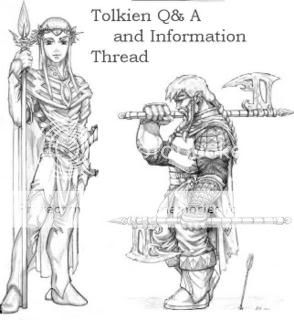
 . Here we in the lower posts provide information on characters, places, and just give you some FaQ and will answer your own questions. Anything you want to know from the movies or books. Whether it be more about Legolas, or just was The Silmarillion about, or maybe history of an obscure character, anything you can think of all.




 Not really sure.. no one is. In fact Tolkien never mentioned her existence at all. We assume she must be there but... really no answer there.