|
|
|
|
|
|
|

StrawberryBudikai Vice Captain
|
 Posted: Mon Oct 04, 2010 1:22 pm Posted: Mon Oct 04, 2010 1:22 pm
 A Word from the Creators
“We deisgned Dragon Age: Origins with the goal of creating of a world with weight and history. A place that felt both lived in and steeped in its own past, much of it forgotten. In the following pages, you’ll go in-depth with world of Thedas. You’ll learn secrets and lore about the stout nation of Ferelden, the excesses of Orlais, the mysterious nature of the Fade and much more.
Of course, not everything you will read in these pages is true, in an absolute, historical sense. Much of the world’s history is shrouded from even the greatest scholars, and many of the facts you will learn below represent the best guesses of the finest minds of the Chantry and Circle of Magi. Still, you hold accurate representation of the current trends in thought, philosophy, history and religion at the time of Dragon Age: Origins.
Whether you’re an aspiring module-maker with the toolset open before you, a game master looking for more in-depth information about the world, or simply a curious soul, welcome to Thedas.”
-The Dragon Age: Origins Team
|
|
|
|
|
|
|
|
|
|
|
|
|
|
|
Posted: Mon Oct 04, 2010 1:23 pm
History of Thedas
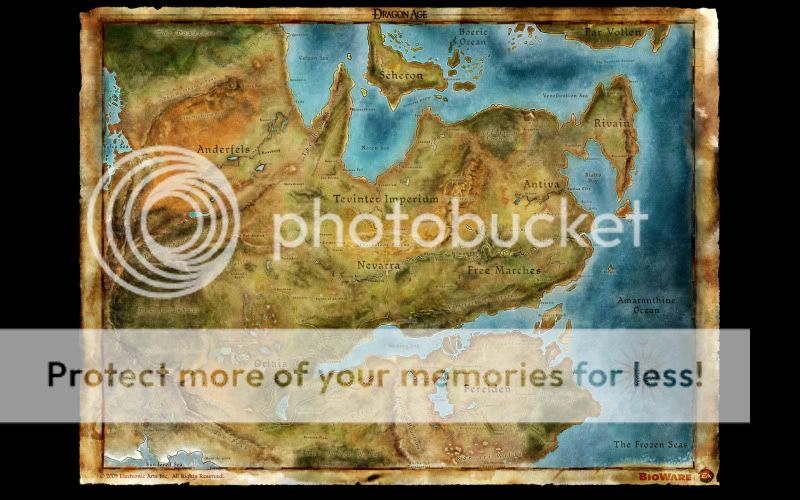
Log ago. The land of Thedas was populated only sparsely by the elves and dwarves. The elves, immortal beings for whom time passed without consequence and who lived spread out on the surface lands, existed in tandem with the forests and nature. The dwarves, meanwhile, were content to live beneath the mountains in an underground kingdom that spanned all of Theda, shaping stone and mining the enchanted metal known as lyrium. And so both races continued until the humans came. Where they came from is unknown and the humans themselves would deny that they ever came from anywhere else, but the elves and the dwarves claim that there was once a time when humans did not walk the land.
The elves encountered the humans first and found this upstart race of quick-lived mortals to be too angry and too impatient. Horrified, the elves withdrew from human contact as the humans spread quickly across Thedas. Humans formed the great Tevinter Imperium, a land ruled by tyrannical magisters who worshipped the mysterious Old Gods, ancient dragons that, according to legend, had once challenged the might of the Maker and thus were imprisoned by him forever beneath the ground---and yet who still whispered in the ears of men from heir orisons and taught them forbidden knowledge. These magisters learned magic from the Old Gods and became powerful, demanding blood sacrifices from their subjects, worship of the Old Gods, and tribute from the dwarves and elves. Eventually the greed of their Imperium grew so great that they destroyed the elven homeland of Arlathan, enslaving the entire elven race and using their usurped wealth to rule all of Thedas.
And so the Tevintor Imperium ruled until its might was challenged by the first Blight. In their pride, the Tevinter magisters succeeded in opening a gateway into the Golden City---heaven itself, an unreachable place within the heart of the dream realm know as the Fade. However, humanity was never meant to walk in heaven, and with each step, these men corrupted it. It became the Black City, and the magisters in turn became twisted and tainted by their own sin, transformed into the drakspawn and thrown back down to Earth by the Maker. They had become creatures that shield form the light and multiplied into terrible hordes in the underground tunnels of the dwarves. These darkspawn sought out and found one of the Old Gods in its underground prison and infected it with their taint, and the great dragon arose as the first archdemon. This creature led the drakspawn horde to the surface, bringing the nations of Thedas to their knees. The people of the Imperium turned to the other Old Gods, praying for protection but none was forthcoming.
Humanity was brought to the brink of destruction, and only a newly formed order known as the Grey Wardens managed to defeat the archdemon and end the Blight. The Imperium was greatly weakened, however, and it did not have the strength to defend itself when a great army of barbarians invaded from the south, led by the prophet Andraste. Andraste proclaimed that magic should exist to serve humanity rather that rule over it. She railed against the magister sans claimed the Old Gods were lies, insisting that the Maker was the one true God of all humanity. Her teachings spread quickly, and much of the Imperium crumbled before her armies. Andraste died a martyr, and around her legend grew a cult, and with it came the Chant of Light: a chant fillrf with Andrastee’s teachings that her priests claimed must be sung from every corner of the world until the Maker forgave humanity for his prophet’s death and turned the world into a paradise. As this cult grew, so were the Old Gods quickly forgotten and abandoned. They had forsaken the Imperium and betrayed its people in its hour of need, and so the old temples quickly fell by the wayside of history.
It was not long before another of the Old Gods awoke to lead the darkspawn in the Second Blight and plunge the world into terror once again. The greatest military mind Thedas, Emperor Drakon of Orlais, became humanity’s best defender; he pushed back the darkspawn hordes before his armies, and as his own power grew, he spread the cult of Andraste. The cult was known as “the Chantry,” and during those dark years, it became the dominant religion even in the old Imperium. It forbade the use of blood magic and mind control; however, the Circle of Magi was formed to allow magic to be harnessed against the darkspawn while ensuring that its mages were carefully watched. Between the Circle of Magi, Emperor Drakon, and a rejuvenated order of Grey Wardens, the Second Blight was thrown back and the dreaded archdemon that led it finally defeated.
Over the centuries to come, two more Blights would arise, threaten humanity, and be defeated. In the last Blight, the Grey Wardens finally struck such a blow against the darkspawn that everyone was certain that their threat was finally over. The nations of humanity prospered until yet another race suddenly appeared and invaded the continent: the Qunari, a race of bronze giants with an alien religion that compels them to dominate all others. In a great war, they invaded deep into the heart of Thedas. Humanity was forced to band together to bring their invasion to a halt and finally pushed them back.
For centuries, there has been an unsteady peace with the Ounari, allowing the nations of Thedas to once again rebuild and prosper. Only recently have the Quanri stepped up their battles against the remnants of the Tevinter Imperium, and their war has escalated to the point where it threatens to once again engulf the rest of Thedas in conflict. Thus the darkspawn are a forgotten threat, the idea that they might now resurface again after four centuries disregarded. The Grey Wardens insist, however that another Blight lies on the horizon. With the Grey Warden numbers having declined greatly and humanity at large giving little credibility to the return of such a threat, the lands of Thedas may be in store for their greatest challenge yet.
|
|
|
|
|
|
StrawberryBudikai Vice Captain
|
|
|
|
|
|
|
|
|
|
StrawberryBudikai Vice Captain
|
Posted: Mon Oct 04, 2010 1:24 pm
Ferelden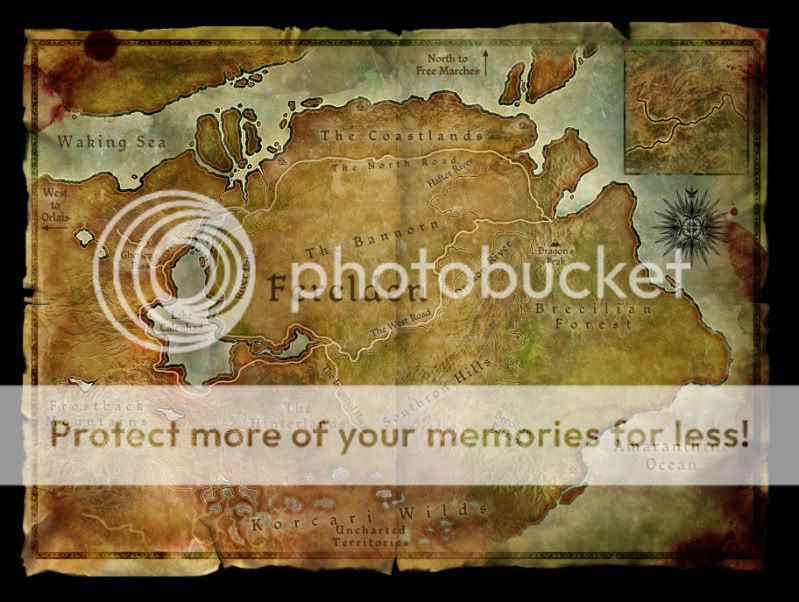
Korcari Wilds
The Korcari Wilds are a large, cold wetland that covers the entire southern border of Ferelden and separates the modern nation from the wandering nomadic barbarians of the tundra lands to the far south. The Wilds have a large culture of “Wilders” (properly known as the Chasind people, tribes who, along with the Avvar, refused to unite with the Alamarri to form Ferelden) who are considered backward even by Fereldan standards. They think of themselves as independent of Fereldan rulership. They are still a primitive people, living in peculiar huts that sit on stilts to keep them above the winter in ice and the summer swamps, and they are well known for their xenophobia. They believe outsiders are fair game to cheat or rob. The Wilders have been particularly welcoming of rogue elves into their numbers (doing nothing for their reputation in the north) and have only one major settlement: the famous “slit-city” of Tombigbee, though its location is kept secret from all save the Wilders themselves.
Brecilian Forest
The Brecilian Forest lies in southeast Ferelden and is the subject of many local legends. Bercilian is a place of darkness and horror, and most people shun the forest altogether. All manner of creatures are rumored to inhabit the forest, from werewolves to the possessed trees known as the wild sylvans. Traffic between the coastal city of Gwaren and the rest of Ferelden must take the long route around the forest through the Brecilian Passage, leaving only the foolhardy or desperate to attempt passing through the forest itself. Only the Dalish elves are known to regularly enter the forest, and this has led some to believe that the elves have a connection to whatever has cursed the forest.
Frostback Mountains
The Frostback Mountains to the west hold the hardy hillsmen known as the Avvars. The Avvars trade with the dwarves but are often at odds with the “lowlanders,” having fought many wars with the Alamarri tribes in the distant past until they were finally driven into the mountains for good. The high mountains are also known for strange ice formations, including “ice bridges” that allow movement between certain peaks- but only for a small length of time before the bridges crumble into shards of ice.
Lake Calenhad
Lake calanhad is fed from the glacier streams of the Frostback Mountains and is a beautiful clear blue. The lake produces an abundance of fish and is perhaps most famous for the Circle of Magi situated within a tower that sits on a single island in the north part of the lake. The tower is a landmark easily seen for many miles around the entire countryside.
Denerim
The capital of Ferelden, the city of Denerim is built around the base of a mountain known locally as “Dragon’s Peak.” The city is a warren of tunnels and steep roads connecting the various districts. There is a large, walled alienage for the elves as well as the wealthy Palace District that contains the royal palace and the estates of most of Ferelden’s wealthy nobility; almost all nobles who are capable of doing so maintain an estate within the city even if they use it only when a Landsmeet is called. The oldest structure in the city is also the highest: Fort Drakon, renamed after Emperor Kordillus Drakon, is an ancient fortress built into the side of the mountain. At one time it was the domain of Denerim’s teyrn, and city’s population could retreat into the fort if it was threatened. Now it is a garrison for Denerim’s city guard as well as a prison.
The most famous aspect of Denerim is that it is considered the birthplace of Andraste. An area of the Palace District is set aside as a shrine to her, one visited by a great number of pilgrims every year.
Lothering
Lothering is a major town built along the Imperial Highway, an elevated road built by the Tevinter magisters that once led from the northern coast down Ostagar. The Imperial Highway is crumbling but is still used for travel on those sections that remain intact.
Redcliffe
Castle Redcliffe is built on an island just off the coast of Lake Calenhad, connected to the shore (and the fishing village located there) by a narrow causeway. The cliffs along the lake’s northern shored are red tinged because of the iron content in the soil, thus the name of the castle. The castle is of military importance, because it’s shortly east of Gherlen’s Pass- the primary route through the Frostback Mountains to Orzammar and ultimately Orlais. Redcliffe is home to the Arl Eamon Guerrein, bother-in-law to King Maric and considered on of the more popular noblemen in country.
Circle of Magi Tower
The Circle of Magi’s tower is built on the remnants of a volcanic island in the northern part of Lake Calenhad. The tower, once an ancient Avvar fort know as Kinloch Hold, was given over to the mages so that they could practice their arts well away from any civilized part of the country. The tower was once connected to the shoreline by the Imperial Highway, but the highway has since mostly collapsed into the water, and the only way out to the tower is now by boat. A small settlement sits on the shore, a waypoint for templars stationed at the tower and travelers journeying to see the mages. It is unknown whether the Avvar built it for them. It may even have been updated in subsequent centuries.
Ostagar
Representing the farthest point of the ancient Tevinter Imperium’ss encroachment into the barbarian lands of the southeast, the fortress of Ostagar was once one of the most important defensive Imperial holdings south of the Waking Sea. It stood at the edge of the Korcari Wilds and watched for any signs of invasion by the barbarians today know as the Chasind Wilders. Straddling a narrow pass in the hills, the fortress needed to be bypassed for the Wilders to reach the fertile lowlands to the north and proved to be exceedingly difficult for the Wilders to attack because of its naturally defensible position. Like most Imperial holdings in the south, Ostagar was abandoned after Tevinter’s collapse during the First Blight. It was successfully sacked by the Chasind Wilders and then, as the Chasind threat dwindled following the creation of the modern Ferelden nation, fell to ruin completely.
It has remained unmanned for four centuries, though most of the walls still stand-as does the tall Tower of Ishal, named after the great Archon that ordered its construction-and Ostagar remains a testament to the magical power of the Imperium that created it.
Ferelden Currencey
1 gold piece = 1 sovereign
1 silver piece= 1 silver
1 copper piece= 1 bit
|
|
|
|
|
|
|
|
|
|
|
|
|
|
|
Posted: Mon Oct 04, 2010 4:03 pm
Humans
The humans are most numerous of the races, yet they are divided people. Once they were united under the great Tevinter Imperium, but the Imperium has since crumbled, and the great noble houses that remain fight among each other for supremacy. Only durrin the Blights has humanity ever united under a single banner, but today, the Blights are a distant memory, and even the invasion by the Qunari cannot bring the nations of humanity to work together.
The Nobility
King (any noble can challenge for the throne at any time)
Teyrn( Warlords and generals)
Arl(same as a Count)
Bann(same as a Baron)
Knight
If you choose to be a noble I leave it up to you to look up you’re history and family. Nobles can only be Humans and dwarves.
The Commoner Classes
The Crafting class
Freemen
Ash Warriors
 The Grey Wardens: The Grey Wardens are responsible for fighting Dark Spawn and Blights. Anyone can he a Warden so long as you pass the test. The Grey Wardens: The Grey Wardens are responsible for fighting Dark Spawn and Blights. Anyone can he a Warden so long as you pass the test.
"In war, victory. In peace, vigilance. In death, sacrifice" - Grey Wardens' motto
 Dogs: The Mabari Hounds are very important to humans. They are war dogs and bound with one master. Dogs: The Mabari Hounds are very important to humans. They are war dogs and bound with one master.
|
|
|
|
|
|
StrawberryBudikai Vice Captain
|
|
|
|
|
|
|
|
|
|
StrawberryBudikai Vice Captain
|
Posted: Mon Oct 04, 2010 4:05 pm
Elves
Once enslaved by humans, most eleves have all but lost thier culture, scrounging an improverished living in the slums of humans cities. Only yje nomadic Dalish tribes still cling to their traditions, living by the bow and rule of their old gods as the roam the anceint cforests, welcome nowhere else. Elves can be warroirs, rogues, or mages.
City Elves Dalish Elves
Elven Language
Abelas (ah-BELL-aws) - elven for "sorrow," also used as an apology
Andaran atish’an (an-DARE-an AH-tish-awn) - a formal elvish greeting (literally, "enter this place in peace")
Arlathan (ahr-LATH-ahn) - the original homeland of the elves, from the phrase "ar lath’an" meaning "I love the place" or, more appropriately, "this place I love"
Da'len - child
Durgen’len (dur-gen-LEN) - "children of the stone," the original elven term for the dwarves
Elvhen - "the People" or "our People", elven name for their own race.
Elvhenan - "place of our people", the name of the elven civilization before the arrival of humans on Thedas[1].
Hahren - "elder", used as a term of respect by the Dalish, but more specifically for the spirtitual and moral leader of an alienage by the City Elves.
Halamshiral - "the end of the journey", also the name of the capital of the second elven homeland in the Dales[2].
Lethallin (leth-ah-LEEN) - "friend of mine," casual reference used for someone with whom one is familiar
Setheneran - "land of waking dreams" - a place where the Veil is thin[3].
Shemlen (shem-LEN) - literally "quick children," the original name of the elves for the human race. It continues to see use as a slang term amongst the City Elves ("Shems") even though its meaning has largely been lost
Shue shah tauthau toetoi thuet. - elven phrase for 'I don't want to kill you.'
Uthenera – archaic term referring to when an immortal elf passed their life onto the next generation. The theme song for Dragon Age: Origins is called ‘In Uthenera.’
Vallaslin (vahl-ess-LEEN) - "blood writing," the art of tattooing adopted by some elves to more prominently (and some might say belligerently) display their worship of the traditional elven pantheon[4].
Vhenadahl - the tree of the people[5].
Vhen'alas - the land itself, as in "the ground"
|
|
|
|
|
|
|
|
|
|
|
|
|
|
|
Posted: Mon Oct 04, 2010 4:07 pm
Dwarves
Rigidky biund by caste and tradition, the dwarves have been waging a losing war for generations, trying to protect the last stronghold of their once-vast underground empire from the darkspwan. Dwarves are very tough and have a high resistance to all forms of magic, thus preventing them from becoming mages.
Dwarven Language and Phrases
"Let one who comes within the thaig
know that Paragons have walked within these halls
know that mothers have bled upon these stones
and when from the Deep Roads shadows crept
we clans arose, our vows were kept
deaths resolute, no tears were wept"
-- of unknown origin, inscribed at entrance to ruin
"Atrast Vala" is a dwarven greeting.
"Mekty nea shrowkan ton yo." -- Dwarven phrase meaning 'I don't want to kill you.'
"Thaig" is a dwarven colony, usually in the Deep Roads.
"Dwarva" is the word they use to refer to themselves. The human word most likely derives from it
Trivia
The dwarven diet consists of nug, and much of their ale is brewed from things found within their caves, the most notable of which can be found in sulfuric pools.
After the death of the dwarf King Endrin Aeducan; Lord Pyral Harrowmont and Prince Bhelen Aeducan, two candidates for the throne of Orzammar, engage in a high profile political conflict meant to determine which of these two candidates will become the next king of Orzammar.
Early in development it was planned that Dwarves would speak with a German accent. It was, however, scrapped and Dwarves now speak with an American accent of English.
Unlike the Dwarves of many other fantasy settings, the Dwarves of the Dragon Age setting are neither averse to the use of magic -despite their complete inability to use it -nor are they the 'natural' enemy of Elves. Indeed, there is more trust between Dwarves and Elves in Dragon Age. In fact, there is evidence of dwarf-elf relations during the times of the ancient elven empire.
|
|
|
|
|
|
StrawberryBudikai Vice Captain
|
|
|
|
|
|
|
|
|
|
StrawberryBudikai Vice Captain
|
Posted: Mon Oct 04, 2010 4:08 pm
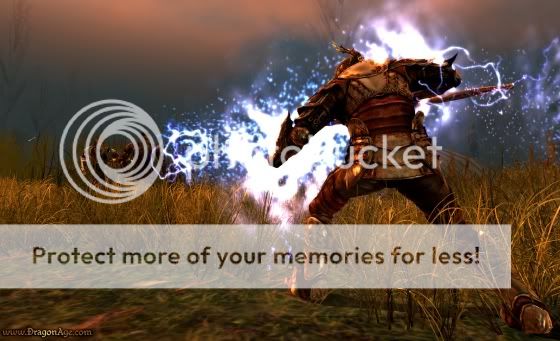
Combat Classes
Warrior
Warriors use the best weapons and armor. They need them, because they are the ones who can charge into combat and take on foes face first. They can withstand large amounts of damage back on their adversaries.
Berserker –The first berserkers were dwarves. They would sacrifice finesse for dark rage that increased their strength and resilience. Eventually, dwarves taught these skills to others, and now berserkers can be found among all races. They are renowned as terrifying adversaries.
Templar- Mages who refuse the Circle’s control become apostates and live in fear of a templar’s powers-the ability to dispel and resist magic. As servants of the Chantry, the templars have been the most effective means of controlling the spread and use of arcane power
Reaver-Demonic spirits teach more than blood magic. Reavers terrorize their enemies, feast upon the souls of their slain opponents to heal their own flesh, and can unleash a blood frenzy that makes them more powerful as they come nearer to their own deaths.
Champion –The champion is a veteran warrior and a confident leader in battle. Possessing skill at arms impressive enough to inspire allies, the champion can also intimidate and demoralize foes. These are the heroes you find commanding an army, or plunging headlong into danger, somehow making it look easy.
Mage
Mages tap into spells instead of talents. These spells range from healing to devasting AoE(area of effect) blasts to defensive buffs for combat and cast their magic from behind the prction of warriors and rogues.
Spirit Healer- Not all entities of the Fade are demonic. Many are benevolent entities consisting of life energy,which can be called upon to mend flesh and heal disease. Spirit healers focus on channeling the negies granted by these spirits, making them indispensable members of a party of adventures.
Shapeshifter- Rumors speak of babarians who hold secrets of transfomring the body into the formof animals. The Circle of Magi denies such rumors, but this rare art survives in the foggetn corners of thdas. MAstery of their bodies allows shapeshifters some protection, even in human form, making them durable oppnents and staunch alllies.
Arcane Warrior-
Blood Mage- Maleficar, "One Who Does Harm." Every MAge can feel the darl lure of blood magic. Originally learned from demons, these dark rites tap into the ppower, converting life into mana and giving the mage command over the minds of others. Such power comes with a price, though; a blood mage must sacrifice his own health, or the health of allies, to fuel these abiliteis.
Rogue
In between warriors and mages in terms of toughness, the rogue has many talents (and we're not just talking about the abilites you unlock level by level!). Rogues can learn to pick locks, spot traps, and deal lethal backstabs from behind enemy targets.
Assassin- The assassin finds any notion of fairness a quaint ideal that has no place in combat. Poisons are their weapon of choice, as are crippling strikes that inflict persistent wounds on their foes. As killers, assassins are marvel of stealth and efficiency.
Bard-Bards follow an Orlesian traditon, acting as assassins, spies, and saboteurs, and following other secretive pursuits in the constant, and sometimes petty, struggles between nobles. Having taken the minstrl's art to new levels, bards are skilled preformed and master manipulators. They can inspire their allies or dishearten their foes through song and tale.
Ranger-Rangers have an affinity for open country and wilderness, but as independent scouts and militia, they are opportunists, not stewards of nature. They exploit every advantage of their enviroment, and can lure wild beasts to attack their foes.
Duelist-Duelists are deadly combatants who prefer to fight in light armors and strike with light, but precise attacks. Esperiened duelists have preternatural reflexes that allow them to evade their opponents' clusmy blows, as well as strike with remarkable precision.
|
|
|
|
|
|
|
|
|
|
|
|
|
|
|
Posted: Mon Oct 04, 2010 4:13 pm
 My Charater My Charater
Name: Kree Mahariel
Age: 18
Gender: Male
Social Rank: Outcast, 2nd Class citizen
Combat Class: Rogue (for now)
Power: He’s a very skilled and ruthless bandit. He’s very adept at trap-making and lock-picking, along with other slight-of hand tricks.
Appearance: Kree has dark skin from his days staying out in the sun. Unlike most Dales he doesn’t enjoy staying within the forest. He inherited his father’s red hair and green eyes so he stands out among his people (I’ve notice that city elves have red hair but not Dalish). He’s a bit below average height for a young elf making him much smaller than any human his age. Despite his slight stature he has a strong build from years of Hunter training. Under the regular Dalish armor he wears a dark shirt and pants tucked into his boots. With some help from Contessa’s mother, he has sewn a hood onto his armor. Though he is of age Kree has not done the Blood Writing ritual mainly due to confussion over which god best reflects him, though many of his clan has chosen for him.
Weapons: Short bow, twin blades, knives in his boots
Personality: Hot tempered, stubborn, and often violent, Kree is incredible rebellious. His rough nature is only matched by his naïve view of the world. Because he thinks he’s right about everything he’s a hard student to teach. He’s also naturally curious, so despite pretending to know the answer he ask a lot of questions. It’s hard to get him to stay quiet. Kree enjoys talking even to humans, who he claims to hate. He’s quick to jump into battle and quick to kill but often times he wonders later if his decision was right. His lack of hesitation shouldn’t be mistaken for overconfidence. He knows his limitations but Kree is very eager to prove himself despite the odds. For a thief his approach to battle is a full frontal blitz with little stragety aside from “Stay Alive.” When he speaks he’s often coarse, crud, and slightly disrespectful. However he is honest and oddly insightful at times. He seems to only lie when he thinks the occasion calls for it, otherwise he tries to intimidate people.
Likes: To fight, Contessa, Ancient Elven artifacts, gems, pain in some degree, sour food and preserved food, adventure
Dislikes: Humans, Templars, Dalish and Human law, his family
History: During the Blight a young Dalish woman and a Grey Warden elf fell in love. There story was short lived, however, because the Warden had to leave to continue his battle against the Blight. He lost his life during the fight with the archfiend (I assume since I haven’t finished the game yet). Kree’s mother tried to raise him to be an honorable young man but he is his father’s son in many ways. He inherited his father’s stubbornness and his thirst for battle. Because of his unruly manner and tendency to disregard rules many of his clan members fear him. Some of the elders even speculate that he has tainted blood from his father or he’s been possessed by a demon of the Dread Wolf himself. He became adapt at trickery and theft. At a very young age he terrorized humans and elves alike with his “practicing”. Eventually, however, Kree met his match when he tried to bully a little human girl named Contessa, who he found in the woods alone. After a very surprising little trick of her own, Contessa and Kree became good friends and their families live respectfully alongside each other. After his mother died from illness Kree began to spend more time with the “witches” than his own people, despite frequently claiming to hate all humans. He would never admit it but he is curious about his father and his adventures as a Grey Warden. His clan, however, knew very little about him and his mother refused to share what little she knew.
Other: Kree is completely based off my Dragon Age: Origins character. Essentially they are the same character. He has no tattoo cause I can’t pick one for him lol XD Also his last name is the same as the in-game surname you get if you play the Dalish Elf Origin. His temper is his worst weakness, often causing him to lose control. Contessa is his 2nd weakness since he feels the need to protect her at all times. Lastly, he wears light armor.
|
|
|
|
|
|
StrawberryBudikai Vice Captain
|
|
|
|
|
|
|
|
|
|
StrawberryBudikai Vice Captain
|
Posted: Mon Oct 04, 2010 4:15 pm
Religion
The Chantry and the Chant of Light
Andraste: Andraste was the prophet whose teachings later served as the foundation for the formation of the Chantry. She was the spiritual wife of the Maker, the being whom the Chantry worships.
Maker: The Maker is the being worshipped by the Chantry. He is referred to as a male, and the prophetess Andraste, who founded the Chantry, is considered to be His wife.
While the Chantry believes that the Maker is all-powerful and created all things, He has also often turned away from them. The Chantry believes this to be because of the faults of His creations. He will not answer prayers, or grant wishes or anything of the sort, until humanity proves itself worthy of His attention again.
It is said that a long time ago, the Maker created the Fade as His first world. His first children were the spirits of the Fade and the Maker believed he had made them in His own image. Yet the Maker turned away from his first children, because while they could alter their world at will, they lacked a soul, and could only copy, not create or imagine for themselves. Dissatisfied with the result, He left the Fade behind, creating the world of Thedas instead.
The next realm that the Maker created was one that his new creations would not be able to change at will. He separated it from the first by putting the Veil in between them, not realizing that His first children would be able to observe His new children and grow envious of their ability to envisage new things.
The children that populated this new realm had the spark of the divine within them, which pleased the Maker. While their world was more solid than that of the spirits, these creatures were able to imagine, and dream new things because of it.
But then the First Sin was committed. Malevolent beings whispered to men from across the Veil, and turned them to the worship of the Old Gods. The Maker turned away from mankind, and left the Golden City. Much later on, Andraste managed to convince the Maker to forgive his creations, but Andraste was betrayed by her mortal husband Maferath, and burned at the stake. The Maker turned away from mankind once more.
Now the Maker has left the world. The Chantry teaches that one day, when the Chant of Light is sung from all the corners of the world, the Maker will finally return and transform the world into a paradise. Until that day, however, he only watches for those few who follow Andraste's teachings. When they die, the Maker brings them to his side. All others wander the Fade throughout eternity, forever lost to the Maker's sight. The Chantry refers to this state as "Oblivion."
The motive to create paradise in the world by spreading the Chant is often cited as the reason the Chantry called an Exalted March against the elves of the Dales, who refused to worship a 'human' god.
The Chantry of Andraste: The major religious group in Ferelden and other parts of Thedas. It’s based on the Chant of Light, a series of teachings written by Andraste, the prophet of the Maker, and was founded by Kordillus Drakon, the first emperor of Orlais. Its followers are known as Andrastian or Andrastians. "Chantric" is also an acceptable adjective to refer to something or someone that is of the Chantry religion.
The view of the Chantry on non-humans is that they need saving -- they have turned even further from the Maker's grace than humanity has. Elves were, and in some cases still are, pagan and dwarves do not worship any gods at all. The Chantry's goal is to spread the Chant of Light to all four corners of the world, that includes non-humans as well.
While the actual priesthood of the Chantry is made up entirely of females, men are allowed into affiliated groups like the Templars and other non-ordained positions. The leader of the Chantry is the Divine who resides in the Grand Cathedral, located in the capital of Orlais. The Chantry also has Grand Clerics, whose position is similar to bishops. The head of the Chantry in Ferelden is a Grand Cleric.
The Chantry calendar is used everywhere in Thedas, save for the Imperium, and is the source of the Ages the game is named after.
It was an Orlesian emperor who made the Chantry into an organized religion. Before that, those who believed in Andraste's message were scattered throughout Thedas.
The funeral rites of the Chantry involve cremation. As Andraste's body was burned, and her spirit ascended to stand by the Throne of the Maker, so too will that of her followers.
When not capitalized, 'chantry' refers to a building in which worship takes place.
Gods of the Elves
Elgar'nan: God of Vengeance, "the All-Father," Eldest of the of the Sun and He Who Overthrew His Father.
Fen'Harel: Fen'harel is also known as the Dread Wolf, Lord of Tricksters and bringer of nightmares. His supposed betrayal of the gods of both good and evil by sealing them away in their respective realms, never again to interact with the mortal world, is sometimes used to explain why the elven gods did not intervene to prevent the fall of Arlathan[8]. Statues of Fen'Harel are set aside from any Dalish camp and facing away, as a reminder that the Dalish must always be wary
Andruil: Goddess of Hunt
Dirthamen: God of secert
Mythal: Mother of the Gods. She is the protector and is considered a figure of justice (the flip side of vengeance)
Falon'Din: "Friend of the Dead," God of Death and Fortune, he ferries the dead across the spirit lands and into the Beyond.
Ghilan'nain: Goddess of Guides and Navigation, Mother of the Halla. Ghilan'nain, goddess of the halla, was once a mortal woman and beloved of Andruil. Halla are white deer-like creatures revered by the Dalish, and used to pull their aravel, or "landships".
June: God of Craft
Sylaise: Goddess of the Hearth and Home
|
|
|
|
|
|
|
|
|
|
|
|
|
|
|
Posted: Thu Oct 07, 2010 10:35 am
NEWS
10/7: The site won't let me post a profile thread currently but besides that this is up and running. For now pm me the profiles.
10/12: The profile thread is up and the rp is open for buisness! YAY!
|
|
|
|
|
|
StrawberryBudikai Vice Captain
|
|
|
|
|
|
|
|
|
|
|
|
|